


 Free Newsletter

Perspectives: Trump’s pledge to ‘solve’ sports ‘mess’ recalls law here
Marshall H. Tanick//April 6, 2026//
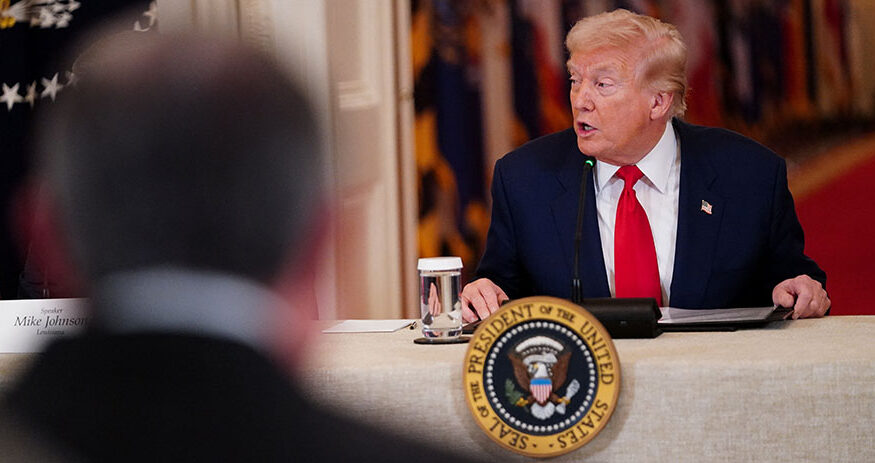
President Donald Trump speaks during a round table on collegiate sports in the White House in Washington, D.C., on March 6, 2026. (Photo: Reuters/Nathan Howard)
Perspectives: Trump’s pledge to ‘solve’ sports ‘mess’ recalls law here
Marshall H. Tanick//April 6, 2026//


 Listen to this article
In a conclave of college professional sports administrators, coaches, owners, politicians, and other athletic bigwigs, summoned to the White House on March to discuss the state of college athletics, President Donald Trump declared that the system is “a mess.”
Not much disagreement there.
The president told the assembled multitude during the two-hour session that the travails brought about by Name Image & Likeness (NIL) and other compensation forms, as well as the wide open unlimited transfer portals, will “destroy” college sports.
But, not to worry, he told the group, for he pledged to issue a “very all-encompassing” executive order “within a week” that will “solve every problem,” amplifying on a mild, ineffectual dictate he issued last summer that solved nothing at all.
But regressing to uncertainty, he added that “we will get sued [is] the only thing I know for sure.”
The former, a solve-it-all edict within a week, by Friday the 13th, did not materialize. But, fortunately, to his credit, a couple of weeks later he did announce as part of his “Save College Sports” initiative the formation by executive order of five committees to study various aspects of what is commonly referred to as the new ”landscape” of college sports and to make recommendations for reforms.
“I think money in general hurts all sports.”
Sportswriter Will McDonough (1935-2003)
**********
“[Y]ou ain’t gonna have any good players… if you don’t have NIL money.”
LSU football coach Lane Kiffin (1975- )
**********
“Young athletes need to stop picking schools based only on NIL money… that’s short-term thinking.”
Colorado football coach Deion Sanders (1967- )
It is a commendable effort, although marred by the paucity of current athletes and their agents, advocates, and representatives and no Democratic officeholders in the mix. But the president did say, as to the former, he plans to add some athletes and their representatives. With respect Democrats, as they say in the president’s native New York City: fuggetabutit; they’re persona non-gratis at the White House these days.
But the president’s latter forecast. the likelihood of litigation, is an inconvenient but inescapable truth because it was lawsuits that have precipitated the current “mess” and are likely to be at the heart of any fix-it plan that may emerge from the White House or elsewhere, including an effort spearheaded in Congress by Texas Republican Sen. Ted Cruz, a Trump ally, encountering strong headwind blowing in from many quarters.
Awaiting the presidentially promised comprehensive fix, like Samuel Beckett’s forlorn characters in his classic 1952 play “Waiting for Godot,” provides an opportune occasion as the major college sports seasons are now concluded to recall that litigation that bred the “problem” the president promises to “solve” has its roots here in Minnesota jurisprudence. It’s a timely topic as this Wednesday, April 8, is opening day for the transfer portals, one of the aperture’s through which athletes, NIL money, and other compensation will continue to be flowing here in Minnesota and elsewhere.
Alston awesome
The ruling of the U.S. Supreme Court four years ago in Alston v NCAA, 594 U.S. 69 (2021) establishing college and even high school athletes to be compensated for their work under the new household phrase NIL (standing for Name, Image, and Likeness) is the main but not the only precipitation of the dysfunction by holding that restrictions on compensation from outside sources constitutes an impermissible antitrust violation under the Federal Sherman Act, 15 U.S.C. s.1, et. seq.
But other factors contribute, including the portals that annually allow college athletes to transfer willy-nilly between schools and often gravitating to the highest bidder, and the settlement of a class action lawsuit by the college athletics oversight body, the National Collegiate Athletic Association (NCAA) in House v. NCAA, 4:20-cv-03919 (N.D. Cal. 2025), unleashing about $21 million annually over the next decade for major college athletic departments, including at the University of Minnesota, add to the woes that animated the president and many others.
In all likelihood, the issues relating to college and even high school sports will be punted to Congress, where an effort spearheaded by Cruz has about as much chance as the Gophers football team winning a national championship, let alone a Big Ten title for the first time since its three-way co-championship in 1967, with the betting odds somewhere between slim and none, and leaning toward the latter.
The result of the triumvirate — NIL, House, and portals — has been awesome to athletes and their families, agents, attorneys, representatives, and hangers-on, while the bulk of the athletic community, along with many fans, supporters, and others, have found it to be awful.
But, for better or worse, the current malaise is traceable to another matter.
Uhlaender undertaking
College athletes in big-time sports in Minnesota, especially at the University of Minnesota, have been slow to cash in on NIL compensation, compared with the well-heeled, elite football and basketball programs at some schools with consistent championship-caliber teams. But the U is undertaking catch-up with its Dinkytown Athletes collective, a money-raising arm of the school’s NIL program.
The slow start and relatively meager hauls to date belie the lineage of NIL traceable to jurisprudential matters in this state.
A watershed case was decided by U.S. District Court Judge Philip P. Neville in Minneapolis in 1971. The case was brought on behalf of the nascent major league baseball players association, who selected a Minnesota Twins centerfielder, Ted Uhlaender, as its proxy for suing a board game company that used the names, identities and statistics of ballplayers without their authorization or any compensation.
In Uhlaender v. Henricksen, 316 F.Supp. 1277 (D. Minn. 1970), Judge Neville held that the board game manufacturer must compensate the ball players for unauthorized use of their names and data about them under the rubric of the “right of publicity.” That concept was not a novel one, having been bandied around for athletes, celebrities and other well-known personages for about two decades, dating back to post-World War II baseball cards with nickel packages of baseball cards, accompanied by cardboard-like chewing gum.
The Uhlaender case elevated the concept to a new level in Judge Neville’s recognition that the players have a compensable right to bar, or to be paid for, the use of what later became known as their NIL. Judge Neville explained that “games and published statistics [are] property subject to legal protection from unauthorized use.” The gravamen which he enjoined was the unauthorized appropriation of their names and statistics for commercial use, a manifestation of the concept that evolved into NIL.
In fact, the terminology used by Judge Neville was strikingly similar to the concept of NIL a half-century later. Ruling for the players and granting injunctive relief, he stated that an athlete was has legally protectible aspect in the “identity embodied in his [sic] name, likeness, statistics and other personal characteristics [as] … a type of property.”
But that concept suffered a setback a number of years later in CDC Distribution & Marketing v. Major League Baseball, 505 F.3d 1818 (8th Cir. 2007), cert. den’d (June 2, 2008) in which the 8th U.S. Circuit Court of Appeals held that a fantasy baseball league entrepreneur was entitled to use the names and statistics of baseball players without compensating them, in a case that presaged the rise of that form of gaming (and gambling) activity. Ultimately, major league baseball and other professional organizations joined in the fantasy craze, after first opposing it for years, a pattern that later accelerated in connection with legalized betting, too, after the Supreme Court decision in Murphy v. NCAA, 584 U.S. 453 (2018) allowing legalized sports betting.
Nonetheless, barely before the digits on the Alston case were finalized, a Minnesota high school athlete became one of the first to cash in on NIL. He was Hercy Miller, a standout basketball player at Minnehaha Academy in south Minneapolis, the private school that has recently produced two prominent NBA players (Jalen Suggs of Orlando and Chet Holmgren, an All-Star center of reigning NBA champion Oklahoma City) in a $2 million NIL before even matriculating at Tennessee State University, the first of four different college stops during his career, which just ended last month. The peripatetic son of rapper Master P, Minnesota’s Miller had a mediocre, partially injury-plagued college career as he careened across the quartet of teams, and he probably will go on to play professional basketball abroad, while his initial $2 million annual figure becomes dwarfed by amounts ranging up to the high seven, and even eight figures to the left of a decimal point annually paid to stellar college athletes these days.
Spanky suits
The “right of publicity” principle was extended two decades later by one of Judge Neville’s successors on the federal bench in Minneapolis, Judge James Rosenbaum, in a lawsuit brought by former child star George McFarland, widely known as “Spanky” of the “Our Gang” or “Little Rascals” comedy series in the 1930s.
In McFarland v. E&K Corp., 1991 WL 13728 (D. Minn. 1991) (nonprecedential), he regarded the unauthorized and uncompensated use of the name and a huge painted visage of the “Spanky” character on a restaurant and bar on the east side of St. Paul, along with his name and image inside the facility and on the menu, as having “unjustly enriched” the facility’s owner at Spanky’s expense. The judge declared that a “celebrity’s identity embedded in his name, likeness and other personal characteristics, is the ‘fruit of his labor’ and becomes a type of property entitled to legal protection.”
Spanky sparked an unusual, perhaps unprecedented volume of similar suits, with dozens at one time listed in a Google search. Another one that materialized in litigation was a facility in New Jersey with a similar “Spanky” name and motif, which led to another lawsuit, McFarland v. Miller, 14 F.3d 192 (3rd Cir. 1992). The 3rd Circuit panel, which included Judge Samuel Alito, who was one of the justices joining in the Alston NIL case as a Supreme Court justice, emulated the ruling of Judge Rosenbaum in the Minnesota case. It, too, recognized the entertainer’s “right of publicity” in a case that was decided posthumously shortly after the beloved child actor died in 1993 at age 64. (Conflict alert: This writer successfully represented “Spanky” in these lawsuits and other “right of publicity” matters.)
The “right of publicity” concept also found its way into Minnesota common law in Lake v. WalMart Stores, Inc., 582 N.W.2d 231 (Minn. 1998), in which the state Supreme Court recognized, for the first time, a three-pronged common law right of privacy. It included “misappropriation” of identity for commercial purposes, nearly three decades after the Uhlaender decision jump-started that principle.
NIL is here to stay as athletes get paid to play. While athletes, their attorneys, agents and others cash in on the lucrative opportunities presented by NIL, they can look back and admire how Minnesota jurisprudence set the wheels in motion for that movement that the president, deus ex machina, is promising to “solve” soon.
But skeptics recall the words of Beckett beckoning the president: “We’re waiting for Godot. Ah, nothing happens, nobody comes nobody goes, it’s awful.”
RELATED: More Perspectives columns
PERSPECTIVES POINTERS
Number of Executive Orders
George Washington: 8
Abraham Lincoln: 48
Franklin Roosevelt: 3,721
John F. Kennedy: 214
Richard Nixon: 346
Barack Obama: 276
Donald Trump I: 220
Donald Trump II (13 months): 243
Marshall H. Tanick is an attorney with the Twin Cities law firm of Meyer, Njus, Tanick, Linder & Robbins, PA.
Related Articles
Related Content


Top News
- Court’s uneven approach to election-map rulings boosts Republicans
- Court rejects horse breeder’s legal malpractice appeal
- U.S. regulator sues to block Minnesota’s ban on prediction markets
- U.S. Supreme Court allows state tort claims vs. freight brokers
- Appeals court rejects bid to block R.I. Hospital’s release of records
- Wisconsin Supreme Court retains jurisdiction over ICE detainer lawsuit
- Texas court orders Rhode Island Hospital to produce gender care records

Expert Testimony
- Legally Speaking: The Mental Clutter Lawyers Carry
- Perspectives: High court cellphone case echoes one here
- Perspectives: Taxing issues: Court addresses property issues
- Perspectives: Daily’s 125th at ‘U’ recalls varied cases


