


 Free Newsletter

Supreme Court wades into Line 5 venue dispute between Michigan, Enbridge
USA TODAY Network via Reuters Connect//February 24, 2026//
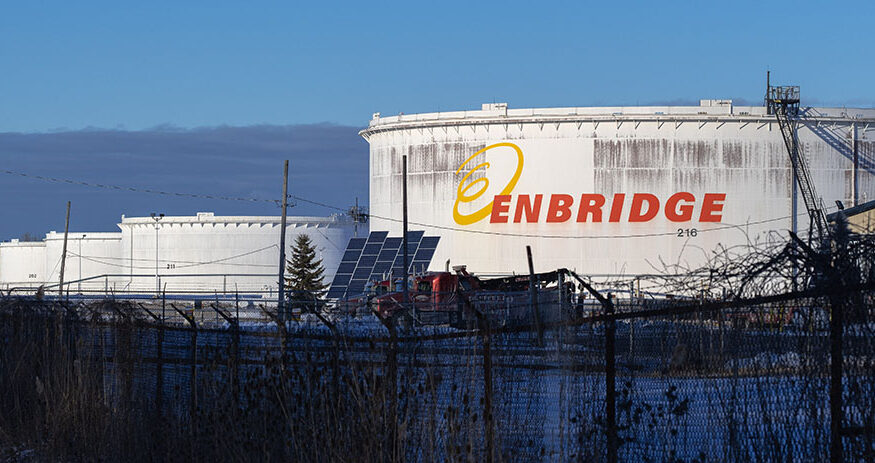
A huge petroleum holding tank is visible at an Enbridge Inc. facility in Sarnia, Ontario, where light crude oil from Enbridge's Line 5 pipeline ends up after traveling across Michigan's Upper and Lower peninsulas. (Photo: USA TODAY Network via Reuters Connect)
Supreme Court wades into Line 5 venue dispute between Michigan, Enbridge
USA TODAY Network via Reuters Connect//February 24, 2026//


In Brief
- Michigan Attorney General Dana Nessel filed suit in 2019 to close the Line 5 pipeline under the Straits of Mackinac.
- Enbridge sought to remove the case to federal court more than two years after filing, missing the 30-day removal deadline.
- The Supreme Court is considering whether federal courts can waive this deadline due to federal issues and treaty implications.
WASHINGTON ― Seven years after Michigan Attorney General Dana Nessel filed suit to close Line 5 in the Straits of Mackinac, the U.S. Supreme Court heard its first oral arguments on a debate over the case’s venue and the ripple effects a state court decision could have on federal issues.
Justices peppered attorneys for the State of Michigan and the Canadian pipeline giant Enbridge Inc. with questions for nearly an hour Tuesday on whether federal courts could practice some flexibility in applying or waiving a 30-day window for removal of a case from state court to federal court. The debate stems from Enbridge’s decision to remove Nessel’s case to federal court more than two years after it was filed, instead of within the 30-day window for removal.
John Bursch, the state’s former solicitor general and an attorney for Enbridge, argued the nation’s highest court could practice “equitable tolling,” essentially waiving that filing deadline, if the circumstances of the case called for it. The federal circumstances in the Enbridge case — such as the invocation of a treaty by Canada and the existence of two similar cases at the federal level — called for such an exception, Bursch argued.
“There’s no need to break new ground here,” Bursch said. “We ask that you apply the court’s well-settled precedents and reverse.”
Michigan Solicitor General Ann Sherman, arguing on behalf of Nessel’s office, urged justices not to allow Enbridge to create an “escape hatch” to evade a procedural deadline clearly spelled out in federal law. The deadline, Sherman argued, is meant to give state judges some predictability about which cases they’ll be handling.
“The deadline serves not to protect defendants from stale claims, but to officially settle which of two courts will decide the merits of a case,” Sherman said. “This allocation of judicial power is a task for Congress, not courts.”
On the surface, the high court is taking on a narrow and technical issue about how flexible to be with a procedural deadline. But how the justices rule could very much influence the ultimate decision over whether Nessel can shut down the controversial oil pipelines under the Straits of Mackinac.
Nessel will stand a better chance with her state-level arguments against Line 5 in state court than she would in federal court, where a judge already has ruled in a separate case that federal regulations take precedent over state efforts to shutter the pipeline. The federal decision shut down state calls for closure and resulted in a stipulated stay in the state court case.
The more than 70-year-old twin span beneath the Straits of Mackinac transports about 540,000 barrels of light crude oil and natural gas liquids a day, and has long been a cause for concern among environmental groups and some government officials, who fear the catastrophic effects of an oil spill at the nexus of Lakes Michigan and Huron. Supporters of the pipeline have warned against closing the line out of concern for potential natural gas and oil shortages in Canada and the Midwest.
Nessel and Gov. Gretchen Whitmer both campaigned in 2018 on promises to shutter the line even as Republican former Gov. Rick Snyder, as he was leaving office, entered a deal with Enbridge requiring the Calgary, Alberta-based company to build a $500 million tunnel beneath the straits to house a new section of the pipeline.
In 2019, after taking office, Nessel filed suit in state court trying to shut down the pipeline. In late 2020, Whitmer revoked the easement allowing the pipeline to rest on the lake bottom and filed suit in state court to uphold that revocation.
Enbridge filed its own countersuit in federal court, Canada invoked a transnational pipeline treaty to stop Whitmer’s lawsuit and Enbridge removed Whitmer’s to federal court. When a judge upheld Enbridge’s removal of the Whitmer case to federal court, the governor dismissed her case and threw her support behind Nessel’s 2019 effort, at which point Enbridge tried to remove Nessel’s case to federal court.
But by that point — more than two years after Nessel initially filed — Enbridge had missed the 30-day window for removal. A U.S. District Court judge waived the 30-day window, given the federal issues at play and the venue gamesmanship alleged to be occurring, but the Sixth Circuit Court of Appeals reversed the decision in June 2024, arguing there was no wiggle room when it came to the 30-day rule. Enbridge brought the case to the U.S. Supreme Court.
Justices question venue fight
Justice Brett Kavanaugh bluntly asked why Enbridge wanted to be in federal court. Enbridge’s lawyer, Bursch, quoted the American lawyer Daniel Webster in saying there’s value in being in a venue that “respects federal authority.”
“We agree with that. In addition, this case here is important because federal courts are uniquely qualified to decide federal common law foreign affairs issues,” Bursch said. “That’s just not something state courts deal with very often.”
“Are you concerned you won’t get a fair shake in state court?” Kavanaugh pressed.
“I’m not impugning the state courts at all. But I’m guessing that the Michigan state courts have not dealt very often with the federal common law of foreign affairs jurisdiction,” Bursch said. “That’s something that’s uniquely situated to the federal system.”
Kavanaugh also asked Sherman why Nessel prefers this case to be in state court.
“If this had been a case where Enbridge looked at it and said, ‘Boy, there’s a lot of really, you know, important issues here, we don’t think this is state law, and we ought to have this in federal court,’ they should have removed timely. They missed every opportunity to remove timely.”
“This is a state official, state law claims, and those state law claims have to do with the primary claim in the Attorney General’s case — public trust and whether the easement is violating a public trust doctrine,” Sherman said.
Kavanaugh asked about Bursch’s point about a federal court being better suited to deal with foreign affairs issues.
“The whole foreign affairs area is not an area where Congress said federal courts have exclusive jurisdiction,” Sherman said.
“We trust state courts to decide big, important federal cases. And even if this turns out to be not a case about state law claims, but somehow a case about a treaty, we trust the state court to do it.”
Justice Sonia Sotomayor noted that federal judges’ ability to waive procedural deadlines usually are limited to statute of limitations cases or precedents, where, without a waiver of that deadline, the courthouse doors would otherwise be closed to litigants.
That’s not the case in Enbridge’s argument, Sotomayor noted. The company still has the opportunity to argue its claims in state court.
“Here, there is a court, whether it’s the state court or the federal court, there is a forum for the claim,” Sotomayor said.
But Bursch argued the current case had similarities to the qualities that triggered additional flexibility in relevant statute of limitations cases because the deadline for removal shut out Enbridge from a significant mechanism — the ability to remove a case to federal court.
Sotomayor also closely questioned if the state would commit to staying the state court case so long as the federal judge’s opinion ruling in Enbridge’s favor remained in place.
“Wouldn’t it avoid waste to have these two actions proceed together in the same court?” Sotomayor said.
Justice Samuel Alito asked Sherman about the concern about the state court possibly issuing a preliminary injunction against the continued operation of Line 5 and it then taking a “long time” before the treaty rights issue with Canada could be reviewed and handled.
Bursch noted that could risk depriving millions of households and businesses of fuel and propane in Michigan and Ohio and parts of Canada, including half the fuel used by the Detroit airport.
Other states, led by West Virginia, had filed a brief with the court with concerns about damaging binational relations with Canada if Michigan were to take this step.
“None of those considerations are at play here, because we trust state courts to adjudicate issues, to even federal questions,” Sherman said.
“They’ve been doing that since the founding, and we trust them to do that with this court’s backstop if something goes really awry in the state court.”
Multiple justices tried to get at what Congress did or didn’t have in mind when it wrote the removal statute, which doesn’t explicitly authorize or prohibit federal courts from “tolling” or temporarily suspending the deadline for removal for equitable reasons.
Enbridge has maintained the language used is similar to other filing deadlines to which the court has held to be subject to equitable tolling. But Justice Ketanji Jackson noted that lawmakers had included other exceptions in other parts of the statute.
“Congress was thinking about this. They covered it,” she said. “And who are we now to believe that other things should be taken into account on this equitable basis?”
Bursch argued that Congress had a “panoply” of options to give a clear command that they were excluding equitable authority and didn’t.
“When that happens, we assume that Congress means to trust courts,” he said. “When we think about this traditional equitable authority … this goes all the way back to before the statute was even passed.”
Sherman countered that Congress did not authorize courts to create their own exceptions.
“Enforcing the rules that Congress has set honors its choice to prioritize efficiency and does not have a harsh consequence of depriving defendants of their day in court,” she told the justices.
“All told, Enbridge’s approach disregards the statute’s text structure and history and would inject messy fact-bound questions into a forum selection process that Congress intended to be short and predictable.”
A ruling in the case is expected sometime before June.
Related Articles
Related Content





Top News
- Groups ask Court of Appeals to review dairy expansion decision
- Federal judge blocks New York mask ban and ID mandate for ICE agents
- Kansans reject constitutional amendment for Supreme Court elections
- Criminal defense lawyers have duty to use AI, paper argues
- Minnesota joins lawsuit challenging Trump’s latest tariffs







Expert Testimony
- Perspectives: Taylor-Travis marriage recalls prenup laws here
- Quandaries & Quagmires: Fast-Tracking Temporary Lawyer Suspensions
- Perspectives: ‘Slam’ suits: Recalling wrestling cases as WWE arrives
- Best At Work Insights: We tore out the workforce backup generator
Legal Tech
- Criminal defense lawyers have duty to use AI, paper argues
- AI is reshaping family law practice, but attorneys worry about DIY research
- Massachusetts court rejects work product protection for AI documents by girlfriend
.png)


