


 Free Newsletter

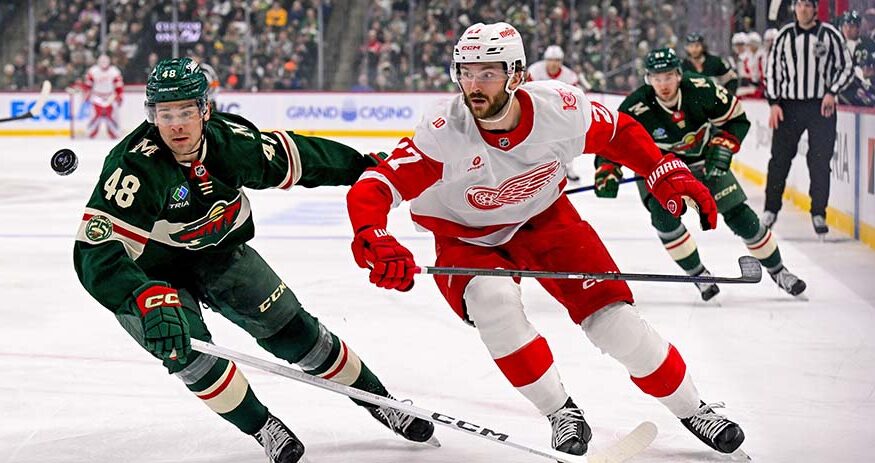
Minnesota Wild defensemen Daemon Hunt (48) and Detroit Red Wings forward Michael Rasmussen (27) race after a loose puck during the first period at Grand Casino Arena in St. Paul on Thursday, Jan. 22, 2026. (USA TODAY Network via Reuters Connect)
Perspectives: Seeking Stanley Cup, Wild recall hockey law here
Marshall H. Tanick//April 13, 2026//


 Listen to this article
As the National Hockey League rolls out its post-season playoffs, the Minnesota Wild have high hopes for a chance at the venerable Stanley Cup.
The team’s hopes are buoyed because it is coming off one of its best seasons during its 28-year existence on the ice at Grand Casino Arena in downtown St. Paul, formerly the Xcel Center.
Whether the club excels in the NHL playoffs this year, following many years of early exits, remains to be seen. But what is certain is that the sport has played a big role in jurisprudence here in the State of Hockey, and that is worth reviewing as the drive for the Cup starts up this weekend at the Grand.
Rink rights
Hockey in Minnesota and its rules date back to a series of games played at an outdoor park in south Minneapolis in 1895, only 20 years after the game was invented in Canada and a couple of years after it made its way to our country.
The game was a man-only matter for many decades, as was the litigation that it spurred on and off the rinks. More recently, cases concerning gender equality have arisen since the 1994 enactment of Minn. Stat. § 126C.45, which required public high schools with ice rinks to offer equal sports opportunities for male and female students.
Gender justice was at issue in Mason v. Minnesota High School League, 2004 WL 1630968 Civ. 03-6462 (D. Minn. 2004), in which 11 high school girls challenged the state hockey league under Title IX of the Federal Civil Rights Act, 20 U.S.C § 1681(a), seeking to move the state tournament from the compact Ridder Arena at the university campus to the much larger Xcel Center, the capacious site of the boy’s tournament.
The players asserted that being relegated to the lesser capacity arena was inequitable. U.S. District Court Judge John Tunheim found factual disputes over whether the sites were “substantially equal,” which allowed the claimants to survive summary judgment. The case ultimately ended favorably for the claimants because, due to a professional hockey work stoppage, the Xcel was made available to them for one year, and they have continued there since that time, despite the misgivings of some advocates of girls’ hockey who would prefer the cozier Ridder rink.
The Mason case became a forerunner of other Title IX related cases against the federal government for failing to properly investigate and pursue an inequity claim in Cobb v. U.S. Department of Education Office of Civil Rights, 487 F. Supp.2d 1049 (Civ. 05-2439 D. Minn. 2016), in which Judge Michael Davis found that, although the pro se parents litigating the case presented “thoughtful and compelling arguments,” they did not have standing without intervention or joinder by their hockey-playing daughters.
Other claims of hockey inequality have been asserted by employees. In Horn v. University of Minnesota, 362 F.3d 1042 (8th Cir. 2004), the 8th U.S. Circuit Court of Appeals upheld dismissal of a lawsuit for wage discrimination and related claims brought by a male assistant coach of the University of Minnesota women’s team. Affirming a ruling by U.S. District Court Judge Joan Ericksen, they held that a higher paid women assistant coach had “distinct … skills and experience” that warranted higher pay for her position than her male counterpart.
Another reverberation of women’s rights on the rink came in litigation that began nearly a decade ago after the fired lesbian coach of the five-time NCAA women’s championship hockey team at the Duluth branch of the University of Minnesota, Sharon Miller, sued for gender discrimination and related claims, joined by a pair of other UMD women’s sports coaches. U.S. District Court Judge Patrick Schiltz dismissed the claims of the other coaches and most of those asserted by Miller but allowed her to proceed with claims of discrimination and retaliation. which led to a verdict of nearly $4.2 million which Judge Schiltz subsequently deemed “shockingly excessive,” reducing it to $2.25 million, but granted her attorney’s fees of $2.5 million, prompting a $4.53 million settlement.
But one of the dismissed coaches failed in her appeal in Banford v. Board of Regents, F.3d (8th Cir. 2022), holding that she was not “the victim of intentional discrimination to her sexual preference.” Meanwhile, the Court of Appeals upheld a lower court dismissal of all three of them on grounds that their discrimination claims were not timely filed under the one-year limitations period under the state Human Rights Act, rejecting an “equitable tolling” argument as well as dismissing other claims on various grounds in Miller v. Board of Regents, 2019WL (Minn. App. 3d, 2019).
“You miss 100% of the hockey shots you don’t take.”
Iconic hockey star Wayne Gretzky (1961- )
*****
“All hockey players are bilingual. They know English and profanity.”
Legendary Red Wing Gordie Howe (1928-2016)
*****
“It’s more fun to be playing hockey than doing anything else.”
Current Oilers star Connor McDavid (1997- )
Range rulings
The Iron Range, a hotbed of hockey, has had more than its share of hockey-related litigation. Appropriately, the city of Eveleth, the site of the U.S. Hockey Hall of Fame, has been the source of significant hockey case law, dating back to the days when indoor hockey was a novelty and pro hockey a nascent concept.
A quartet of rulings concerning the attempted construction of a municipal rink on the range illustrates the contentiousness of hockey in Minnesota law.
In Burns v. Essling, 156 Minn. 171, 194 N.W. 44 (1923), Eveleth city officials, including the mayor and members of the city council, were found to have improperly spent city funds to build a 3,000-seat hockey arena, which was erected to enable the city to host professional or semi-pro games. The expenditure of public funds for that purpose was considered improper, while expenditure for purely recreational purposes for the citizenry, with ancillary use of the hockey rink, would have been appropriate. Because spectators would be charged for attending the games, the expenditure was deemed inappropriate. Equating Eveleth with ancient Rome, the Supreme Court proscribed using the public fisc to “amuse the people with games and spectacles.”
Two companion cases added to the woes of the Eveleth authorities. In Burns v. Essling II, 163 Minn. 57, 203 N.W.2d 605 (1925), using public funds to subsidize municipal hockey and baseball teams, as well as materials for construction of the hockey arena, was again deemed to be a “prohibited purpose” and outside the scope of municipal powers. In Burns v. Van Burskrak, 163 Minn. 48 203 N.W. 608 (1925), the right of taxpayers to compel restitution of money illegally spent for the prohibited athletic expenditures was allowed.
Finally, in Burns v. Murray, 163 Minn. 53, 203 N.W. 610 (1925), taxpayers were allowed recovery of sums paid by the city to professional baseball and hockey players.
Collateral cases
The doctrine of collateral estoppel led to dismissal of a pair of hockey-related cases.
It was at the heart of a lawsuit by a Minnesota hockey player challenging inter-collegiate hockey rules restricting eligibility for players who transfer between colleges in Vanneli v. National Collegiate Athletic Association, 1988 WL 35433 (Minn. App. 1998) (unpublished). The aspiring student athlete alleged a state antitrust claim after his federal lawsuit was dismissed because he had not been sufficiently injured to mount a federal antitrust challenge. The Minnesota Court of Appeals body-checked the state lawsuit, out of the same collateral estoppel grounds.
Impropriety of a sports agent was unsuccessfully contested by a retired Minnesota North Stars hockey player, challenging his former representative for secretly negotiating an illegal side agreement that ostensibly deprived him of post-retirement salary in Mandich v. Watters, 970 F.2d 462 (8th Cir. 1992). The 8th Circuit upheld dismissal of the claim, ruling that it was collaterally estopped by an arbitrator’s ruling in a prior dispute that the player’s contract claim against the team never came into existence.
Because there was no underlying contract, there was no liability on the part of the agent for depriving the player of post-retirement benefits. The arbitration decision was given collateral estoppel effect to “carry out the public policy underlying the court’s institutional encouragement of alternative forms of dispute resolution, as well as policies designed to promote judicial efficiency.
Similarly, a federal court refused to hear an antitrust challenge brought by the NHL against bargaining representatives and a group of players seeking to establish immunity of the league’s rules regarding free agents from antitrust challenge in NHL v. NHL Players’ Association, 789 F.Supp. 288 (D. Minn. 1992). An effort to obtain a declaratory judgment of the validity of free agent restrictions in anticipation of a subsequent lawsuit by the players was rejected by U.S. District Court Judge James Rosenbaum, who held that there was no subject matter jurisdiction. The mere possibility of the antitrust litigation, which had not yet occurred, did not create an actual controversy to permit adjudication. Because all of the players indicated that they did not intend to pursue any litigation, there was an absence of any concrete dispute of sufficient immediacy to warrant judicial intervention.
Competitive considerations also were at the heart of a lawsuit between a television station and a partnership consisting of the Minnesota Twins and North Stars to jointly market the broadcasting rights to hockey and baseball games in Midwest Communications Inc. v. Minnesota Twins Inc., 779 F.2d 444 (8th Cir. 1985). The television station asserted an antitrust claim against the Twins-North Stars collective after failing to win the bid to telecast rights to the games of those two teams. Although a federal jury found in favor of the television station, U.S. District Court Judge Robert Renner overturned the jury’s verdict, and his determination was affirmed by the 8th Circuit, which held that the television station lacked standing to sue under the antitrust laws because there was no threat or injury to competition.
American players trying to protect their turf were unsuccessful in a lawsuit against National Hockey League teams and federal officials for alleged violation of federal immigration law and the Minnesota Human Rights Act, arising out of the hiring of Canadian-born players in Collyard v. Washington Capitals, 477 F. Supp. 1247 (D. Minn. 1979). U.S. District Court Judge Miles Lord refused to permit aspiring American players from asserting claims that they were entitled to preference in hiring because they could play hockey as well, or better, than the Canadians, who at that time, dominated the NHL. The Minnesota long-arm statute, Minn. Stat. § 543.19, could not be asserted to obtain personal jurisdiction over out-of-state hockey teams, and further, the players could not maintain a private action under the Immigration & Nationality Act, 8 U.S.C. § 1101, et seq.
Data disclosures
The North Stars’ final year in Minnesota, the 1992-93 season, was plagued by a number of other problems. One was an incident in which a member of the team, along with players from an opposing squad, was involved in sexual escapades with some women at a hotel in Bloomington.
After the Hennepin County attorney decided not to prosecute, the four players obtained a court order for the expungement of the arrest record of the North Star player and sealing of the file.
But the Supreme Court reversed in In re Quinn, 517 N.W.2d 895 (Minn. 1994), holding that under the Government Data Practices Act, the file must be released to the media and the public. It rejected the player’s claim that disclosure could harm his reputation, reasoning that “possible harm to reputation often accompanies the release of information of the sort involved in this case.” The acute issue of access by one of the victims of the incident to the data was resolved in favor of disclosure because access by her would not “hinder the investigation or further an intent to use it for unlawful purposes.”
These cases reflect the rich lore of hockey in this state and its impact on Minnesota jurisprudence.
RELATED: More Perspectives columns
PERSPECTIVES POINTERS
Wild all-time records
Win-loss record: 984-731-55
Playoff openers: 14
Post-season record: 36-61
All-Time goals leader: Kirill Kaprizov (225)
All-Time points leader, goals & assists: Mikko Koivu (709)
Best season: 2021-22: 53-22-7
Worst season: 2000-01: 25-39-13
Marshall H. Tanick is an attorney with the Twin Cities Law Firm of Meyer, Njus, Tanick, Linder & Robbins, PA.
Related Articles
Related Content




Top News
- Court rejects church liability in online sexual abuse suit
- DOJ charges 15 in Minnesota with conspiracy to block ICE
- DOJ brings new criminal charge in deadly Key Bridge collapse probe
- D.C. groups sue over Trump’s planned ‘Garden of American Heroes’
- Supreme Court to review immigrant detention; other cases turned away
- Trump to tap former defense team member for Manhattan prosecutor post
- Family sues Milwaukee over 2023 death of teen left in tow lot for days







Expert Testimony
- Legally Speaking: What spring can teach us about active listening
- Perspectives: Key figure’s recent death recalls Watergate here
- Perspectives: Two new cases here recall Miranda at 60
- Perspectives: Election litigation starting early in Minnesota


