


 Free Newsletter

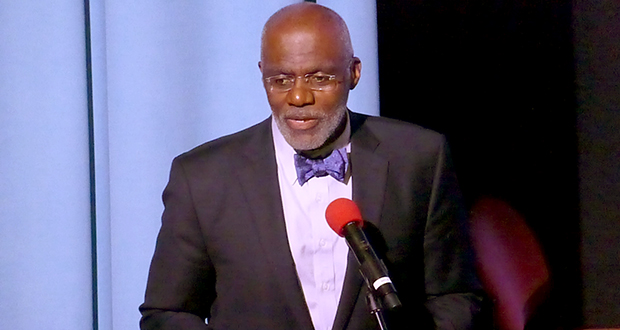
The visit to Edison High School on Monday marked the final such appearance for the Minnesota Supreme Court’s most senior member, Justice Alan Page, who is approaching the court’s mandatory retirement age of 70. Given Page’s advocacy on education issues, it was hardly surprising that he was singled out for a tribute. (Staff photo: Mike Mosedale)
Justices to high school students: Don’t listen to talking heads
Mike Mosedale//May 14, 2015//


 Listen to this article
On Monday, the Minnesota Supreme Court traveled to Edison High School in northeast Minneapolis to take oral arguments in a gang murder case out of St. Paul (State v. True Thao) and, along the way, give the assembled students an object lesson in the principles of American jurisprudence.
For about an hour, the students quietly listened as justices peppered attorneys for both sides with sometimes pointed questions about proper Spreigl notice and other fine points, before exiting the auditorium, shucking off their robes and returning to the stage.
Then it was time for the kids to pose some questions of their own.
One student asked if the justices ever disagree with the laws they are entrusted with interpreting.
“Yes,” said Chief Justice Lorie Gildea, who paused just long enough that it seemed she was not going to elaborate further. She did, of course, telling the students that the court’s role is to apply the law as written, regardless of personal feelings.
Another student wanted to know about the relationship between the justices. Are they “best buds” outside the courtroom?
“Boy, I have to be careful with that one,” responded Justice David Stras. Stras then explained that, while the he and his fellow justices “spend an enormous amount of time together,” it is mostly in relation to their official duties. “We have other friends, too, and we can’t completely ignore them,” he said.
Do you regret any of your rulings? That one fell to Justice David Lillehaug.
“So far, I think the answer is no,” said Lillehaug, who added the caveat that that he’s only served on the high court for two years. “I’m confident that with more experience on the court, the answer will be yes.”
While most of the other queries were similarly broad in scope, the last question came from a student who was perhaps a little more familiar with theoretical underpinnings of constitutional law. He wanted an opinion on the respective merits of judicial activism and judicial restraint.
“That’s a very complicated topic,” responded Justice G. Barry Anderson, who went on to say that much of the public discourse on subject is not well formed before offering up some evergreen advice.
“Don’t listen to talking heads,” he said.
Homage to Justice Page
The Supreme Court’s stop to Edison High School marked its 41st school visit since 1995, when the high court began rambling about the state twice a year in a public outreach and education effort aimed at the voters of tomorrow.
The visit to Edison marked the final such appearance for the court’s most senior member, Justice Alan Page, who is fast approaching the court’s mandatory retirement age of 70.
Given Page’s well-known advocacy on education issues and impending retirement, it was hardly surprising that he was singled out for a tribute during the visit.
Among those paying homage to Page at the event was Michael Walker, the director of Minneapolis Public Schools’ Office of Black Male Student Achievement.
Page, it turns out, was more than a role model for Walker. Walker said scholarships he received from the Page Education Foundation were critical to his own academic advancement as he pursued his undergraduate and graduate degrees.
Walker said he isn’t the only Page scholar in his immediate family. Both his wife and his brother also received grants from Page’s foundation.
Related Content






Top News
- Judges appear to audition for Supreme Court amid vacancy speculation
- Perspectives: Election litigation starting early in Minnesota
- Experts: Eschewing AI may create legal malpractice risk
- Judge temporarily blocks Trump’s $1.8B ‘weaponization’ fund
- 8th Circuit upholds state’s firearm permit reciprocity law
- Judge declines to dismiss workplace drug testing lawsuit
- Justices side with Trump in fight tied to speech curbs on immigration judges







Expert Testimony
- Perspectives: Election litigation starting early in Minnesota
- Quandaries & Quagmires: ‘Dear Ethics Lawyer’ — A Resource for Ethics Training
- Best at Work Insights: AI alone can’t improve your company
- Perspectives: ‘Nuremberg’ movie has Minnesota legal links


