


 Free Newsletter

Depositphotos.com image
8th Circuit upholds state’s firearm permit reciprocity law
Laura Brown//May 29, 2026//


In Brief
- 8th Circuit rejected Second Amendment challenge to Minnesota gun permit reciprocity law.
- Truck drivers argued Minnesota’s permit requirements burdened interstate travel and self-defense rights.
- Court ruled the reciprocity statute expands rather than restricts firearm carry rights.
- Panel found the Constitution does not require states to recognize all out-of-state gun permits.
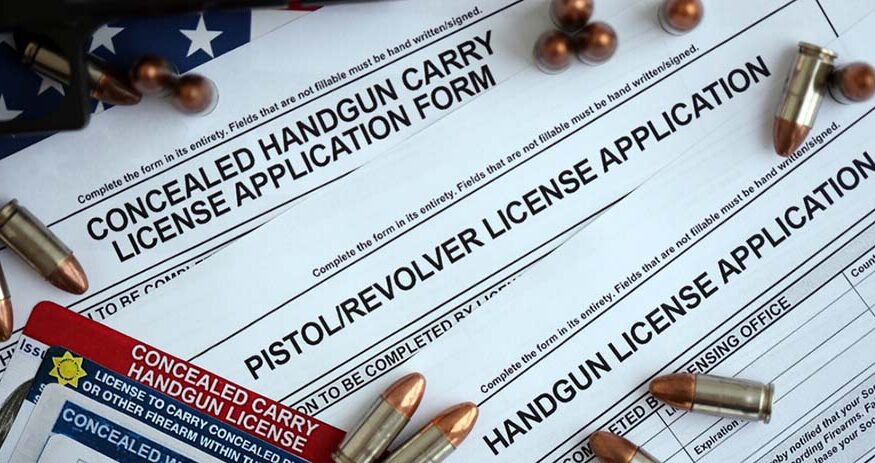
The 8th U.S. Circuit Court of Appeals affirmed dismissal of a truck driver’s federal lawsuit challenging Minnesota’s firearm permitting regime. In a ruling filed May 26, it concluded that Minnesota’s permit reciprocity statute recognizing gun permits from some states but not others does not violate the Second Amendment.
Minn. Stat. § 624.714, subds. 1a, 16 states that an individual who “carries, holds, or possesses a pistol in a motor vehicle, snowmobile, or boat, or on or about the person’s clothes or the person, or otherwise in possession or control in a public place” must have a Minnesota permit to carry or one that is issued by a state with recipricoty with Minnesota. A first offense is a misdemeanor and the second offense is a felony.
While Minnesota does recognize permits from several states, it does not recognize permits from other states, including Texas, Florida, and Georgia. David McCoy and Jeffrey Johnson, long-haul truck drivers who reside in Texas and Florida, respectively, filed suit. Although they hold firearm carry licenses issued by their home states, Minnesota does not recognize those licenses. Therefore, neither may lawfully carry a firearm for self-defense in Minnesota without first obtaining a Minnesota permit.
Although McCoy and Johnson could obtain Minnesota permits, doing so would require an in-person application, payment of a fee, and a waiting period of up to 30 days, with the permits valid for five years. They argued that obtaining permits from every contiguous state was prohibitively costly and burdensome, particularly because their work as long-haul truck drivers kept them on the road for most of the year and would require a special trip to Minnesota.
In the absence of a Minnesota permit or a recognized out-of-state permit, the truckers are required to store firearms unloaded in a closed, fastened container. Johnson and McCoy stated that they were afraid for their safety, citing crimes against truckers. They argued that Minnesota’s policy required them to choose between legal compliance and self-defense.
McCoy and Johnson claimed that that Minnesota’s firearm law deprived them of their Second Amendment rights. Johnson sought a judgment declaring that Minnesota’s refusal to recognize lawfully issued out-of-state firearm permits violates the Second Amendment and an order requiring the state to recognize and honor such permits issued by all other states.
The district court, applying the U.S. Supreme Court ruling in New York State Rifle & Pistol Ass’n v. Bruen, dismissed the lawsuit, finding Minnesota’s permitting regime and reciprocity provision constitutional. U.S. District Court Judge John Tunheim found that Johnson’s argument failed under step 2 of Bruen. Tunheim disagreed that the reciprocity provision was historically supported, finding that the reciprocity provision made it easier for out-of-state individuals to carry in MInnesota. “Nothing in Bruen or the Constitution requires states to adopt or defer to the licensing standards of other states,” Tunheim reasoned.
During oral arguments before the 8th Circuit panel, Madeline DeMeules, assistant Minnesota attorney general, stated, “The Second Amendment does not require Minnesota to make it easier for out-of-state residents to get a firearm license than it is for Minnesotans. People can carry freely once permitted in Minnesota.”
Ryan Morrison, attorney at Liberty Justice Center, said, “The Second Amendment applies wherever you go. And to make you have a rolodex of permits wherever you go reduces it to a second-class right.”
In an opinion written by Judge L. Steven Grasz, the 8th Circuit panel concluded that Johnson’s Second Amendment challenge failed at Bruen‘s first step because Minnesota’s reciprocity statute did not regulate conduct protected by the amendment’s text. Although the right to publicly carry a firearm fell within the Second Amendment’s scope, Minnesota regulated that conduct through its permit-to-carry requirement, which Johnson acknowledged was constitutional.
The panel reasoned that the Second Amendment did not guarantee interstate permit reciprocity and that the reciprocity statute merely permitted holders of recognized out-of-state permits to carry as though they possessed a Minnesota permit. Because the statute functioned as an exemption from Minnesota’s permitting process rather than as a restriction on firearm carriage, the panel determined that it did not burden Second Amendment rights.
Additionally, the panel rejected Johnson’s claim that Minnesota’s reciprocity statute burdened Second Amendment rights by requiring holders of unrecognized out-of-state permits to obtain a Minnesota permit. It explained that because Minnesota could constitutionally require all nonresidents to secure a Minnesota permit, the reciprocity statute actually eased that requirement for some individuals by recognizing their out-of-state permits. The panel found that Minnesota’s refusal to exempt Johnson from the requirement did not impose additional burdens on his Second Amendment rights, so the convenience of reciprocal permitting depended on interstate comity.
Related Articles
Related Content






Legal Tech
- How ransomware tactics against law firms are changing
- How large language models are leveling the personal injury playing field
- Attorney Share, Lawmatics integrate to automate law firm referrals
Top News
- Administration pauses $1B in Medicaid payments to Minnesota, California
- HHS sued over attempts to restrict child care funding
- Appeals court tosses 2 more convictions in Whitmer kidnap plot
- Legally Speaking: How communication failures turn disputes into lawsuits
- Judge orders Paramount to temporarily pause Warner Bros acquisition







Expert Testimony
- Legally Speaking: How communication failures turn disputes into lawsuits
- Perspectives: Umpire’s death recalls case law in Minnesota
- Perspectives: It’s not ‘football’ here, but soccer cases abound
- AI prompts used by experts may be discoverable


