


 Free Newsletter

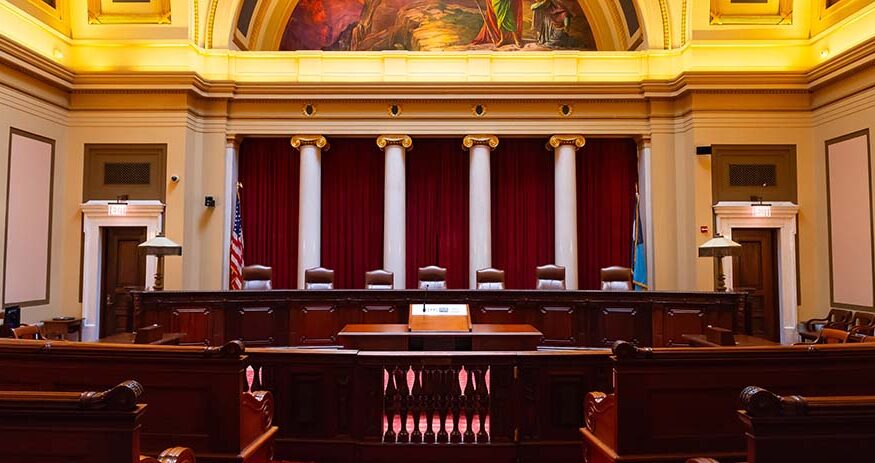
The Minnesota Supreme Court chamber in the Capitol. (Depositphotos.com image)
Citing jury instruction, justices order new sex-abuse trial
Laura Brown//July 24, 2026//


In Brief
- The Minnesota Supreme Court ordered a new trial for Ge Yang on a first-degree criminal sexual conduct conviction.
- The court ruled jurors should have received a specific unanimity instruction because multiple alleged acts could independently support the charge.
- The decision applies the court’s recent precedent in State v. Keyes, which clarified jury unanimity requirements in cases involving multiple alleged criminal acts.
- A dissenting opinion argued the Keyes framework is too rigid and that the trial record did not create a genuine risk of juror disagreement.
Ge Yang was found guilty of first-degree criminal sexual conduct and second-degree criminal sexual conduct of his minor stepdaughter. Applying the framework established in State v. Keyes, the court reserved the conviction for first-degree criminal sexual conduct and remanded for a new trial on that charge.
According to facts presented in the high court’s opinion, A.K. was 16-years-old when she disclosed that her stepfather, Yang, had sexually abused her. She described multiple instances of sexual assault happening in Yang’s apartment and in a townhome. A.K. also testified that many different sex acts took place.
At trial, the district court gave the jury a general unanimity instruction requiring a unanimous verdict. However, the jurors were not instructed that they had to unanimously agree on which specific act constituted the offense.
The jury found Yang guilty of both charges, and the court sentenced him to 144 months in prison for first-degree criminal sexual conduct. Yang appealed, arguing that the court should have provided a specific-unanimity instruction, but the Minnesota Court of Appeals upheld the conviction.
Last week, the Minnesota Supreme Court decided a similar case. In Keyes, the defendant was charged with first-degree criminal sexual conduct after allegations that he committed separate acts of sexual assault in different areas of the victim’s home, but jury received only a general-unanimity instruction. The Minnesota Supreme Court held that a specific-unanimity instruction was required because the State presented multiple distinct acts that could each independently support the charge.
In Yang’s case, the Minnesota Supreme Court held that Yang was entitled to a specific-unanimity instruction because the State presented multiple distinct acts that could each independently support the first-degree criminal sexual conduct charge. Applying Keyes, the majority found that the offense required jurors to unanimously agree on which specific act proved the elements of the crime. Because the jury was not given this instruction, the high court determined the error was plain, affected Yang’s substantial rights, and warranted a new trial.
“[T]he trial record reflects many alleged acts, the details of which were often vague, committed on unspecified dates, over a period of potentially two years,” wrote Justice Theodora Gaïtas. “Some of the acts were alleged by A.K. at trial, some were alleged by other witnesses, and still other acts were alleged by A.K. only during an out-of-court video-recorded interview that was introduced as evidence at trial. Given these circumstances, there is a real possibility that, without a specific-unanimity instruction, the jury may have instead decided that ‘where there is smoke there must be fire.’”
Writing a dissent joined by Justice Anne McKeig and Justice Sarah Hennesy, Justice Gordon Moore asserted that the Keyes framework was “rigid” and “risks unpredictable, inconsistent, and unjust outcomes.” Moore reiterated his “deep concerns with the application of the test” that the court adopted in Keyes. He also argued that there was not a genuine risk of disagreement in the jury about which acts supported the first-degree criminal sexual conduct charge.
“In most cases, I would be deeply concerned about packaging multiple distinct offenses occurring that far apart into a single charge,” Moore asserted, citing the fact that the alleged abuse took place over months, rather than the 45-minute period in Keyes. “Although it is theoretically possible that a juror could have believed that only fellatio or only cunnilingus occurred, there is simply no plausible basis on this record for concluding that jurors credited A.K.’s testimony on one act of penetration but not others.
“Thus, at the time the jury was instructed, there was no genuine risk that a general verdict of guilty would conceal disagreement among the jurors as to the facts constituting the sexual penetration element of first-degree criminal sexual conduct.”
Related Articles
Related Content






Legal Tech
- How ransomware tactics against law firms are changing
- How large language models are leveling the personal injury playing field
- Attorney Share, Lawmatics integrate to automate law firm referrals
Top News
- Prosecutors struggle to turn voter fraud claims into charges
- Best At Work Insights: We tore out the workforce backup generator
- Citing jury instruction, justices order new sex-abuse trial
- Judicial Branch announces $4 million in courthouse security grants
- 8th Circuit upholds school district in student suicide suit







Expert Testimony
- Best At Work Insights: We tore out the workforce backup generator
- Legally Speaking: How communication failures turn disputes into lawsuits
- Perspectives: Umpire’s death recalls case law in Minnesota
- Perspectives: It’s not ‘football’ here, but soccer cases abound


