


 Free Newsletter

Quandaries & Quagmires: Rules amended for pro bono lawyers, prosecutors
William J. Wernz//June 23, 2026//
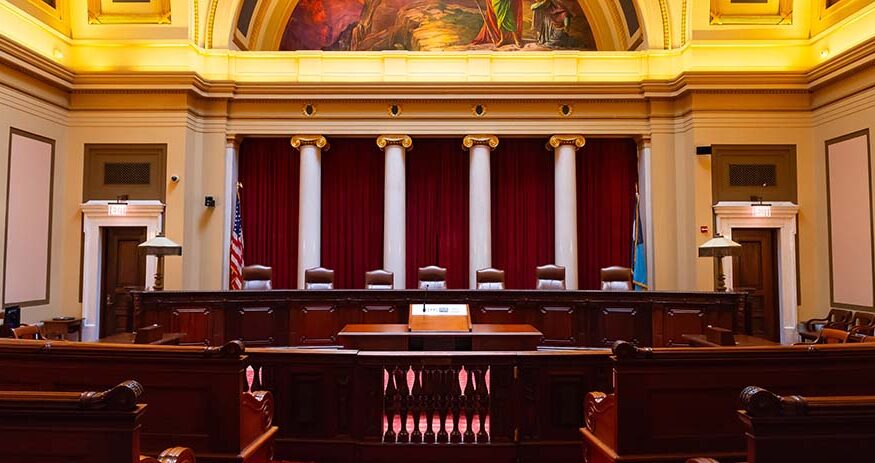
The Minnesota Supreme Court chamber in the Capitol. (Depositphotos.com image)
Quandaries & Quagmires: Rules amended for pro bono lawyers, prosecutors
William J. Wernz//June 23, 2026//


On May 14, 2026, the Minnesota Supreme Court amended Rules 1.8(e) and 3.8, Minn. R. Prof. Conduct (MRPC). Order – Promulgating Amendments to the MRPC – OLPR The Rule 1.8(e) amendment allows a pro bono lawyers to give an indigent client “a modest gift for basic living expenses.” The Rule 3.8 amendment enhances a prosecutor’s duties to (a) disclose exculpatory and mitigating evidence and (b) use such evidence for the benefit of those wrongly convicted. Both amendments bring the MRPC into closer but not complete alignment with ABA Model Rules. Neither amendment applies to the great majority of lawyers.
Rule 1.8(e)(4) Amendment. Rule 1.8(e) beings with a general prohibition, “A lawyer shall not provide financial assistance to a client in connection with pending or contemplated litigation,…” The prohibition is based on the belief that if lawyers come to have too great a financial stake in clients’ cases, conflicts of interest are apt to develop. For example, a lawyer who had guaranteed a large loan to a client, and had a case on a contingent fee, might counsel a client to accept a settlement that would ensure payment of the lawyer’s advances.1 The petitioners for the “modest gift for basic living expenses” exception averred that such gifts would not create conflicts for pro bono lawyers. With the amendment, Rule 1.8(e)’s prohibition now has four exceptions, two relating to court costs and litigation expenses and the third exception allowing loan guarantees.
Before the “humanitarian exception” was allowed for modest gifts, Minnesota lawyers were sometimes disciplined for making such gifts. For example, a lawyer representing an incarcerated defendant was admonished for putting $1,000 of his own funds in the client’s jail spending account. An OLPR article explained, “The attorney’s actions appeared well-intentioned, but nevertheless violated the rule.”2 A rejoinder might have been, “OLPR’s discipline was well-intentioned, but lacked a humanitarian perspective.”
Two sets of issues arise regarding amended Rule 1.8(e). First, what is the meaning of a “modest gift for living expenses?” “Modest” has two meanings: “Unpretentious and simple, or limited in size, amount, or range.”3 Living expenses for a client with a large family and complicated litigation could be “unpretentious and simple,” but still involve large amounts. Would a gift of $40,000 to cover a year’s living expenses for a large family be deemed “modest?” To support discipline, the application of a rule to facts must be clear, but “modest” is not univocal.
The second set of issues arises from Rule 1.8’s prohibition that a lawyer “may not promise, assure, or imply the availability of such gifts prior to retention or as an inducement to continue the client-lawyer relationship after retention.” This prohibition arguably conflicts with the rule’s purpose and raises First Amendment concerns.
Suppose that a prospective or existing client tells the lawyer, “I cannot undertake or continue this litigation unless someone gives me a modest amount for my living expenses.” If the lawyer replies, “I cannot promise any such assistance,” the client might well decide to settle rather than exercise their rights. The lawyer may not even “imply” the availability of a sustaining gift. Neither the Order nor the comments offer any rationale for the prohibition. Restrictions on speech that are made without explaining their substantial purpose are generally vulnerable to First Amendment challenge.4
The Order published new comments 12, 13, and 14 to Rule 1.8 but, as is the Court’s custom, the Court did not adopt the comments. Comment 13 states that pro bono gifting is allowed in statutory fee-shifting cases but not in contingent fee or contractual fee-shifting cases. These statements appear to be specifications of the meaning of the “pro bono” representation term in Rule 1.8(e).
The Rule 1.8(e) amendments will have practical effects. For example, an immigration lawyer might help a client with travel expenses for a hearing, or a family lawyer might pay for rent and food for a client who cannot return to a home plagued by violence.
Rule 3.8 Amendments. The Court amended Rule 3.8 by adding new paragraphs (g) and (h) and by modifying the prosecutor’s scienter requirements in paragraph (d). These amendments clarify a prosecutor’s obligations to disclose and act on certain exculpatory evidence known to the prosecutor. Paragraphs (g) and (h) relate to evidence that that a prosecutor knows of and that indicate a convicted defendant is, or likely is, innocent.
Rule 3.8(g)’s obligations to disclose and cause investigation are triggered “when a prosecutor knows of new, credible, and material evidence creating a reasonable belief that a convicted defendant did not commit an offense of which the defendant was convicted.” Rule 3.8(h)’s obligations to “seek to remedy the conviction” are triggered “when a prosecutor knows of clear and convincing evidence establishing that a defendant in the prosecutor’s current jurisdiction was convicted of an offense that the defendant did not commit.” Before the amendments, a prosecutor’s disclosure duties under Rule 3.8 extended only to “the accused” and to the defendant who had been found guilty but not yet sentenced and did not extend to convicted defendants.
What a prosecutor actually “knows” is still the dominant scienter criterion in Rule 3.8.5 However, the Rule 3.8(d) amendment adds an alternate scienter standard. A prosecutor must “make timely disclosure to the defense of all evidence or information known to the prosecutor that a prosecutor is required to disclose under applicable law and procedural rules that a prosecutor knows or reasonably should know tends to negate the guilt of the accused or mitigates the offense…” Rule 3.8(d) is not triggered at all unless a prosecutor has actual knowledge of the evidence or information in question. But, if a prosecutor reasonably should know that the known evidence or information is exculpatory or mitigating, disclosure is required. Combining these scienter criteria creates fine epistemological distinctions.
Prosecutorial ethics has been the subject of increasing scrutiny in recent years. Public disciplines of Minnesota prosecutors have been more frequent in the 2020’s than in any previous decade. The OLPR Director published two articles announcing her intent to increase scrutiny and action.6 A March 2023 Bench & Bar cover article, by Barry Edward and Stack Bettison, was titled “Getting Serious About Prosecutorial Misconduct.” A recent article by former OLPR Senior Director Kevin Slator advocates getting still more serious.7
The Slator article makes two material errors on the “reasonably should know” test in Rule 3.8(d). The article claims Rule 3.8(d) as amended would include, “a subjective test that would require disclosure of evidence or information that a prosecutor should reasonably know about.” However, “reasonably should know” is not in fact defined as “a subjective test.” Rather, it “denotes that a lawyer of reasonable prudence and competence would ascertain the matter in question.” Rule 1.0(k). The “reasonable lawyer” test is objective.8
The Slator article also errs in stating that the “reasonably should know” test in amended Rule 3.8(d) applies to what “a prosecutor should reasonably know about.” Instead, the test applies to recognition of the significance of the evidence or information (as exculpatory or mitigating) that the prosecutor actually knows.
The Slator article endorses the OLPR Director’s argument that Rule 3.8 should be amended to incorporate broader disclosure requirements, especially those found in Rule 9.01, Minn. R. Crim. Proc. That rule requires disclosure, on request, of ““all matters within the prosecutor’s possession or control that relate to the case”), except for “non-discoverable information,” such as work product.” (Emphasis added.)
MRPC 3.4(c) already incorporates rules outside the MRPC by providing, “A lawyer shall not: … (c) knowingly disobey an obligation under the rules of a tribunal except for an open refusal based on an assertion that no valid obligation exists.” However, the actual knowledge requirement of Rule 3.4(c) is unacceptable to Slator.
Slator argues, in effect, that even unintentional criminal procedure rule violations should be subject to discipline. The OLPR and the Lawyers Board filed their petition to amend Rules 1.8 and 3.8 a year before the Slator article without asking the Court for an amendment that would provide discipline for good faith mistakes.
Because Rule 3.8 and substantive criminal law requirements have been generally so similar, an OLPR article stated, “As a result of this substantial overlap, the Director’s Office rarely is involved in investigating complaints based on Rule 3.8. Most such allegations are properly brought to the attention of a trial court in the first instance, or as part of a post-conviction proceeding alleging prosecutorial misconduct. Unless a court makes a finding of misconduct that matches a section of Rule 3.8, the disciplinary system is not likely to investigate such allegations or impose discipline.”9
New Rules 3.8(g) and (h) create more independent obligations for prosecutors. However, OLPR may still be reluctant to conduct independent investigations to determine such matter as whether certain criminal evidence or information is new and clearly exculpatory. OLPR is not well suited for reviewing complicated criminal files and determining how exculpatory certain evidence may be. However, in a clear case OLPR might choose to act on a complaint before a court takes action.
Although the 2026 MRPC amendments more closely align MRPC 3.8 with Model Rule 3.8, there remain differences between the rules in paragraphs (d), (e), (f), and (g). The Model Rule and its Minnesota counterparts both require more from prosecutors than constitutional law does. “Rule 3.8(d) is more demanding than the constitutional case law, in that it requires the disclosure of evidence or information favorable to the defense without regard to the anticipated impact of the evidence or information on a trial’s outcome. The rule thereby requires prosecutors to steer clear of the constitutional line, erring on the side of caution.”10
Conclusion. OLPR and the Lawyers Board could help lawyers apply Rule 1.8(e) by giving examples of what they would regard as a “modest” gift. The Rule 3.8 amendments are limited in scope but important in application. Paragraphs (g) and (h) apply only to strong exculpatory evidence that is both known to a prosecutor and relates to a convicted defendant. The Rule 3.8(d) amendment applies only to a subset of evidence or information “that a prosecutor is required to disclose under applicable law and procedural rules.” The amendments to both rules restate and enhance principles that are important to all lawyers – that lawyers have special obligations and opportunities to serve indigent clients, that a humanitarian gift is not a bad thing, and that prosecutors have special duties to promote justice, openness, and fairness.
William J. Wernz is the author of the online treatise, “Minnesota Legal Ethics.” He has been a member of the Board on Judicial Standards, and he has served as Dorsey & Whitney’s ethics partner and as director of the Office of Lawyers Professional Responsibility.
Notes
- MRPC 1.8(e)(3) allows such loan guarantees on certain conditions. Model Rule 1.8(e) does not allow such guarantees.
- Martin A. Cole, Summary of Admonitions, Bench & B. of Minn., Feb. 2012. See also In re Novak, 918 N.W.2d 822 (Minn. 2018) (Per stipulation, disciplining lawyer for various offenses, including helping incarcerated client buy a TV set.)
- American Heritage Dictionary.
- Minnesota did not adopt Model Rule Model Rule 1.8(e)(3)(iii), which provides that the lawyer, “may not publicize or advertise a willingness to provide such gifts to prospective clients.” The Minnesota petition explains,”The Board and the Director have serious concerns about the First Amendment implications of that kind of restriction on speech.”
- “Knows” denotes “actual knowledge of the fact in question. A person’s knowledge may be inferred from circumstances.” Rule 1.0(g).
- Susan Humiston, Prosecutorial Ethics—Holding Ministers of Justice to Account, Bench & B. of Minn., Oct. 2020 and Susan Humiston, Prosecutorial Ethics —Part Two, Bench & B. of Minn., Nov. 2020.
- Kevin Slator, Getting Serious About Prosecutorial Misconduct, Bench & B. of Minn., Jan. / Feb. 2026.
- In re Graham, 453 N.W.2d 313, 322 (Minn. 1990) (“we hold that the standard must be an objective one dependent on what the reasonable attorney, considered in light of all his professional functions, would do in the same or similar circumstances.”)
- Martin A. Cole, Three Rules of Professional Conduct, Bench & B. of Minn., July 2011.
- ABA Formal Opinion 09-454.
Related Articles
Related Content





Top News
- Who is liable when AI goes rogue? Lawyers see new risks
- Trump says he’ll bring ballroom fight to Supreme Court after lower court halts work
- Trump tries new tack against birthright citizenship after Supreme Court snub
- Justices void contractor’s lien, deny legal fees in construction suit
- Judicial Branch announces death of OLPR’S Humiston








Expert Testimony
- Perspectives: Taylor-Travis marriage recalls prenup laws here
- Quandaries & Quagmires: Fast-Tracking Temporary Lawyer Suspensions
- Perspectives: ‘Slam’ suits: Recalling wrestling cases as WWE arrives
- Best At Work Insights: We tore out the workforce backup generator
Legal Tech
- Criminal defense lawyers have duty to use AI, paper argues
- AI is reshaping family law practice, but attorneys worry about DIY research
- Massachusetts court rejects work product protection for AI documents by girlfriend

.png)


