


 Free Newsletter

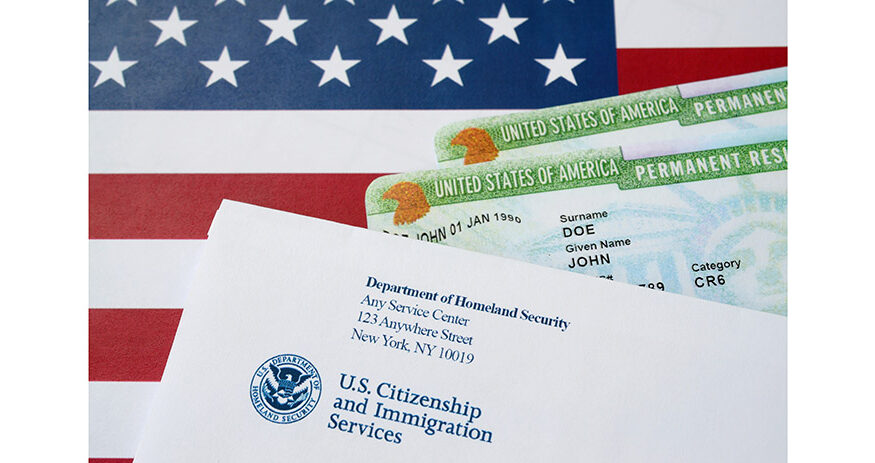
Deposit Photos image
USCIS green card policy shift raises immigration concerns
Dan Heilman//June 10, 2026//


In Brief
- USCIS announced adjustment of status (AOS) will be granted only in “extraordinary circumstances.”
- The agency says consular processing abroad should be the default path for most immigrant visa applicants.
- Immigration attorneys say the policy may largely restate existing discretionary authority but could have significant impacts depending on enforcement.
- Lawyers are advising green card applicants and employers to monitor the policy as USCIS provides further guidance.
A recent announcement from U.S. Citizenship and Immigration Services (USCIS) might seem minor, but it could also prove to have major consequences when it comes to an ever more contentious issue.
The policy announcement, issued last month, says that USCIS will now grant adjustment of status (AOS) inside the United States only in “extraordinary circumstances.” Under its interpretation of longstanding immigration law, the agency said, most applicants are expected to depart the United States and complete immigrant visa processing at a U.S. consulate abroad.
AOS is the process that allows a foreign national who is already physically present in the United States to apply for a green card without having to return to their home country to complete the process.
The agency pointed out that the change doesn’t mean that all applicants must now pursue consular processing. Eligibility rules have not changed, and applicants who qualify for AOS, including those in categories such as H-1B or L‑1, may still file those applications.
Immigration lawyers say that the initial announcement put a bit of a scare into them and their clients, but that the nuances of the change might not be as meaningful as they first thought.
“Whether it’s a big deal is to be determined,” said Peter Nagell, a partner with Nagell Law in St. Paul. “At first I thought, This is a huge change. Once you dig in to what they’re directing officers to do, it seems more like they’re just restating existing law around discretionary authority.”
“It depends on how they exercise it. It has the potential to be a major change,” said Kamyar Ghorbanebrahimi, an attorney with Martin Law in Bloomington. “It depends on whether it’s applied in just limited cases.”
With the change, adjustment of status is now framed as extraordinary relief, not the customary method of moving a green card case forward. According to USCIS, AOS was never intended to replace consular processing.
Ghorbanebrahimi said he sees the change as a means of reminding immigration officers that they have significant authority and discretion in granting or denying green card applications. USCIS directs officers to consider consular processing as the default path.
“I don’t see anything encouraging them to use their discretion in favor of an applicant,” he said.
That means officers will be empowered to evaluate whether the circumstances of a particular case warrant adjudication inside the United States.
“There are people who have been here 15 years on an H-1B waiting for their green card application to be adjudicated,” said David S. Adams, a member of Cozen O’Connor’s New York office.
“They don’t have super-strong ties to their home country anymore. To tell them that they have go back there and wait out the process would not only be detrimental to the individual, but also to the company employing them in the United States.”
The agency asserts that congressional intent favors immigrant visa processing abroad. This applies even to applicants who historically would have had adjusted status in the U.S.
Adams said he doesn’t see the change as necessarily targeting people who are in the United States in a legal, work-authorized capacity.
“It seems to aimed more at people who enter the U.S. without a visa, and are able to somehow file for a green card via marriage or asylum,” he said. “It seems to be saying, ‘You benefited up to this point, but now to finish the process, you need to go back to your home country.’”
Even if the change isn’t quite as drastic as it did at first blush, immigration lawyers are advising their clients to keep an eye on the issue as it develops.
“There’s not much for them to do right now because there’s been no formal guidance from Immigration Services,” said Adams. “They haven’t said anything like you need to fill out this additional form when you file for a green card, or provide evidence of your economic contribution.”
Nagell said the bones of the pertinent regulation make up a tool USCIS has always had to deny otherwise eligible applicants.
“It’s also to more vigorously scrutinize people who have overstayed,” he said.
Even if the change is minimal, though, Nagell said his clients nervous. He’s encouraging them to watch and wait, especially considering that the USCIS memo uses loose language such as “extraordinary circumstances.”
“The initial reports said that people can’t get green cards in the United States anymore, that they have to go through their home countries,” he said. “But I think that’s a misunderstanding of the change.”
“I tell them that it remains to be seen how this is going to work in practice,” agreed Ghorbanebrahimi. “We just don’t know yet.”
Related Articles
Related Content






Top News
- Perspectives: 250th anniversary recalls Declaration decisions
- Legal scholars assess dispute over prediction market ban
- Former Milwaukee judge faces sentencing in ICE case
- Attorney, law firm sanctioned for AI mistakes in court filing
- 8th Circuit: Choice Hotels didn’t breach franchise pact
- Ellison shuts unit reviewing wrongful convictions, cites Trump funding cut
- Breaking the Ice: Immigration lawyer ramped up during Metro Surge








Expert Testimony
- Perspectives: 250th anniversary recalls Declaration decisions
- Perspectives: ‘Pentagon Papers’ case at 55 not far from Near
- Best at Work Insights: Workplace growth beats burnout and boreout
- Quandaries & Quagmires: Rules amended for pro bono lawyers, prosecutors


