


 Free Newsletter

Milwaukee court clerk reprimanded after calling ICE agent a fascist
John Diedrich, USA TODAY Network via Reuters Connect//December 25, 2025//

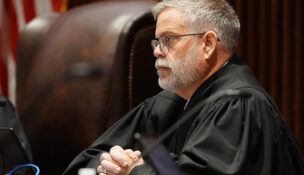
Alan Freed, Judge Hannah Dugan's clerk leaves the courthouse after testifying on the third day of Dugan's federal obstruction case at the Milwaukee Federal Building and U.S. Courthouse in Milwaukee on Dec. 17, 2025. (USA TODAY Network via Reuters Connect)
Milwaukee court clerk reprimanded after calling ICE agent a fascist
John Diedrich, USA TODAY Network via Reuters Connect//December 25, 2025//


 Listen to this article
In Brief
- Judge Hannah Dugan‘s clerk was reprimanded for comments made outside the courtroom.
- Clerk Alan Freed admitted calling a federal immigration agent a fascist.
- Officials cited state Supreme Court rules requiring courtroom neutrality.
- The incident arose during the federal obstruction case against Dugan.
Milwaukee County Judge Hannah Dugan’s clerk, who called a federal immigration agent a fascist outside a courtroom, was reprimanded for the comment.
Alan Freed testified at Dugan’s federal obstruction trial that he told Dugan the U.S. Immigration and Customs Enforcement agents were in the hallway outside her courtroom on April 18.
Freed testified he went into the public hallway and called one of the agents a fascist.
The agents were in the hallway outside Dugan’s courtroom to arrest Eduardo Flores-Ruiz, who was wanted for illegally re-entering the U.S. after being previously deported.
In a split verdict, a jury found Dugan guilty of felony obstruction of agents, but not guilty of trying to hide the suspect, a misdemeanor.
Dugan’s defense team is seeking to overturn the jury verdict and will file motions by late January with U.S. District Judge Lynn Adelman.
Milwaukee County Clerk of Courts Anna Hodges said she couldn’t provide specifics about the situation with Freed because it is a personnel matter. But she added it is impermissible, under state Supreme Court rules, for court staff like Freed to express personal opinions on the job.
Clerks are key employee for judges, calling cases, determining available dates for next hearings and answering questions when the judge is not on the bench.
“People have their own personal opinions, but we need to be professional and appropriate in the courtroom setting,” she said. “Our job is to be impartial.”
Radio host Mark Belling first reported on Hodges’ concern about Freed’s conduct.
Hodges said her staff, including Freed, are well aware of the state Supreme Court rules on decorum because of required trainings.
In an interview, Freed said he is retiring Jan. 2, but said it was planned and unrelated to his reprimand. He is 70.
Freed said he received the “lowest level of write-up” for what he said on April 18. He said he didn’t back down when it was delivered and added that it was his first reprimand in seven years as a clerk.
“I said, ‘I stand by my comments, and it’s political speech, and that’s that,’ ” Freed said.
Freed said the reprimand came before he testified. He said his supervisor approached him again after his testimony, but didn’t give him an additional write-up, because it was for the same thing, he said.
Freed said he was told by his supervisor that “language like that isn’t appropriate, especially in the public hallway, as you’re an employee of the county, and it doesn’t show good judgment.”
“I said, ‘It was on the spur of the moment, and a lot of us were outraged at what was going on. And I stand by my words.’ ”
Freed said he wasn’t aware of rules around decorum for court clerks.
“I’m not aware of that, but maybe [Hodges] has got some document but she hasn’t shared it with me,” said Freed, who was a disability rights lawyer before he became a court clerk.
Asked if he would have done anything differently on April 18, Freed said he may have tried to convince Dugan not to take Flores-Ruiz and his attorney out of an employee-only door into a private hallway.
At trial, Freed testified he had never seen a defendant use that door in thousands of cases. Dugan guiding the pair into that private hallway was a key part of the case.
“I might have spoken out and encouraged the judge not to do what she did, but you know, that’s her call,” Freed said. “It’s ultimately her courtroom.”
This article originally appeared on Milwaukee Journal Sentinel
Related Articles
Related Content





Top News
- Dugan’s lawyers ask judge to overturn verdict, citing Virginia case
- Settlement approved in Sartell mobile home park lawsuit
- Massachusetts accuses UnitedHealth unit of fraud
- Larkin’s coming retirement creates Court of Appeals vacancy
- 8th Circuit affirms denial of death benefits under ERISA
- Texas settlement papers describe nation’s first gender ‘detransition clinic’
- Are rap lyrics criminal evidence in Kansas or just artistic expression?







Expert Testimony
- Perspectives: Election litigation starting early in Minnesota
- Quandaries & Quagmires: ‘Dear Ethics Lawyer’ — A Resource for Ethics Training
- Best at Work Insights: AI alone can’t improve your company
- Perspectives: ‘Nuremberg’ movie has Minnesota legal links


