


 Free Newsletter

Federal judge blocks Michigan’s Line 5 pipeline shutdown
Keith Matheny, USA TODAY Network via Reuters Connect//December 18, 2025//
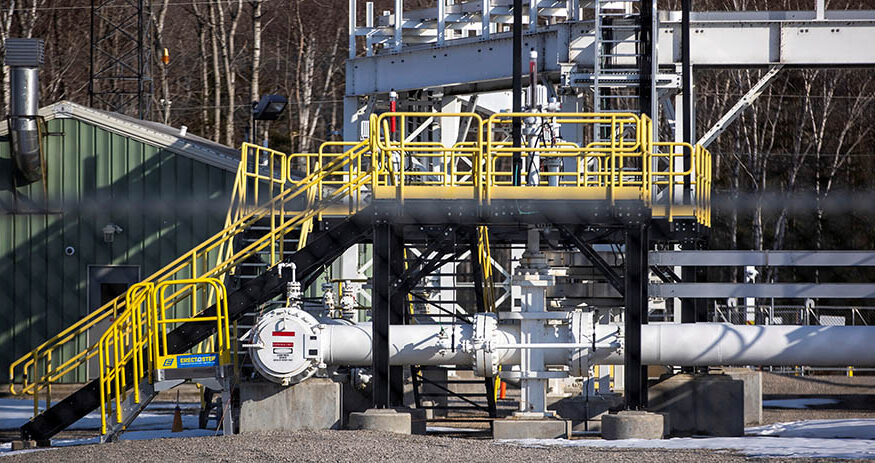
A view of Enbridge’s Mackinaw facility, servicing the company’s existing underwater Line 5 pipeline and its planned replacement tunnel through the Straits of Mackinac between lakes Michigan and Huron, in Mackinaw City, Michigan, February 25, 2024. (Reuters: Carlos Osorio)
Federal judge blocks Michigan’s Line 5 pipeline shutdown
Keith Matheny, USA TODAY Network via Reuters Connect//December 18, 2025//


 Listen to this article
In Brief
- A federal judge ruled Michigan cannot revoke Enbridge’s 1953 easement for Line 5.
- The court found Whitmer’s shutdown order violates the U.S. Constitution’s Supremacy Clause.
- Line 5 is governed by federal pipeline safety law and a U.S.–Canada treaty.
- Michigan officials are reviewing the ruling and considering a possible appeal.
A federal judge has sided with Canadian oil transport giant Enbridge, precluding Michigan Gov. Gretchen Whitmer from enforcing a 2020 notice to revoke Enbridge’s 1953 easement allowing the company to operate the twin Line 5 oil and gas pipelines on Straits of Mackinac lake bottom.
Judge Robert J. Jonker, in a ruling on Wednesday, Dec. 17, in U.S. District Court in Lansing, concurred with Enbridge’s position that Whitmer’s order to shut down the pipelines violates the Supremacy Clause of the U.S. Constitution, which asserts that federal authority overrides conflicting state laws. Interstate pipelines are regulated under the federal Pipeline Safety Act of 1992.
Jonker further agreed with Enbridge that the state’s shutdown order conflicted with the federal government’s conduct of foreign affairs, impeding the flow of hydrocarbons between Canada and the U.S., as agreed upon in a 1977 treaty. Both the Canadian government and the Trump Administration expressed their support for Enbridge’s position in federal court.
Line 5 moves 23 million gallons of oil and natural gas liquids per day east through the Upper Peninsula, splitting into twin underwater pipelines through the Straits − pipes that are now 72 years old − before returning to a single transmission pipeline through the Lower Peninsula that runs south to Sarnia, Ontario.
Enbridge was responsible for one of the largest inland oil spills in U.S. history — a major leak on one of its large oil transmission lines near Marshall in July 2010. That spill fouled more than 38 miles of the Kalamazoo River and took four years and more than $1 billion to clean up. Enbridge in 2016 agreed to a $177-million settlement with the U.S. Justice Department and Environmental Protection Agency, including $62 million in penalties, over the Marshall spill and a 2010 spill on another of its pipelines in Romeoville, Illinois.
A similar spill disaster on Line 5 in the Straits would devastate the Great Lakes shoreline communities and the Michigan economy, critics of the pipeline have long contended. Enbridge officials have countered that Line 5 is safe, and they are currently seeking federal and state permission to construct a tunnel beneath the Straits bottom that would house a new, replacement oil and gas pipeline, a tunnel company officials said would provide added layers of safety.
Whitmer, in November 2020, sent notice of her intention to revoke the state’s 1953 easement with the company allowing the pipelines underwater on the Straits of Mackinac bottomlands. The governor cited “Enbridge’s persistent and incurable violations of the easement’s terms and conditions.” Problems discovered in recent years included an anchor strike that damaged the pipeline, missing pipeline supports and loss of protective coating.
“Enbridge has routinely refused to take action to protect our Great Lakes and the millions of Americans who depend on them for clean drinking water and good jobs. They have repeatedly violated the terms of the 1953 easement by ignoring structural problems that put our Great Lakes and our families at risk,” Whitmer said at the time.
“Most importantly, Enbridge has imposed on the people of Michigan an unacceptable risk of a catastrophic oil spill in the Great Lakes that could devastate our economy and way of life. That’s why we’re taking action now, and why I will continue to hold accountable anyone who threatens our Great Lakes and fresh water.”
Jonker, in his ruling Wednesday, didn’t disagree with what’s at stake with Line 5’s continued operation in the Great Lakes.
“An oil spill in Michigan’s Great Lakes would undoubtedly be an environmental catastrophe,” he stated. “And Michigan would undoubtedly be the recipient of almost all the environmental damage that would result.”
Jonker noted the Great Lakes contain about 84% of North America’s fresh surface water, and about 21% of the world’s supply. “They must be protected,” he said.
“All relevant parties − Enbridge, the United States and Canada − should continue to work together to ensure that the Great Lakes are kept safe. But for better or worse, the national government has unequivocally decided to displace state power in this area and assume exclusive responsibility for interstate pipeline safety. It is not this Court’s job to judge the wisdom of the national government’s policy.”
Jonker granted Enbridge’s motion for summary judgment − a directed verdict based on the facts without proceeding further with a trial. He also denied the state’s motion to stay or abstain from his ruling to allow another Line 5 case in state court between state Attorney General Dana Nessel and Enbridge to proceed, Jonker ruling that the obvious federal supremacy on the Line 5 questions made that unnecessary.
Danny Wimmer, press secretary for Nessel’s office, said the office is working with the governor’s staff to review Jonker’s opinion and determine next steps, “which could include efforts to appeal this ruling.”
“From our own preliminary review, it appears this opinion is wrongly decided on the law and an affront to Michigan’s sovereign interests in managing the use and occupation of its submerged lands,” he said.
The Attorney General’s lawsuit, Nessel v. Enbridge, remains pending in Ingham County Circuit Court.
This article originally appeared on Detroit Free Press.
Related Content






Top News
- Court of Appeals revives fire restoration lawsuit
- DOJ has cut law-enforcement jobs while vowing to get tough on crime
- Supreme Court sides with Michigan attorney general in Line 5 case
- Breaking the Ice: ‘Winning for thousands’ drives policy advocate
- Supreme Court allows soldier to sue contractor over suicide bombing
- Court: Employers not liable for hiring decisions after charges
- 5th Circuit allows Texas to require Ten Commandments in classrooms








Expert Testimony
- Perspectives: Actor’s death recalls key defamation case here
- Best at Work Insights: Why employee growth matters more than salary
- Legally Speaking: April showers don’t wait, neither do difficult conversations
- Perspectives: Seeking Stanley Cup, Wild recall hockey law here


