


 Free Newsletter


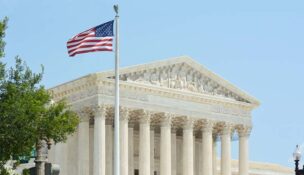
The Minnesota Supreme Court held that the defendant’s right to confront her witness face-to-face was not violated with remote technology. (Depositphotos.com image)
Justices affirm video testimony did not violate right to confront
Laura Brown//February 16, 2023//


 Listen to this article
One year ago, the Minnesota Court of Appeals grappled with whether allowing a law enforcement agent exposed to COVID-19 to testify via remote technology threatened a defendant’s constitutional right to confrontation, ultimately finding that it was not. One year later, in State v. Tate, the Minnesota Supreme Court has reached the same conclusion.
The decision, filed Feb. 8, stems from a drug deal in March 2018 in which Kim Tate sold methamphetamine to a confidential informant. One of the key witnesses for the prosecution was the special agent. However, four days before the trial began in November 2020, the special agent was exposed to an individual who had tested positive for COVID-19. The court granted the state’s request for the special agent to provide testimony through the Zoom teleconferencing platform.
Tate alleged genuine concerns about prejudice resulting from remote testimony. She claimed that remote testimony would lessen the jury’s ability to observe the witness’s demeanor. Her other concern dealt with whether the witness was using impermissible materials during the testimony, as the court would be unable to fully monitor it with remote testimony.
Although Tate objected and asked for a trial continuance, the trial went on and the witness testified on Zoom. The testimony was broadcast to the jury on a 65-inch screen. The court also instructed the jury before the remote testimony to “judge the credibility just as a live witness with the factors that I had given you, and any other factors you believe bear on the credibility and weight.” Additionally, the court provided a cautionary instruction about COVID-19 and its influence on the court’s policies during final jury instructions.
Ultimately, Tate was convicted. She was given a stayed sentence of 21 months in prison and placed on probation.
The Minnesota Supreme Court held that Tate’s right to confront her witness face-to-face was not violated with remote technology.
Richard Schmitz, assistant state public defender, represented Tate. Schmitz argued that the use of technology impacted the witness’s testimony. “The witness was not able to see the exhibit,” Schmitz attested. He also raised concerns about the testimony taking place outside of court. “[Zoom] only shows the head of the witness. It doesn’t show the hands or if there are any sorts of notes in front of the witness.”
Despite being limited with what it could see on screen, the court concluded that the district court confirmed that the lead investigator was alone during remote testimony and would only refer to court-approved materials. Although the court conceded that “some subtle intricacies of the witness’s demeanor may have been lost” through remote testimony, it maintained that the special investigator’s face was clearly viewable.
Nor did the court agree that the case could have just been continued. “Although a two-week continuance might sound reasonable in present circumstances, when the district court decided the issue, it knew from the Governor’s extension of the emergency order—issued 4 days before trial stated—that COVID-19 cases were surging in Minnesota, hospitals were under great strain with capacity shortages in their intensive care units, and a new record for daily deaths had been set in Minnesota,” the court maintained. “In short, unlike other cases when a district court could predict an end date, the court here did not know when the unpredictable COVID-19 crisis would ameliorate or end.”
“No serious person would doubt that the pandemic was very serious in November of 2020,” Schmitz stated. “If everything was as serious as it was in November 2020, the court system probably should not have been having jury trials during that timeframe.”
The court was not unanimous. As Justice Thissen frankly put it, “[W]e cannot throw out the basic constitutional principles by which our criminal justice system operates simply by invoking the word ‘COVID.’” He continued, “COVID-19 is not a universal justification for ignoring a criminal defendant’s constitutional rights.”
Thissen agreed with the majority that the two-part test set out in Maryland v. Craig applied, citing the portion in which the U.S. Supreme Court held that in-person testimony could only be denied when the denial was necessary to further an important public policy. “That ‘only’ is important and should not be ignored,” Thissen wrote. “It is an acknowledgement that we are dealing with a constitutional right and not merely with a convenience.”
Although Thissen agreed that protecting trial participants from COVID-19 was an important public policy, he denied that denying Tate’s constitutional right to confrontation was necessary to do so. Alternatively, the case could have been continued, Thissen argued. While Tate was not demanding a speedy trial, and there were no concerns about the witnesses disappearing or evidence going stale, Thissen argued that the state was dead set on expediency.
Lydia Villalva Lijó, assistant attorney general, represented Minnesota and argued that the courts had to balance many interests, including a fair trial and potential exposure. “In this case, you have a defendant who has requested multiple continuances, and where the trial was ready to go pursuant to judicial orders for safe trial, and on the literal eve of the trial, it turns out that a witness was exposed to COVID-19,” Villalva Lijó stated. “What makes this scenario very different is the potential of exposing everyone in the courtroom to COVID-19.”
Thissen argued that the use of remote testimony was unnecessary to avoid potential risks presented by the pandemic. He noted that the investigator did not even have a confirmed case of COVID-19. The witness simply was exposed to COVID-19 and there was no evidence that he ever became infected with the virus. “I am concerned that the court’s willingness to rely on speculation and conjecture opens a substantial hole in the essential protections afforded by the accused by the constitutional right to confrontation,” Thissen wrote.
Related Content



Top News
- Supreme Court to review immigrant detention; other cases turned away
- Trump to tap former defense team member for Manhattan prosecutor post
- Family sues Milwaukee over 2023 death of teen left in tow lot for days
- Wisconsin law firm challenges national dairy marketing program
- Walz appoints Bea, Blissenbach and Cahill to 4th District bench
- Perspectives: Key figure’s recent death recalls Watergate here
- Judge lets artist’s sculpture destruction lawsuit proceed





Expert Testimony
- Perspectives: Key figure’s recent death recalls Watergate here
- Perspectives: Two new cases here recall Miranda at 60
- Perspectives: Election litigation starting early in Minnesota
- Quandaries & Quagmires: ‘Dear Ethics Lawyer’ — A Resource for Ethics Training


