


 Free Newsletter

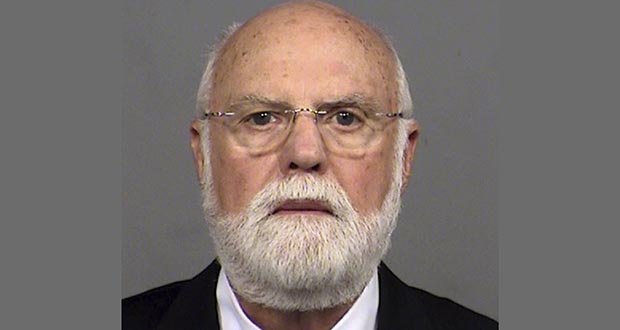
Donald Cline (Marion County, Ind. via AP)
‘Fertility fraud’ documentary illustrates lack of oversight
Laura Brown//May 27, 2022//


 Listen to this article
A new documentary on Netflix called “Our Father” has viewers abuzz about “fertility fraud” — that is, cases where a person receiving fertility treatment is unknowingly and non-consensually given different genetic material than what they expected to receive.
While the case that spurred the documentary is dramatic, and nothing on such a scale has is known to have occurred in Minnesota, it raises questions about what legal action could be taken if such events occurred here.
Donald Cline was a highly sought fertility doctor from Indianapolis. But he had a terrible secret — he was using his own sperm in place of supposed donor sperm from medical residents or, in some cases, the recipient’s husband, to inseminate countless patients. Over 90 offspring have been identified as of the release of the documentary, although there are potentially many more.
Cline’s actions remained secret until one of his offspring, Jacoba Ballard, took an at-home DNA test. In 2015, Ballard was shocked to learn that she had seven half-siblings and that her mother’s fertility doctor was actually her biological father. Ballard has now become a fertility fraud advocate, helping educate her half-siblings as they submit at-home DNA tests and come to realize the truth about half of their DNA.
After Ballard discovered the truth about Cline, she contacted the Indiana Attorney General’s Office. She was initially brushed off until her story was picked up by the press, at which point the office determined the allegations had slipped through the cracks. Eventually, the Marion County prosecutor’s office became involved in the case.
The documentary builds up to the point where the viewer is certain that the next scene will show Cline in handcuffs. Ultimately, Cline was not charged with any crime related to the non-consensual inseminations. The only thing that Cline was charged with was two counts of obstructions of justice; he served no jail time and only had to pay a $500 fine. Cline also lost his medical license, though he had retired nearly a decade earlier.
This raises the question of what would happen if a child in Minnesota learned that they were a product of a fertility doctor’s DNA? David Schultz, professor of political science at Hamline University and visiting professor at Minnesota Law, provided some insight about what legal recourse might exist in Minnesota.
Schultz raised the possibility of many civil causes of action, including basic negligence, malpractice, breach of contract, and negligent or intentional infliction of emotional distress. Additionally, if the resulting offspring were minors, the mother could sue for child support. Things could also prove messy upon the fertility doctor’s death, because the offspring would legally be considered heirs. In Cline’s case, his estate would have to be split nearly 100 ways.
On May 18, 2022, it was revealed that civil cases regarding medical malpractice against Cline were settled and resulted in $1.3 million being paid out. Wilson Kehoe Winingham, who has represented some of the offspring, surmises that many more civil cases will be pursued against Cline. Medical malpractice has a two-year statute of limitations in Indiana, but if discovery was not possible within those two years, individuals could file a lawsuit beyond the deadline.
Schultz also contends that a state may still be able to file criminal charges against a fertility doctor without a law on point. He suggests that a doctor may be able to be charged with assault in the third degree (substantial bodily harm) or assault in the fifth degree (intentional infliction of bodily harm). While Schultz admits these are long shots, he argues that “the use of medical devices to cause someone to become pregnant against their will might constitute some form of bodily harm.” Schultz also asserts that an individual could be charged with criminal fraud, as the doctor makes a false statement knowing it is false.
While hopeful mothers being assisted at fertility treatment centers can never be completely certain what genetic material is being used in the pregnancy, they can still protect themselves. Schultz suggests, “Put the language specifically in writing regarding whose sperm will be used and specific damages (paternity, child support, and other costs) for a breach.”
Although there is no law explicitly prohibiting the conduct in Minnesota, the documentary has caused state legislatures to consider passing legislation. California was the first state to criminalize this action back in 1995. It was the result of a discovery that a University of California Irvine’s Center for Reproductive Health doctor took women’s eggs without their permission and put them in other women. Fifteen births occurred as a result. Indiana became the first state in the Midwest to allow patients to sue doctors for fertility fraud in 2019. In Indiana, this crime is classified as a Class 6 felony. The statute of limitations is either 10 years after the resultant child’s 18th birthday, or within five years of discovering the fraud through DNA tests.
With more people taking at-home DNA tests, it is likely that further cases of fertility fraud will be discovered across the country. As seems to always be the case in assisted reproduction, the law has to catch up.
Related Content






Top News
- Ramsey County affirms six murder convictions linked to former medical examiner
- Trump’s power takes center stage in Supreme Court’s home stretch
- She got eight years for plotting to kill Kavanaugh. Prosecutors want more.
- Supreme Court sets higher standard for Norgaard pleas
- U.S. Supreme Court boosts Exxon’s bid to get compensation from Cuba
- U.S. Supreme Court ends suit alleging Cisco helped China pursue Falun Gong
- U.S. Supreme Court rules Michigan family not owed fair market proceeds on tax sale




Expert Testimony
- Quandaries & Quagmires: Rules amended for pro bono lawyers, prosecutors
- Perspectives: NIL flaws cause concerns here after five years
- How using AI can improve client communication
- Legally Speaking: What spring can teach us about active listening


