


 Free Newsletter


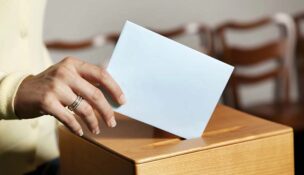
In this July 29, 2020, photo, election workers process mail-in ballots at Minneapolis Elections and Voter Services. (AP file photo: Star Tribune)
Supreme Court rejects suit over absentee ballot boards
Laura Brown//March 24, 2022//


The Minnesota Supreme Court on March 16 determined that the Court of Appeals properly dismissed a lawsuit against Ramsey County and Olmsted County contesting the appointment of deputy county auditors to help process absentee ballots during the 2020 election.
The lawsuit was filed by the Upper Midwest Law Center on behalf of the Minnesota Voters Alliance, which states that it is a nonpartisan organization dedicated to election integrity and voter education.
The Alliance argued that when absentee ballot boards contain deputy county auditors, those deputies must meet the same requirements that election judges must meet. Additionally, the Alliance contended that only preexisting “bona fide” deputy auditors could serve on absentee ballot boards. The court rejected both arguments.
Minnesota Statutes has a chapter, 203B, that governs absentee voting. But the chapter incorporates some requirements from general election administration provisions. For instance, the absentee ballot board statute requires the appointment of “a sufficient number of election judges” and includes the provision that they be “appointed as provided in sections 204B.19 to 204B.22.” It also permits the appointment of “deputy county auditors.” Regarding general election judges, according to Minn. Stat. § 204B.21, subd. 2, they must be appointed from a list of candidates that is supplied by major political parties and disclose their personal political affiliation.
Both counties said that they had satisfied their statutory requirements. In Ramsey County in 2020, the Board of Commissioners established an absentee ballot board. It asked every individual on the major party election judge candidate lists to serve as election judges. Those who expressed an ability to serve were also asked about serving on the ballot board; however, just seven people replied that they would serve on the ballot board. From those seven, only three were actually able to serve due to scheduling conflicts. The county was forced to turn to others who had served on past elections. The final board was composed of the three that responded, 59 people from other sources, and five deputy county auditors. No more than half of the 62 election judges were affiliated with the same major political party. The county, however, did not have the deputy county auditors disclose their political affiliation.
Notably, the Alliance did not allege that there was misconduct, fraud, or negligence committed by any member of the absentee ballot boards. Instead, the Alliance argued that the counties impermissibly appointed deputy county auditors who were ineligible to serve given the statutory requirements. It sought a writ of mandamus. The District Court and Court of Appeals both held that the Alliance had not proven a violation of a duty clearly imposed by law.
First, the Supreme Court determined that the Alliance could not argue that deputy county auditors are election judges, and hence subject to the same appointment rules, because the language of the statute distinguishes between deputy county auditors and election judges. “This assertion cannot overcome the plain language of the statute,” the court wrote.
The Alliance also argued that the government entities must follow the same appointment procedure to ensure that appointing deputy country auditors remained a last resort for populating the absentee ballot boards. It expressed concern that counties may prefer to appoint deputy county auditors if they were not bound by the same restrictions as concern election judges. Again, the court pointed to the statutory language, finding that it did not establish that counties must primarily appoint election judges to the absentee ballot boards.
Nor did the court determine that the counties were bound to appoint those who are qualified as election judges, as the language of the statute reads that the county “may” include deputy county auditors on the board. “The absentee ballot board statute leaves the counties with the discretion to decide what constitutes a ‘sufficient number’ of election judges and to otherwise appoint deputy county auditors,” the court affirmed.
Additionally, the Alliance argued that those serving on the absentee ballot board must be “bona fide” deputy county auditors, meaning that they are only bona fide when they can perform all the duties that a county auditor can. Since the deputy county auditors do not possess the full powers of a county auditors, the Alliance argues that the counties violated their duty. Again, the court asserted that the Alliance misinterpreted the statutory language. “That deputy county auditors ‘may’ do any task the county auditor can does not establish that all deputy county auditors must personally be able to perform all such tasks,” the court wrote.
The Minnesota Supreme Court affirmed the Court of Appeals’ dismissal of the petition for a writ of mandamus, arguing that the Alliance failed to prove a violation of duty clearly established by law.
In an email to Minnesota Lawyer, Olmsted County Attorney Mark A. Ostrem responded to the court’s decision:
“[W]e are pleased with the analysis from the Supreme Court. The court affirmed our position that we had not impermissibly appointed ineligible persons to our absentee ballot board. [Minnesota Voters Alliance] sought to combine the language from two separate statutes so as to presume the appointments to our ballot board were unlawful. The Court disagreed, saying the statutes cannot be read together as MVA wanted and that the appointments by Olmsted County were fine.”
James Dickey, senior trial counsel for the Upper Midwest Law Center, wrote of the decision:
“The most important takeaway from this decision is that the critical task of verifying signatures after an identification number mismatch between absentee ballot applications and ballot envelopes ‘is committed to election judges alone, and the absentee ballot board must therefore include a sufficient number of election judges to handle this duty.’ Election judges must be balanced by party under the Minnesota Election Law, and mismatches of identification numbers are a substantial portion of ‘problem ballots’ during ballot processing. Thus, while the Court technically affirmed the decision below, the Court made it clear that party-balanced election judges are responsible for accepting or rejecting these ballots. This holding directly rejected the Secretary of State’s argument in his amicus curiae brief that ballot boards can be staffed only with hand-picked staff, and no election judges.”
On Nov. 12, 2020, the Minnesota Voters Alliance issued a statement that it did not accept the 2020 general election results as they were reported by the Minnesota Secretary of State. It noted that it was “not saying there was fraud or irregularities that changed the outcome of a specific race, though the MVA has received scores of reports that point to fraud and irregularities.”
Various organizations, including the FBI, have reported that it is nearly impossible to pull off fraud through absentee mail-in voting. Studies of billions of ballots over many years have found voter fraud of less than 0.0001%.
Minnesota Secretary of State reported that that there were 3,292,977 voters, a turnout of nearly 80%. Of those who voted, more than 1.9 million did it by absentee ballot.
Related Content



Legal Tech
- How ransomware tactics against law firms are changing
- How large language models are leveling the personal injury playing field
- Attorney Share, Lawmatics integrate to automate law firm referrals
Top News
- Prosecutors struggle to turn voter fraud claims into charges
- Best At Work Insights: We tore out the workforce backup generator
- Citing jury instruction, justices order new sex-abuse trial
- Judicial Branch announces $4 million in courthouse security grants
- 8th Circuit upholds school district in student suicide suit








Expert Testimony
- Best At Work Insights: We tore out the workforce backup generator
- Legally Speaking: How communication failures turn disputes into lawsuits
- Perspectives: Umpire’s death recalls case law in Minnesota
- Perspectives: It’s not ‘football’ here, but soccer cases abound


