


 Free Newsletter

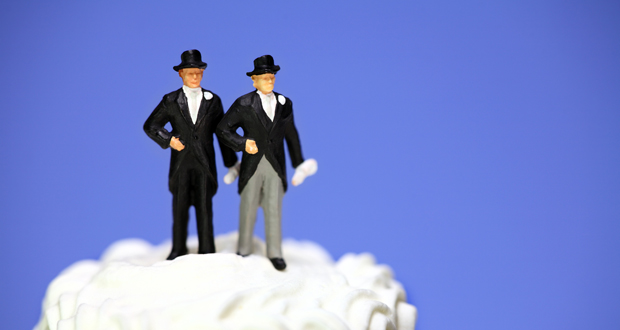
Perspectives: Same-sex marriage case had genesis here
Marshall H. Tanick//February 12, 2015//


“Marriage, if one will face the truth, is an evil, but a necessary evil.” —Greek Philosopher Menander (347 – 292 B.C.)
The decision by the U.S. Supreme Court in mid-January to resolve this term the constitutionality of state prohibitions on same-sex marriages was greeted with approval from many opposing quarters.
Same-sex marriage advocates applauded the decision as a means of achieving nationwide uniformity allowing such arrangements. Detractors saw it as a vehicle to stop the growing momentum for marriage equality in many federal and state jurisdictions. The high court will hear a consolidated appeal of four cases decided last fall adversely to same-sex claimants by the 6th Circuit Court of Appeals. DeBoer, et al. v. Snyder, Nos. 14-556, 562, 571, 574, with its ruling expected by the end of the 2014-15 term this June.
While the focus will be on the justices in the nation’s capitol, the circuitous route that the law concerning same-sex marriage has followed is traceable to Minnesota, where the roots of the current Supreme Court litigation were planted more than four decades ago.
Baker Brouhaha
Legal recognition of intra-gender marriages, once deemed laughable, had its genesis in Minnesota, where it was first firmly rejected on grounds, in part, of Genesis, no less.
The long path to the current abundance of Supreme Court appeals began at the Hennepin County District Court, at the old downtown Minneapolis City Hall, a few years before completion across Fifth Street of the Hennepin County Government Center. The case was brought by Jack Baker, an openly gay University of Minnesota student, and a gay colleague after their request for a marriage license was denied on May 18, 1970, by the clerk of court. Baker had been elected president of the student government at the University of Minnesota, spurred by a flamboyant advertisement in the Minnesota Daily student newspaper showing a male candidate in high heel shoes. He was re-elected during the litigation in Hennepin County. He and his companion asserted various constitutional claims under the First, Eight, and Ninth Amendments, as well as the Due Process and Equal Protection clauses of the 14th Amendment.
A Hennepin County District Court judge rejected the lawsuit on grounds that the state marriage law at the time, Minn. Stat. § 517.08, limited lawful unions to couples of opposite genders. The Minnesota Supreme Court, in the days before an appellate court existed, upheld that determination prodded by an impassioned plea from the Hennepin County Attorney’s Office. Defending the clerk’s action, the then county attorney, who later became a member of the state high tribunal, warned the justices of the “extreme and unresolvable difficulty” that would ensue if they were to “undermine the law of the creator,” as deftly recounted recently in an enlightening and evocative article by Supreme Court Justice David Lillehaug, “Sweet Justice,” Minneapolis-St. Paul, Feb. 2015, p. 58.
The court agreed with the county, construing the state marriage statute as “meaning the union between a man and a woman.” Baker v. Nelson, 291 Minn. 310, 191 N.W.2d 185 (1971). Noting that marriage between a “man and a woman [is one] uniquely involving the procreation and rearing of children within a family [and] is as old as the book of Genesis,” it rejected the contention that barring same-sex marriage was “irrational and invidiously discriminatory.”
In addition to biblical support for its position, the court pointed to absence of “support … in any decisions of the United States Supreme Court” allowing same-sex marriage. To the contrary, it relied upon the high court’s decision in Skinner v. Oklahoma, 316 U.S. 535 (1942) which invalidated a state statute allowing sterilization of “habitual” criminals on grounds that it violated the Equal Protection Clause because “[m]arriage and procreation are fundamental to the very existence and survival of the race.” Rebuffing the analogy to the high court’s ruling in Loving v. Virginia, 388 U.S. 1 (1967), which banned state laws prohibiting inter-racial marriage, it recognized “a clear distinction between a marital restriction based merely upon race and one based upon the fundamental difference in sex.”
The case was appealed to the U.S. Supreme Court which, a year later, nonchalantly flicked away the lawsuit with a single sentence: “The appeal is dismissed for want of a substantial federal question.” 409 U.S. 810 (1972). That determination became a seemingly binding precedent because, unlike a declination of a petition for certiorari, which characterizes the disposition of most appeals to the Supreme Court, the Baker dismissal on grounds of insubstantiality constituted a determination on the merits. Mandel v. Bradley, 432 U.S. 173, 176 (1977).
Baker bashing
There the law stood, deeming same-sex marriage outside the purview of constitutional protection, for some three decades. As the millennium turned, a few states, however, began to recognize same-sex marriages, some prodded by court rulings, while others came up with a lesser version of “civil unions,” bestowing most of the state-sanctioned benefits of marriage, without using that buzz word, for same-sex couples.
In Minnesota, of course, the statutory prohibition underwent an attempt at conversion into a constitutional amendment, which was voted down by nearly 53 percent of the electorate in 2012. That election also ushered in DFL majorities in both houses of the state Legislature and, with approval of DFL Gov. Mark Dayton, it enacted a measure in 2013 redefining marriage as “between two individuals,” regardless of gender.
As these developments occurred, marriage equality adherents made an attempt to bash the Baker precedent. A nonprofit organization known as Marry Me Minnesota used a new approach to assure that Baker did not consecrate the statutory ban on same-sex marriages. In May, 2010, nearly 30 years to the date after the marriage license was denied to the Baker couple, a group of six same-sex couples, all members of the group, sued in Hennepin County District Court, like the Baker plaintiffs, to have their marriages recognized. Unlike Baker, they asserted only claims under the state constitution. But they experienced the same outcome in Hennepin County District Court which dismissed the case, relying on Baker.
The Court of Appeals, however, reversed, holding that Baker did not preclude claims under the state constitutional provisions of freedom of association, due process, and equal protection, which were not raised or addressed in the Baker litigation. Benson v. Alverson, No. A11-811, 2012 WL 171399 (Minn. App. Jan. 23, 2012) (unpublished). Rejecting the contention that Baker was a “binding precedent,” it reasoned that at the time of Baker, case law was adverse but, since the Supreme Court cases have furnished “guidance … that moral disapproval of a class because of sexual orientation” is illegitimate.
The case was remanded to the District Court, where it was pending until mid-2013, when the enactment of the same-sex marriage law, effective Aug. 1 of the year, mooted the matter.
By that time, the momentum for marriage equality had shifted considerably. Meanwhile, Baker, who later became a lawyer, was residing in south Minneapolis with his longtime companion.
Within a month of passage of the Minnesota measure, the U.S. Supreme Court issued its landmark ruling in U.S. v. Windsor, 133 S.Ct. 2675 (2013), which struck down on constitutional grounds a provision in the Federal Defense of Marriage Act (DOMA) forbidding federal government recognition of same sex marriages, even in states where they are permissible. The Windsor decision, although not directly addressing state marriage restrictions, contained strong language supportive of the unconstitutionality of forbidding same-sex marriages, highlighted by the remark of Justice Anthony Kennedy in the majority opinion that “banning marriage between same sex individuals does “demean” [those] whose moral and sexual choices the Constitution protects.”
The Baker decision, considered settled law by many, reared its head during oral argument before the Supreme Court the day Windsor was argued. In the companion case in Hollingsworth v. Perry, 133 S.Ct. 2652 (2013), the justices passed on ruling upon the validity of a 9th Circuit ruling prohibiting the ban on same-sex marriages in California on grounds of lack of standing by the private party challengers. The argument made by same-sex opponents in that case pointed to the high court’s disposition of the Baker case more than four decades ago. Justice Ruth Bader Ginsburg noted at the argument that, at the time of the Baker decision, the high court had not “even decided that gender based classifications get any kind of heightened scrutiny” and “same sex intimate conduct was considered criminal” in much of the country, “I don’t think we can extract much in [sic] Baker v. Nelson.”
Appellate assault
The appellate assault on the Baker rationale started with a ruling by the highest tribunal in Massachusetts 12 years ago, Goodridge v. Dept. of Public Health, 798 N.E.2d 941 (Mass. 2003), and that momentum accelerated following the Windsor ruling as nearly every tribunal confronting the issue relied upon the Windsor language in striking down such restrictions, except two. One of these, a federal trial court in Puerto Rico, rejected a similar challenge to that Commonwealth’s ban on same-sex marriage because the 1st Circuit had, only two years earlier, indicated “that Baker remains binding precedent,” citing Massachusetts v. U.S. Department of Health & Human Services, 682 F.3d 1 (1st Cir. 2012).
The other, more noteworthy contrarian opinion was issued by the 6th Circuit last fall in the DeBoer litigation. It’s that 6th Circuit litigation that the high court has now agreed to adjudicate with briefing scheduled this spring; oral argument probably coming in May; and a decision expected before the justices adjourn the term early this summer.
The consolidated litigation now before the Supreme Court, involving 15 cases from four states, comes at a time when same-sex marriage equality is no longer the laughing stock that it was at the time the Baker case was moving through the Minnesota judicial system. At least 36 states and the District of Columbia, encompassing more than 75 percent of the population of the United States, now allow same-sex marriages. Public opinion polls, which hovered at about one-third support for gay marriages about five years ago, have flipped, particularly among younger people. A majority of the public now support gay marriages. An astonishing 80 percent of those between ages 18 — 29 are supportive.
Meanwhile, the 8th Circuit Court of Appeals has decided not to stay its hand. Two weeks ago, it agreed to proceed with a consolidated hearing on appeals of federal district court rulings invalidating same-sex bans in three states within its jurisdiction. Rosenbrahn v. Daugaard, (South Dakota), Lawson v. State (Missouri), and Jernigan v. Crane (Arkansas). The hearing surprisingly is set for May 11, 2015, sometime after the high court hears the 6th Circuit litigation but probably before it issues its ruling. See “8th Circuit to hear 3 more gay marriage cases,” Minnesota Lawyer, Feb. 2, 2105, p. 5. When it hears the cases, the Court will confront its own precedent less than a decade ago upholding a voter-initiated same-sex ban in Nebraska in reliance, in part, on the Baker precedent in Citizens for Equal Protection v. Bruning, 455 F.3d 859 (8th Cir. 2006)
While the general view is that the Supreme Court will definitively resolve the constitutionality of gay marriage bans, technically the cases, which are to be given an unusual 2½-hour slot on the court’s docket, raise two inter-related questions. As propounded by the justices, the first question they will address is whether the 14th Amendment, presumably both the Due Process and Equal Protection clauses, “require a state to license a marriage between two people of the same sex.” The second issue concerns the Windsor-type situation at the state level, whether these constitutional provisions “require states to recognize a marriage between two people of the same sex … lawfully licensed and performed out-of-state.”
An affirmative answer to the first question would probably moot the second one. But it is theoretically possible, some hair-splitting observers say, for the court to uphold same sex prohibitions at the state level but require, evoking Windsor, lawfully-contracted marriages to be recognized in non-consenting states under the Full Faith and Credit Clause of Article IV, section 1, of the U.S. Constitution.
Recognition route
Along the route from Baker to Windsor, the Supreme Court has extended its recognition of the rights of gays and lesbians under the 9th Amendment, highlighted by striking down state sodomy laws in Lawrence v. Texas, 539 U.S. 558 (2003), overruling the infamous precedent of Bowers v. Hardwick, 478 U.S. 186 (1986). A dissent in the Lawrence case by Justice Antonin Scalia may provide fodder for same-sex claimants. They can point to his warning that, if state laws may not express moral disapproval of homosexual conduct, “what justification could there possibly be for denying the benefits of marriage to homosexual couples,” words which are likely to ring loudly in the briefing and oral argument before the High Court this spring.
It’s been a long and difficult road for same-sex marriage claimants, and the trek began right here in Minnesota, more precisely Hennepin County District Court, when the Hennepin County Clerk of Court rejected the marriage license in what became the Baker case, the genesis of same-sex marriage litigation.
While the original claimants did not have a prayer, most savants, even some who deride the concept, anticipate that the Supreme Court may very well invalidate the prohibitions remaining in effect in 14 states, and give a favorable answer to the prayers of those who have, in the wake of Baker, been awaiting that determination for more than four decades.
PERSPECTIVES POINTERS
Four same-sex cases before U.S. Supreme Court
- DeBoer v. Snyder, (Michigan)
- Obergefell v. Hedges, (Ohio)
- Bourke v. Beshear, (Kentucky)
- Tanco v. Haslam, (Tennessee)
Related Content




Legal Tech
- How ransomware tactics against law firms are changing
- How large language models are leveling the personal injury playing field
- Attorney Share, Lawmatics integrate to automate law firm referrals
Top News
- Prosecutors struggle to turn voter fraud claims into charges
- Best At Work Insights: We tore out the workforce backup generator
- Citing jury instruction, justices order new sex-abuse trial
- Judicial Branch announces $4 million in courthouse security grants
- 8th Circuit upholds school district in student suicide suit







Expert Testimony
- Best At Work Insights: We tore out the workforce backup generator
- Legally Speaking: How communication failures turn disputes into lawsuits
- Perspectives: Umpire’s death recalls case law in Minnesota
- Perspectives: It’s not ‘football’ here, but soccer cases abound


