


 Free Newsletter

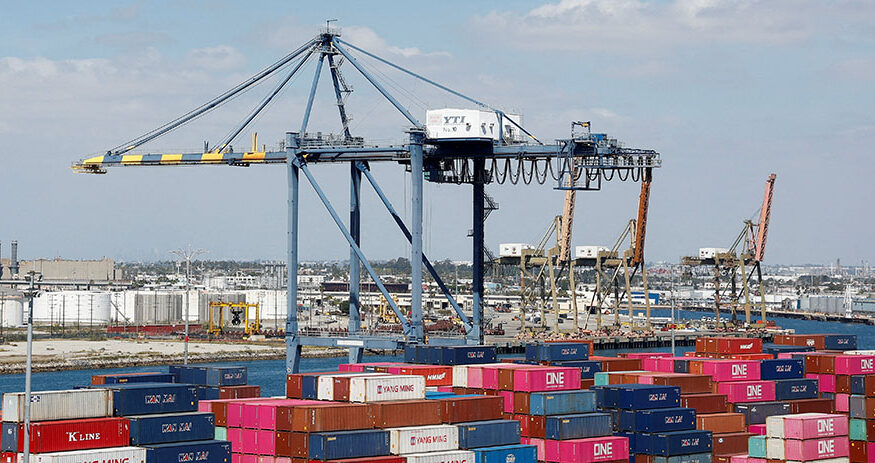
Shipping containers are stacked at a terminal at the port of Los Angeles in Long Beach, California, on March 10, 2026. (Reuters file photo)
Minnesota joins lawsuit challenging Trump’s latest tariffs
Reuters//August 4, 2026//


In Brief
- Lawsuit filed in U.S. Court of International Trade in New York.
- Tariffs imposed under Section 301 of the Trade Act of 1974.
- 25 Democratic-led states join lawsuit against tariffs on 60 partners.
NEW YORK — A group of 25 Democratic-led U.S. states, including Minnesota, sued the Trump administration Monday, arguing that the president’s latest round of tariffs on goods from 60 trading partners exceeds his legal authority to tax imports, like most of his earlier sweeping tariffs.
The states’ lawsuit filed in the U.S. Court of International Trade in New York follows previous challenges by small U.S. businesses, which sued to block the tariffs on the day they went into effect last month. States and small businesses have successfully challenged previous global tariffs imposed by Trump in his second term, but the president has continued to pursue new tariffs despite a series of legal setbacks.
The Trump administration imposed new tariffs on July 24 of 10% and 12.5% on 60 trading partners, including the European Union, over allegations they were not doing enough to stop the export of goods produced with forced labor. The tariffs went into effect just as a previous 10% global tariff expired.
The states that sued all have Democratic attorneys general or governors.
“The next time you’re wondering why prices keep going up, know that this president’s tariffs are a big reason for those higher prices,” Minnesota Attorney General Ellison said in a statement. “My mission is to help Minnesotans afford their lives and to defend our state from federal overreach, which is why I’m taking Trump to court yet again over his illegal tariffs. I won my last lawsuit against Trump’s illegal tariffs, and I will continue to fight this fight until the president decides to follow the law and stop raising costs on Minnesota families.”
White House spokesman Kush Desai said the tariffs were an appropriate and legal response to unfair trade practices in other nations.
“A foreign country’s failure to impose and effectively enforce a prohibition on the importation of goods produced with forced labor is unreasonable and burdens U.S. commerce, including American workers, and must be addressed,” Desai said.
Trump has made tariffs a central pillar of his foreign policy, even after a stinging defeat in the U.S. Supreme Court. The court ruled against most of Trump’s widest-ranging tariffs on February 20, finding that the International Emergency Economic Powers Act (IEEPA) does not authorize the president to unilaterally impose tariffs on trading partners.
Trump responded to that ruling by escalating his trade war, calling Supreme Court justices “disloyal” and issuing new temporary 10% tariffs under a different legal authority that, like IEEPA, no president had previously used to impose tariffs. Those tariffs were also ruled illegal by the U.S. Court of International Trade, but they remained in effect while the Trump administration appealed.
The latest round of global tariffs was imposed under Section 301 of the Trade Act of 1974, which is meant to combat unfair or discriminatory economic practices by other nations. The tariffs imposed in July affect over 99% of U.S. imports.
Unlike IEEPA or the temporary global tariff authority, Section 301 has been used by past presidents. But the states and small businesses said in their lawsuits that Section 301 tariffs have historically been targeted to address specific nations and industries, and Trump’s broad-brush approach has no historical precedent.
The states’ complaint, like two previous lawsuits filed by small businesses over the tariffs, also argued that the new tariffs used “forced labor” as a pretext to re-impose the tariffs that had already been ruled illegal in court. They said that a sweeping tax on imports would do nothing to address the real problems of forced labor around the world.
The lawsuit is led by Oregon Attorney General Dan Rayfield, Arizona Attorney General Kris Mayes, and California Attorney General Rob Bonta. Also joining in addition to Attorney General Ellison are the attorneys general of Colorado, Connecticut, Delaware, Hawaii, Illinois, Massachusetts, Maryland, Maine, Michigan, Nevada, New Jersey, New Mexico, New York, North Carolina, Rhode Island, Virginia, Vermont, Washington, Wisconsin, and the governors of Kentucky and Pennsylvania.
Related Articles
Related Content





Top News
- Groups ask Court of Appeals to review dairy expansion decision
- Federal judge blocks New York mask ban and ID mandate for ICE agents
- Kansans reject constitutional amendment for Supreme Court elections
- Criminal defense lawyers have duty to use AI, paper argues
- Minnesota joins lawsuit challenging Trump’s latest tariffs








Expert Testimony
- Perspectives: Taylor-Travis marriage recalls prenup laws here
- Quandaries & Quagmires: Fast-Tracking Temporary Lawyer Suspensions
- Perspectives: ‘Slam’ suits: Recalling wrestling cases as WWE arrives
- Best At Work Insights: We tore out the workforce backup generator
Legal Tech
- Criminal defense lawyers have duty to use AI, paper argues
- AI is reshaping family law practice, but attorneys worry about DIY research
- Massachusetts court rejects work product protection for AI documents by girlfriend


