


 Free Newsletter

Women argue more at Supreme Court but parity remains distant
Liz Kramer and Jadyn Lovelady, Special to Minnesota Lawyer//August 3, 2026//
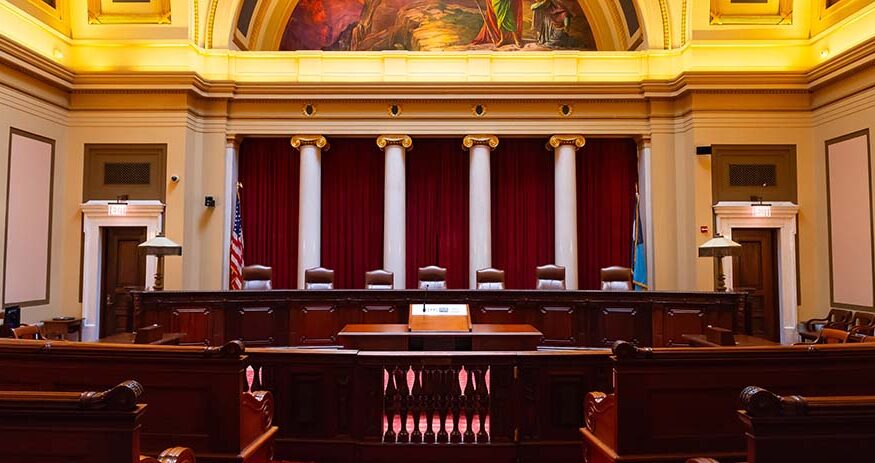
The Minnesota Supreme Court chamber in the Capitol. (Depositphotos.com image)
Women argue more at Supreme Court but parity remains distant
Liz Kramer and Jadyn Lovelady, Special to Minnesota Lawyer//August 3, 2026//


In Brief
- Women presented 33.8% of oral arguments before the Minnesota Supreme Court during the 2024-25 term, up from 29.5% five years earlier.
- Most of the increase came from government attorneys, while women in private practice remained significantly underrepresented.
- The authors argue that, at the current pace, gender parity in Supreme Court advocacy would not be reached until approximately 2045.
- The article recommends expanding appellate advocacy training and mentorship in law schools and law firms to improve opportunities for women advocates.
About five years ago, one of us (Liz) co-authored an article in this paper that identified the low percentage of women arguing at the Minnesota Supreme Court (29.5%) and offered analysis about why the percentage of women arguing was significantly lower than the percentage of women in the profession.1 Since that date, a lot has happened in our state and the world, and it’s a good time to look and see if this particular needle has moved at all.
Before we delve into the more recent statistics, two contextual points are in order. First, an analysis of the racial identities of advocates at our high court would be equally important. However, that racial data is not kept by our court, meaning that the analysis would require cold-calling/emailing about 150 individuals to ask how they identify and waiting for their responses, which is daunting. For that reason, we have stuck with gender.2
Second, it’s important to note that Minnesota is not an outlier. Judge Amy St. Eve studied women advocates at the Seventh Circuit. Her research revealed that in 2009, 24% of the appellate advocates at that court were female. And in 2019, it had increased slightly to 28%.3 Bloomberg Law reported that women gave 24% of arguments at the United States Supreme Court in the 2021-22 term.4
Inspired by our work in Minnesota in 2020, other state solicitors general completed similar studies. North Carolina’s Solicitor General did a study of the arguments at its high court in the 2021-22 term and found that women gave 27.8% of the arguments.5 And those women were far more likely to come from a government office than private practice. Virginia’s Solicitor General did a study that same year and found 26% of the arguments given in its high court were given by women.6 And again, most of them came from public law offices. (Indeed, with all advocates from law firms as the denominator, just 17% of those were women.)
And yet, women are appointed to those high courts at a rate that is closer to parity. The Brennan Center’s most recent findings show women occupy 43% of seats on state high courts, and 20 states have female majorities on their high courts (including Minnesota for the next few weeks).7 Plus, women have represented about half of law school classes since around 2000.8 And yet, those five surveys (three state high courts and two federal appellate courts) found women arguing between 24-29% of the time.
Which brings us to current data. Did women in Minnesota argue a greater percentage of the cases at the Minnesota Supreme Court in the last term (September 2024-July 2025) than the five years before? Yes, they did. Women gave 51 oral arguments out of a total 151, or 33.8% of the total. That’s a gain of 4 percentage points since the 2019-2020 term — a term starting approximately five years prior. If the same 4 percentage-point increase occurs every five years, gender parity would not transpire until 2045. Again, government attorneys represented the bulk of that number, with 38 of those 51 arguments presented by women in public practice, and only 13 coming from private practice.
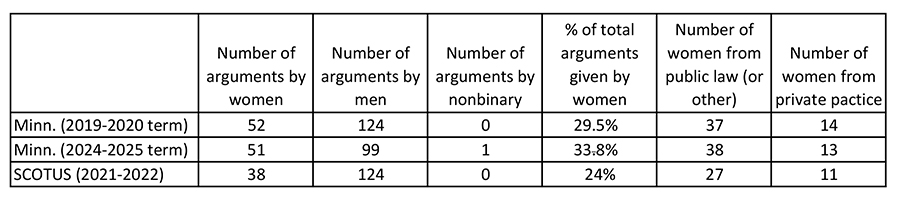
We would love to credit this increase to greater awareness of the gender disparity and an intentional effort to give women advocates more appellate experiences. Certainly, at the Attorney General’s Office, we make a concerted effort to give women and diverse attorneys appellate arguments. It is possible, however, that this uptick reflects the shift in the Minnesota Supreme Court’s docket toward more cases involving public law. One way to reflect that is by analyzing the percentage of all arguments given by government attorneys. When we did the math in 2019, there were 81 arguments given by government lawyers, as compared to 95 by private practitioners, so 46% of advocates were public lawyers. In this last term, there were fewer arguments overall, but a higher proportion were by public lawyers. Out of 151 arguments, 80 were from government lawyers, or 53%. Because public lawyers have greater gender parity, that higher proportion may explain much of the increase in women advocates.
For those who agree that this representation gap is a problem, how can we address it? We have some thoughts, building on the suggestions in the original article.
Closing the gap likely needs to begin in law school. Without exposure to appellate practice, individuals cannot choose to participate. To address this, we would like to see more opportunities to try appellate work in a safe environment, where learning and growth are the objectives (not demonstrating previous mastery). Law schools and employers (assisted by the court system) play a vital role in developing advocates and can become fertile ground for cultivating appellate talent.
For example, law schools could expose students to appellate advocacy early in their legal education. The Appellate Project aptly notes, “you need experience to build trust, but often [you] need trust to get that first opportunity.”9 Introducing law students to the fundamentals of appellate law can spark interest in students who may otherwise be unaware. Fundamental skills can easily be integrated into their course work through observation of oral arguments, familiarizing themselves with using a record, or assigning short appellate briefs. Once students have this initial exposure, they can make an informed choice to pursue more training. Reinforcing this pipeline, second-level opportunities should focus on scaffolding core appellate skills while initially decoupling grading. Focusing on skill building allows flexibility for underrepresented people and those unconnected to the field (e.g., women) to explore without the anxiety of losing their competitive standing. Prioritizing low-stakes mastery over high-stakes ranking allows room for intrinsic motivation that sets diverse students up for a confident exploration of appellate law.
Employers can also provide early opportunities for appellate skill building insulated from the fear of adverse employment consequences. Those opportunities can be built into a training schedule (lots of first-year associates are given training on depositions and trial advocacy, but we haven’t seen any offered training on appellate arguments). They can also be hands-on opportunities with intentional mentorship on appeals for clients. The mentor must be selected for their ability to see potential, not just existing skill, as intentional mentorship carves out safe spaces for mistakes as new advocates develop and actively model how to rehabilitate errors. Reducing the traditional obstacles may empower more diverse pools to self-select in. This is a win-win for employers as they are developing a larger selection of internal specialists, and the world welcomes more diverse appellate advocates.
We hope that offering these two ideas for moving forward will inspire others to adopt them or to share their own ideas to bring about gender parity in high court advocacy. Pursuing gender parity does more than balance a statistic; a pathway for diverse talent fosters more robust advocacy, ultimately elevating the entire appellate bar.
Liz Kramer is the former Solicitor General of Minnesota; Jadyn Lovelady is a University of Minnesota Law School Saeks Resident at the Attorney General’s Office; Bex Warner is a 2026 graduate of the University of Minnesota Law School and contributed to the data collection in this piece during her time as a law clerk at the Attorney General’s Office. All authors and contributors identify as female.
Notes
- Liz Kramer, Cicely Miltich, Hillary Taylor & Cat Rios-Keating, A Gender Reveal: Who’s Arguing at Minnesota Supreme Court, Minn. Law., Sept. 14, 2020, at 6.
- We determine gender by researching each advocate and/or using a contributor’s personal knowledge.
- Amy J. St. Eve & Jamie B. Luguri, How Unappealing: An Empirical Analysis of the Gender Gap Among Appellate Attorneys, at 10 (Am. Bar Ass’n Comm’n on Women in the Pro. 2021).
- Kimberly Strawbridge Robinson, Women Lawyers from Government Get More Chances at Supreme Court, Bloomberg L.: U.S. L. Wk. (May 2, 2022), https://news.bloomberglaw.com/us-law-week/women-lawyers-from-government-get-more-chances-at-supreme-court.
- Ryan Park, Mary Gen Sanner & Emma Ritter, Diversity and the North Caroline Supreme Court: A Look at the Advocates, N.C. Bar Ass’n: N.C. Law. (May 17, 2023), https://www.ncbar.org/nc-lawyer/2023-05/diversity-and-the-north-carolina-supreme-court-a-look-at-the-advocates/.
- Michelle Kallen & Kimberly Veklerov, The Gender Gap Among Advocates in Virginia’s Appellate Courts, Va. Law., April 2022, at 34, 35.
- Jamie Muth & Chihiro Isozaki, State Supreme Court Diversity: November 2025 Update, Brennan Ctr. for Just. (November 18, 2025), https://www.brennancenter.org/our-work/research-reports/state-supreme-court-diversity-november-2025-update.
- Women in the Legal Profession, Am. Bar Ass’n: Profile of the Legal Profession, https://www.americanbar.org/news/profile-legal-profession/women/ (last visited June 4, 2026).
- Cody L. Frank Appellate 101: Barriers to Entering Appellate Practice, The Appellate Project (May 26, 2026) https://theappellateproject.org/news-and-voices/all-posts/barriers-to-entering-appellate-practice.
Related Content





Top News
- Criminal defense lawyers have duty to use AI, paper argues
- Minnesota joins lawsuit challenging Trump’s latest tariffs
- Trump vowed to ‘bring free speech back.’ 75 rulings say he has stifled it
- After 36 years in U.S., Sheboygan woman spent 9 months in ICE detention
- League of Women Voters, environmental groups join Ojibwe against pipeline








Expert Testimony
- Perspectives: Taylor-Travis marriage recalls prenup laws here
- Quandaries & Quagmires: Fast-Tracking Temporary Lawyer Suspensions
- Perspectives: ‘Slam’ suits: Recalling wrestling cases as WWE arrives
- Best At Work Insights: We tore out the workforce backup generator
Legal Tech Directory

.png)


Legal Tech
- Criminal defense lawyers have duty to use AI, paper argues
- AI is reshaping family law practice, but attorneys worry about DIY research
- Massachusetts court rejects work product protection for AI documents by girlfriend


