


 Free Newsletter

Michigan Supreme Court halts Line 5 tunnel project, orders more review
USA TODAY Network via Reuters Connect//August 3, 2026//
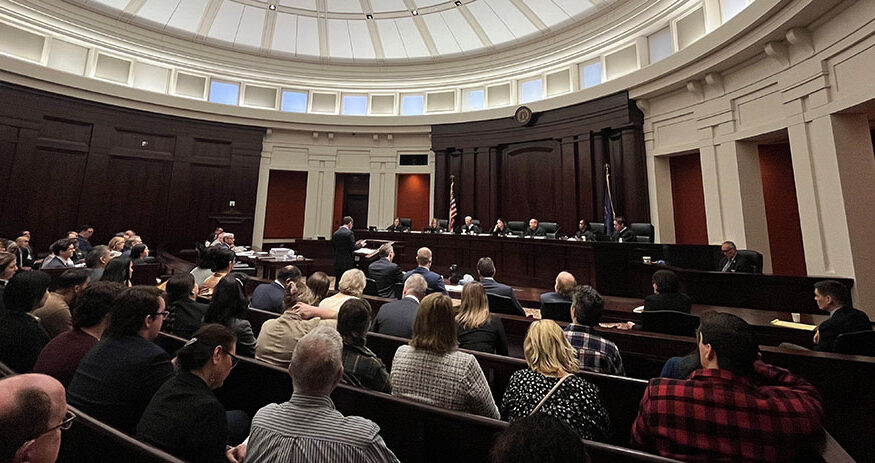
John Bursch, an attorney for Enbridge Energy, argues before the Michigan Supreme Court on Wednesday, March 11, 2026. (Photo: USA TODAY Network via Reuters Connect)
Michigan Supreme Court halts Line 5 tunnel project, orders more review
USA TODAY Network via Reuters Connect//August 3, 2026//


In Brief
- Michigan Supreme Court rules 6-1 to remand Line 5 tunnel approval.
- Justice Elizabeth Welch authors majority opinion on public trust.
- Enbridge‘s Line 5 pipeline continues operation amid legal battles.
- Tribes and environmental groups challenge tunnel under Michigan law.
LANSING, Mich. — A state regulatory body that took years to review the environmental effects of an oil pipeline tunnel under the Straits of Mackinac must go back to the drawing board under a Friday order issued by the Michigan Supreme Court.
The Supreme Court’s 6-1 decision found the Michigan Public Service Commission, while examining the environmental effects of tunnel construction, failed to consider how the continued operation of the controversial Line 5 oil pipeline and the accompanying continued consumption of hydrocarbons would impact the environment. The commission also failed to consistently examine potential alternatives and failed to take into account effects on public trust resources, the high court found.
The decision is likely to delay tunnel construction for years more. In the meantime, Enbridge’s 73-year-old twin oil pipelines sitting on the bottomlands of the Straits of Mackinac will continue transferring oil at the nexus of Lakes Huron and Michigan. Separate court efforts to shut down the existing line have failed.
“We conclude that the PSC erred by not examining whether the replacement project would be the proximate cause of further environmental harms by extending Line 5’s lifespan,” Justice Elizabeth Welch, a Democratic-nominated justice, wrote in the majority opinion. Welch is the former president of the Michigan League for Conservation Voters, a left-of-center environmental group.
State regulators failed to “determine whether the replacement project would ‘pollute, impair, or destroy’ the public trust,” Welch wrote in the ruling, issued on the last day of the court’s term.
The state court decision Friday came the same day the U.S. and Canadian governments asked a federal appeals court to reject Michigan’s separate legal efforts to shut down the existing pipelines resting on the lake bottom. The Trump administration argued the pipeline’s continued operation and safety falls under the exclusive jurisdiction of the federal government. Both governments argued Michigan’s efforts to shutter the line would negatively affect U.S.-Canada relations.
“The United States has a manifest interest in complying with its treaty obligations with all sovereigns, and in avoiding potential monetary liability if it is found to have breached those obligations,” the Trump administration said in its filing.
Prior to Friday’s high court ruling on the tunnel, lower courts had found the Michigan Public Service Commission had little authority to examine impacts on the public trust because it was an issue of common law and the regulatory body was a creature of the Legislature, which is largely superseded by common law.
That was an error, Welch wrote.
“On remand, the PSC must determine the replacement project’s effects on the public trust pursuant to the common-law principles discussed in this opinion.”
Justice Brian Zahra, the court’s only Republican-nominated justice, wrote in a dissent that the Michigan Public Service Commission’s expertise should be given some deference, not micromanagement, by the court. He also disagreed that the continued operation of Line 5, in and of itself, is an “adverse environmental effect of the replacement project.”
“This conclusion is poorly reasoned and illogical; worse yet, it creates a moral hazard,” Zahra wrote.
Zahra said he would remand the approval to the public service commission only for a specific review in light of the state’s duty to protect the public trust. But he also noted the MPSC’s final decision clearly considered the public trust, if not explicitly, when the panel observed impacts to residences, fauna, surface and ground water and even a nearby dark sky park.
“The opinion clearly addresses the substance of the public trust in the state’s natural resources,” Zahra wrote.
Michigan tribes who helped mount the challenge to the tunnel approvals celebrated Friday’s decision, arguing it was proof that “when people stand together with courage and conviction, change is possible.”
“This decision gives us another opportunity to honor our treaty rights, protect our waters, and consider the generations who will inherit this place,” said Whitney Gravelle, president of the Bay Mills Indian Community. “The Straits of Mackinac are not simply a route for an oil pipeline to be abused.”
Enbridge, in a statement, said it disagreed with the decision and was disappointed with the delay it will cause to the tunnel construction timeline.
“Enbridge continues to review the opinion and assess our legal options,” said Ryan Duffy, a spokesman for Enbridge, “but one thing remains unchanged: we are fully committed to the safe and responsible operation of Line 5, incorporating enhanced safety measures in the Straits and continuing to safeguard Michigan’s natural resources now and for future generations.”
The state court fight is one of several legal battles that Enbridge is engaged in at the state and federal levels over the future of the dual pipeline. Court decisions so far have allowed the continued operation of Line 5 where it currently sits on the underwater bottomlands of the Straits of Mackinac.
The Michigan Public Service Commission in December 2023 ruled that the relocation of Enbridge Energy’s Line 5 oil pipeline from the lakebed of the Straits of Mackinac to a yet-to-be-constructed tunnel beneath the lakebed was the “best option” to improve safety while still securing the “public need” for fossil fuels.
The groups challenging the approvals ― several Native American tribes and the environmental group For Love of Water ― have argued that the commission should have done a more comprehensive environmental review under the Michigan Environmental Protection Act and public trust doctrine. That review, they argued, should have included the environmental effects of the complete line, not just the Line 5 segment that runs through the Straits of Mackinac.
The 73-year-old twin span beneath the Straits of Mackinac transports about 540,000 barrels of light crude oil and natural gas liquids a day, and has long been a cause for concern among environmental groups and some government officials, who fear the catastrophic effects of an oil spill at the nexus of Lakes Michigan and Huron. Supporters of the pipeline have warned against closing the line out of concern for potential natural gas and oil shortages in Canada and the Midwest.
Attorney General Dana Nessel and Gov. Gretchen Whitmer both campaigned in 2018 on promises to shutter the line even as Republican former Gov. Rick Snyder, as he was leaving office, entered a deal with Enbridge requiring the Calgary, Alberta-based company to build a $500 million tunnel beneath the straits to house a new section of the pipeline.
Enbridge recently secured its last state-level permits for the project, prior to Friday’s decision.
Nessel and Whitmer both have pursued litigation to shut down the pipeline along the lake bottom but have so far been unsuccessful in their efforts. In federal court cases related to their litigation, Canada has intervened to prevent the shutdown and even invoked a never-before-used treaty to stop the state’s closure of the line.
Related Articles
Related Content





Top News
- Criminal defense lawyers have duty to use AI, paper argues
- Minnesota joins lawsuit challenging Trump’s latest tariffs
- Trump vowed to ‘bring free speech back.’ 75 rulings say he has stifled it
- After 36 years in U.S., Sheboygan woman spent 9 months in ICE detention
- League of Women Voters, environmental groups join Ojibwe against pipeline








Expert Testimony
- Perspectives: Taylor-Travis marriage recalls prenup laws here
- Quandaries & Quagmires: Fast-Tracking Temporary Lawyer Suspensions
- Perspectives: ‘Slam’ suits: Recalling wrestling cases as WWE arrives
- Best At Work Insights: We tore out the workforce backup generator
Legal Tech Directory


Legal Tech
- Criminal defense lawyers have duty to use AI, paper argues
- AI is reshaping family law practice, but attorneys worry about DIY research
- Massachusetts court rejects work product protection for AI documents by girlfriend


