


 Free Newsletter

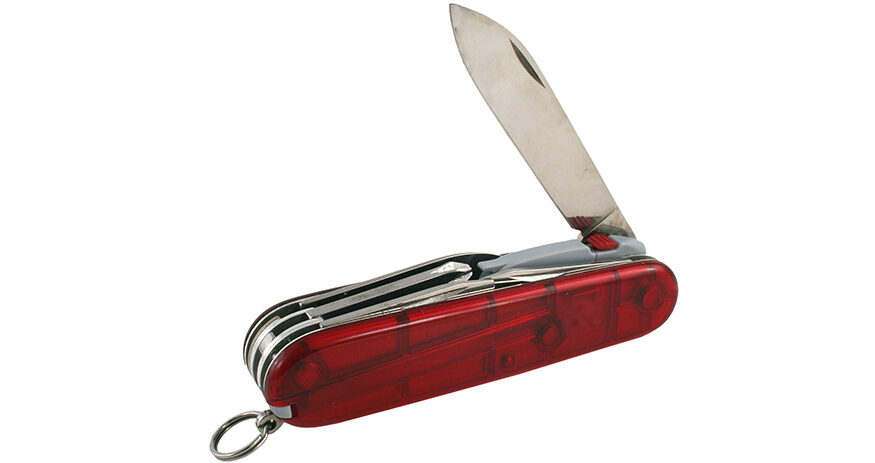
Deposit Photos image
Court of Appeals reverses burglary with knife conviction
Laura Brown//July 22, 2026//


In Brief
- Minnesota Court of Appeals reversed a first-degree burglary conviction involving a folding pocketknife.
- The court found the evidence failed to prove the pocketknife qualified as a dangerous weapon under Minnesota law.
- Judges emphasized the defendant never threatened, pointed, or advanced toward the postal worker with the knife.
- The case was reversed and remanded after the court found the circumstantial evidence supported a reasonable inference that the defendant was merely fidgeting with the knife.
A man was convicted of first-degree burglary following his entry to a Moorhead post office. That conviction was reversed after the Minnesota Court of Appeals determined that his folding pocketknife was not a “dangerous weapon.”
The Moorhead Post Office lobby remains open 24 hours a day for customers to access their mail. J.C., a window clerk working the overnight shift, heard shouting and loud banging that sounded like someone kicking mailboxes. When he entered the lobby, he found Abdirahman Mohamed Abdi pacing, wearing camouflage pants and a black coat. J.C. told Abdi several times that he could not remain in the lobby because sleeping there was prohibited. Abdi responded with apparently slurred, difficult-to-understand speech and did not leave.
Abdi sat behind a trash can in the corner of the lobby. J.C. then heard a clicking sound and saw what appeared to be a small silver folding pocketknife. Concerned for his safety, J.C. retreated behind a locked glass security door and called 911. While waiting for police, he observed Abdi sitting with the knife pointed toward the floor, tracing figure-eight patterns.
J.C. testified that Abdi never pointed the knife at him, threatened him, or attempted to approach him. However, he believed the knife was intended to discourage anyone from coming closer.
After noticing J.C. on the phone, Abdi walked out of the post office. Responding officers located and arrested him shortly afterward, recovering the folding pocketknife from his jacket pocket in the open position.
Abdi was charged with two counts of first-degree burglary, one alleging possession of a dangerous weapon and the other alleging assault of a person inside the building. He was also charged with second-degree assault with a dangerous weapon and fifth-degree drug possession. Before trial, Abdi pleaded guilty to the drug possession charge, and the remaining three charges were tried before a jury.
The district court instructed the jury that a dangerous weapon is a device designed as a weapon or one used or intended to be used in a manner likely to cause death or great bodily harm. Prosecutors argued that Abdi’s folding pocketknife met that definition because it could inflict serious injury and was displayed to intimidate the postal worker. The jury convicted Abdi of first-degree burglary while possessing a dangerous weapon.
Abdi moved for a judgment of acquittal, arguing the state failed to prove his folding pocketknife was a dangerous weapon. The district court denied the motion, finding the evidence was sufficient because Abdi displayed the knife during the confrontation and intended it to deter the postal worker from approaching him. Abdi was sentenced to 98 months in prison for the burglary charge.
Greg Scanlan, assistant public defender, represented Abdi. He said that Abdi was looking for a place to get warm in November 2024, and was resistant to J.C.’s instructions to leave. However, Scanlan maintained that Abdi was not using his pocketknife to threaten J.C.
“J.C. remained down a hallway at the back of the lobby, with his hand on a secure door that led to his work areas,” Scanlan said. “J.C. could only see the knife through the space under Abdi’s knees.”
“Abdi did not make eye contact, did not make any threats, or … raise the knife to show it to J.C.,” Scanlan added.
“Knives have many different uses,” Jackson Elmquist, assistant Clay County attorney, asserted. “One of them could be for attack or defense.”
“A three-inch blade could have the innocuous uses of cutting rope or opening packages, but it could also have the additional use of being a dangerous weapon,” Elmquist reiterated.
Abdi argued that the evidence was insufficient to prove his three-inch folding pocketknife qualified as a dangerous weapon under Minnesota law.
The Minnesota Court of Appeals agreed that the dangerous-weapon element was supported only by circumstantial evidence because the knife itself did not establish it was designed as a weapon. The court noted that folding pocketknives have many ordinary, lawful uses, such as opening packages, cutting rope, and camping. It also emphasized that knife lacked features commonly associated with combat or tactical knives, including a serrated edge, blood groove, or other specialized design. The court also stressed that Abdi never pointed the pocketknife at the postal worker, approached him with it, or otherwise used it in a threatening manner.
Abdi also argued that the state failed to prove beyond a reasonable doubt that he used or intended to use his folding pocketknife in a manner likely to cause death or great bodily harm. Applying the heightened circumstantial-evidence standard, the Minnesota Court of Appeals concluded the evidence supported a reasonable inference that Abdi was merely fidgeting with the knife rather than threatening the postal worker. The court noted that after a verbal exchange, Abdi retreated to a corner of the lobby, sat with his knees against his chest, and traced figure-eight patterns with the blade pointed at the floor. It again emphasized that Abdi never approached, lunged at, pointed the knife toward, or verbally threatened J.C., and the knife remained on the side of his body farthest from the employee. Finding that the evidence did not establish that Abdi intended to use the knife as a dangerous weapon, the court reversed and remanded the conviction.
Related Articles
Related Content






Legal Tech
- How ransomware tactics against law firms are changing
- How large language models are leveling the personal injury playing field
- Attorney Share, Lawmatics integrate to automate law firm referrals
Top News
- Court of Appeals reverses burglary with knife conviction
- Court-appointed U.S. attorney for Seattle sues over firing by Trump
- Senate Democrats demand investigation into ouster of IRS lawyer
- White House lawyer confirmed to judgeship after bashing senators
- Administration pauses $1B in Medicaid payments to Minnesota, California








Expert Testimony
- Legally Speaking: How communication failures turn disputes into lawsuits
- Perspectives: Umpire’s death recalls case law in Minnesota
- Perspectives: It’s not ‘football’ here, but soccer cases abound
- AI prompts used by experts may be discoverable


