


 Free Newsletter

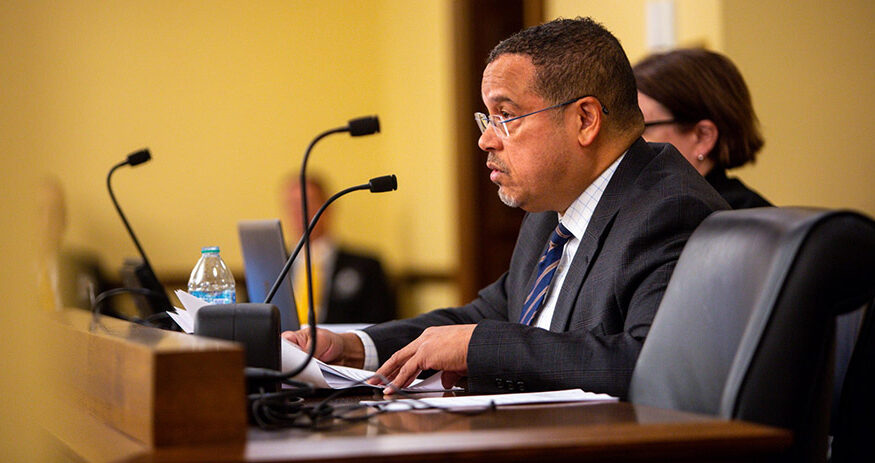
Attorney General Keith Ellison was a named defendants in the federal government's unsuccessful challenge to Minnesota college tuition laws. (Photo: USA TODAY Network via Reuters Connect)
Court dismisses U.S. challenge to Minnesota tuition laws
Laura Brown//March 31, 2026//


 Listen to this article
In Brief:
- Federal court ruled the U.S. lacked standing to challenge Minnesota tuition statutes.
- Judge held Minnesota tuition benefits are not based on residency.
- Laws allow undocumented students to qualify for in state tuition and North Star Promise aid.
- Court found no conflict or preemption under federal immigration law.
The state of Minnesota and elected officials were sued over state laws granting tuition benefits to undocumented students, which the U.S. government claimed violated federal law and were preempted. The U.S. District Court for the District of Minnesota held March 27 that there was no sufficient enforcement authority to give the U.S. standing and dismissed the claims, and it concluded that Minnesota’s statutes do not violate a federal law.
The case centered on 8 U.S.C. § 1623, a federal law that prohibits states from giving postsecondary education benefits to undocumented noncitizens based on residency unless at least one U.S. citizen can receive the same benefit regardless of residency.
In June 2025, the United States filed a lawsuit alleging that several Minnesota laws granting tuition benefits to undocumented noncitizens violated federal law and were preempted. Named defendants included the state of Minnesota, the Minnesota Office of Higher Education, Gov. Tim Walz, and Attorney General Keith Ellison. The federal government sought a declaratory judgment and a permanent injunction to prevent the enforcement of the laws.
Three interrelated Minnesota statutes were targeted. Minn. Stat. § 135A.043 allows students to receive in-state tuition if they attended a Minnesota high school for 3-plus years and graduated. Undocumented students can qualify by meeting those requirements and providing selective service registration and proof of applying for legal status if available. The statute does not require lawful immigration status.
Minn. Stat. § 136A.101, subd. 8 incorporates § 135A.043 by making eligibility for resident tuition one way to qualify as a “resident student.” That “resident student” status is then used in Minn. Stat. § 136A.1465 to determine eligibility for the North Star Promise program. The North Star Promise, enacted in 2023, provides state-funded scholarships covering tuition and fees for eligible students at Minnesota public colleges.
When read together, the statutes allow undocumented noncitizens to qualify for free tuition under the North Star Promise program. The United States argues that this violates federal law by giving benefits based on residence to noncitizens but not equally to U.S. citizens.
U.S. District Judge Katherine Menendez held that the United States lacked standing to sue Walz because his duty under the “Take Care” clause did not establish a sufficient connection to enforcing the challenged statutes. Citing repeated rulings from the 8th U.S. Circuit Court of Appeals, Menendez explained that a governor’s broad constitutional responsibility is not enough without a specific enforcement mechanism. Menendez also rejected arguments based on Walz’s authority over agency officials and his public support for the program.
Menendez reached the same conclusion for Attorney General Keith Ellison. Although the United States argued that Minn. Stat. § 8.01 gives the attorney general enforcement authority, Menendez found that the statute only allows him to appear in or intervene in cases, not to independently enforce the laws at issue.
Menendez also found that 8 U.S.C. § 1623 did not preempt Minnesota’s tuition statutes. Section 1623 prohibits states from granting postsecondary education benefits to undocumented individuals “on the basis of residence” unless U.S. citizens can receive the same benefits regardless of residency. Menendez focused on interpreting two key phrases: “on the basis of residence” and the requirement involving eligibility for “a citizen.”
The judge held that Minnesota’s resident tuition statute does not grant benefits “on the basis of residence.” Applying ordinary meaning, the phrase requires a but-for causal link between residency and eligibility. However, Minnesota’s law bases eligibility on high school attendance and graduation within the state—not on where a student lives. Because some nonresidents can qualify (such as students attending Minnesota schools while living in neighboring states or at boarding schools), residency is not a necessary condition. Without this causal link, § 1623 does not apply.
Additionally, Menendez looked at 1623’s requirement that benefits be available to “a citizen” regardless of residency. It rejected the federal government’s argument that this means all U.S. citizens must qualify. Instead, relying on ordinary usage and case law, Menendez interpreted “a” to mean any or at least one citizen. Because some nonresident U.S. citizens can qualify under Minnesota’s criteria, this requirement is satisfied. Because the judge concluded that Minnesota’s statutes neither base eligibility on residency nor exclude all nonresident citizens, they did not conflict with § 1623 and were not preempted by federal law.
Related Content





Top News
- DOJ hires ‘deportation judges’ with less training, experience
- High court justices turn children’s books into big paydays
- Perspectives: Law Day: Notable Supreme Court quotes
- Wisconsin judge allows use of ex-Trump attorney’s statements in fake elector case
- Court of Appeals rejects increased sentence after case remanded
- Commentary: What can we learn from a secret act of judicial tyranny?
- Supreme Court approval dips amid tariff ruling divide








Expert Testimony
- Perspectives: Law Day: Notable Supreme Court quotes
- Commentary: What can we learn from a secret act of judicial tyranny?
- Perspectives: Actor’s death recalls key defamation case here
- Best at Work Insights: Why employee growth matters more than salary


