


 Free Newsletter

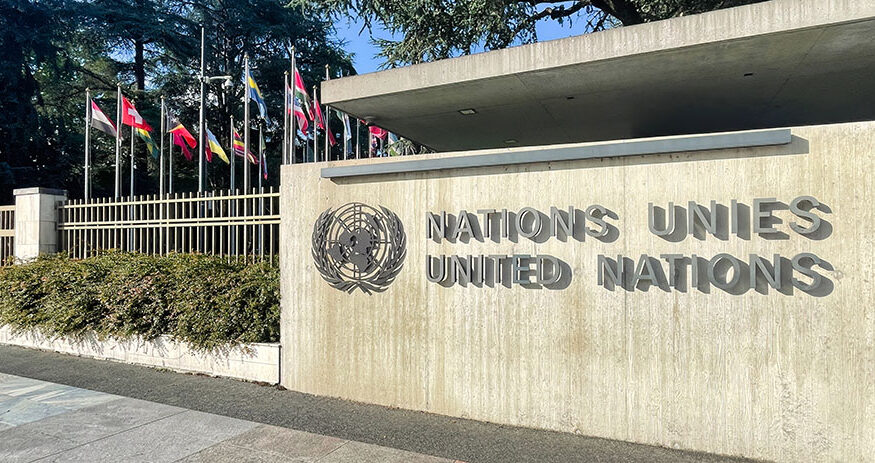
National flags of U.N. member states outside the Palace of Nations in Geneva, Switzerland. (Deposit Photos)
Minnesota lawyers tell U.N. of ICE enforcement impacts
Laura Brown//March 5, 2026//


In Brief
- Minnesota attorneys briefed the U.N. Human Rights Council on the impacts of intensified ICE immigration enforcement.
- Panelists described arrests at formerly protected locations such as schools, hospitals, and places of worship.
- Lawyers said immigration enforcement has disrupted courts, communities, and children’s access to education.
- Advocates warned that federal actions and pressure on law firms could threaten civil liberties and judicial independence.
Several Minnesota attorneys traveled to Geneva, Switzerland, for a March 4 U.N. Human Rights Council briefing regarding intensified immigration enforcement and its impacts on people as well as legal institutions.
Attorneys on the panel were guided by Amanda Lyons, executive director of the Human Rights Center at the University of Minnesota. While the panel was there to share its very hyper-local experience in Minnesota, Lyons said she thought the audience would see the threads with citizens across the world witnessing the “erosion of the rule of law.”
Panelists included Sarah Brenes, executive director of the James H. Binger Center for New Americans; Michele Garnett McKenzie, executive director for the Advocates for Human Rights; Jan Conlin, founding partner at Ciresi Conlin LLP as well as a volunteer for the Advocates for Human Rights; and Jessica Klander, shareholder and president at Bassford Remele and president of the Hennepin County Bar Association.
Brenes set the scene by describing how, within days of President Donald Trump taking office in 2025, there was an important memo that rescinded a long-standing policy for immigration officers not to do enforcement in protected areas. The areas included preschools, higher education institutions, hospitals, places of worship, domestic violence shelters, food pantries, and hospitals. Additionally, civic and cultural gathering places, which includes weddings, funerals and parades, were on the list.
“We can probably give you an example of every one of these places where there was an enforcement action,” Brenes said. “That was a signal to the community [that] taking away those protected spaces would have a drastic impact on immigrant communities.”
Brenes also relayed incidents in which officers kicked people’s doors down, broke windows of cars, and ran cars off the road. In another incident, ICE allegedly brought a man to the hospital with a skull fracture and claimed that he had injured himself while handcuffed. “That’s just one of many examples,” Brenes said.
Brenes detailed ways that “immigration enforcement services are detaining people and having them be incommunicado from their family for days or weeks.” She said that this included not posting information about where they are, not having working phones, or transferring people multiple times to different detention facilities. Brenes says that in cases where the individuals were released, they were frequently released far from home and not given their identity documents, making returning home quite challenging.
She also noted that, when individuals have tried to hold the government accountable and establish the legality of their detention, the government has refused to comply with court orders to release the individuals when the court has found that their detention was unlawful.
Conlin spoke about the impact that immigration enforcement efforts have had on Minnesota children. “It has been incredibly traumatic for the people of Minneapolis, and the children in particular,” Conlin stated. “If you think about it, you’ve got men in tactical gear and long guns, more suited to war than standing on a street corner, as kids are trying to get on the bus.”
Minneapolis Public Schools canceled classes for a few days. While most students returned, Conlin reported that not all students of color returned. “Unlike COVID, which was a shared experience among children of the United States, this is not that. The only kids showing up remotely were kids of color,” Conlin said. This has also had nutritional impact on children who rely on free breakfast and lunch at school.
While the ICE presence in Minneapolis is reduced, Conlin said, it remains large enough to cause fear. “Families are afraid to leave their houses,” Conlin stated. “Kids can’t learn if they don’t feel safe.”
Garnett McKenzie echoed the other panelists’ description of the impacts on Minnesotans: “This is truly breathtaking to have our colleagues followed on the street, to have ICE show up at protesters’ homes ahead of them, telling them, ‘We have tracked your location using facial recognition, or license plate readers. We know where you live, and we’ll show you that.’” Garnett McKenzie also reported government officials stating that ICE officials surveilled them by filming their property, standing outside their homes, and intimidating their staff.
However, Garnett McKenzie emphasized that these actions, while reprehensible, are not new. “Very little has changed in the law around immigration enforcement. The spotlight is on us now, and we can see the impact at scale of the investment in detention infrastructure, the refusal to follow court orders, things like that,” Garnett McKenzie said. “We are seeing them at scale now, but they have been a feature of the U.S. immigration law for years.”
Garnett McKenzie also warned about the consequences of immigration enforcement not just for immigrants, but also for United States citizens. “All of this is a precursor, of course, to greater repression of civil liberties,” Garnett McKenzie said.
“We do know that immigrants and refugees in Minnesota are the target of this operation. But they are not the end-game,” Garnett McKenzie avowed. “This is about strengthening the government apparatus to intimidate and harass, and making it normal to arrest, detain, disappear people who don’t agree with them.”
Klander also spoke, emphasizing the effects of immigration enforcement on the courts themselves as well as judicial independence, but situating it among broader domestic and international tensions involving constitutional governance in the United States.
For instance, Klander spoke on backlash against law firms for challenging the federal government, as well as pressure to eliminate DEI programs at firms. She said that these pressures “produce a chilling effect across the legal community.”
“We’re seeing attorneys reluctant to be publicly identified in matters involving criticism of the federal government, and law firms and businesses that have historically spoken out during moments of constitutional crisis, have remained silent for fear of retribution,” Klander stated. “That silence is shocking for the legal community of Minnesota and the country, and it’s one important indicator of institutional strain.”
Klander also spoke about effects on the actual judicial structure in Minnesota. “The impact of federal operations on our courts has been tangible.” Klander noted U.S. District Court for the District of Minnesota Chief Judge Patrick’s Schiltz’s recent court order in which he noted that federal authorities have violated over 200 court orders. “Such findings are extraordinary,” she emphasized. “They reflect not just disagreement but a breakdown in adherence to judicial authority.”
Klander also noted that ICE agents had been present at courthouses, causing disruption. “Courthouses must remain neutral forums for the resolution of disputes. When they become places of fear, access to justice suffers,” Klander said.
All of the panelists, brought their remarks back to Lyons’ comments that, while the discussion was on Minnesota, the impacts had national and international implications. “What we are experiencing locally, in terms of the independence and functionality of the legal system, reflects larger national trends and threatens democratic institutions, the separation of powers, and the rule of law,” Klander maintained.
Related Articles
Related Content





Legal Tech
- New dedicated coverage of tech challenges facing law firms and legal departments
- Gemini Legal launches DraftEngine for civil litigation forms
- Lawyers continue to grapple with AI ethical issues
Top News
- Applications sought for 5th District judgeships
- Federal judge denies online casino’s arbitration bid
- Legal group warns abortion opponents to stop ‘twisting’ mom’s story
- Ramsey County sues DHS over Thao investigation records
- Breaking the Ice: Immigration roundtables offer connection, strategy







Expert Testimony
- Perspectives: It’s not ‘football’ here, but soccer cases abound
- AI prompts used by experts may be discoverable
- Perspectives: 250th anniversary recalls Declaration decisions
- Perspectives: ‘Pentagon Papers’ case at 55 not far from Near


