


 Free Newsletter

Supreme Court signals support for transgender sports bans
Andrew Chung and John Kruzel, Reuters//January 13, 2026//
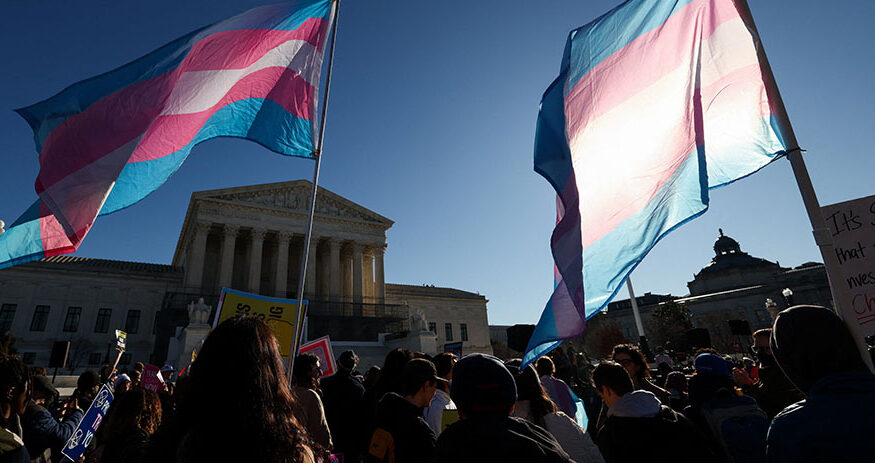
Demonstrators carry transgender flags outside the U.S. Supreme Court in Washington, D.C., on January 13, 2026. (Reuters: Kevin Lamarque)
Supreme Court signals support for transgender sports bans
Andrew Chung and John Kruzel, Reuters//January 13, 2026//


In Brief
- Supreme Court heard challenges to transgender sports bans in Idaho and West Virginia.
- Conservative justices signaled support for laws separating teams by biological sex.
- States argue bans protect fairness in women’s and girls’ athletics.
- Rulings could affect broader transgender rights under Title IX and the Constitution.
WASHINGTON — Conservative U.S. Supreme Court justices signaled sympathy on Tuesday toward the legality of state laws banning transgender athletes from participating on female sports teams amid escalating efforts nationwide to restrict the rights of transgender people.
The justices heard arguments in appeals by Idaho and West Virginia of decisions by lower courts siding with transgender students who challenged the bans in the two states as violating the U.S. Constitution and a federal anti-discrimination law. Twenty-five other states have similar laws on the books.
The Supreme Court, which has a 6-3 conservative majority, backed other restrictions on transgender people in rulings issued last year.
President Donald Trump’s administration defended the laws during the arguments.
“Obviously, one of the great successes in America over the last 50 years has been the growth of women’s and girls’ sports. And it’s inspiring,” conservative Justice Brett Kavanaugh said.
Kavanaugh noted that the federal government, certain states, the NCAA governing body for college sports and the U.S. Olympic Committee “think that allowing transgender women and girls to participate will undermine or reverse that amazing success, and will create unfairness.”
Alan Hurst, Idaho’s solicitor general arguing for the state, touched on that issue early in the arguments.
“If women don’t have their own competitions, they won’t be able to compete,” Hurst said.
“Idaho’s law classifies on the basis of sex, because sex is what matters in sports,” Hurst told the justices. “It correlates strongly with countless athletic advantages, like size, muscle mass, bone mass and heart and lung capacity.”
Wider repercussions
The case could have wider repercussions for transgender people and affect whether other measures targeting them in the public sphere — including military service, bathroom access, treatment in classrooms and designations in official documents such as passports — can be enforced.
The Idaho and West Virginia laws designate sports teams at public schools including universities according to “biological sex” and bar “students of the male sex” from female athletic teams. The states said the laws preserve fair and safe competition for women and girls.
“Gender identity does not matter in sports, and that’s why Idaho’s law does not classify on the basis of gender identity. It treats all males equally and all females equally regardless of identity. And its purpose is exactly what the (state) legislature said – preserving women’s equal opportunity,” Hurst said.
The challengers claimed that these measures discriminate based on an individual’s sex or status as a transgender person in violation of the Constitution’s 14th Amendment guarantee of equal protection under the law, as well as the Title IX civil rights statute that bars discrimination in education “on the basis of sex.”
Justice Department lawyer Hashim Mooppan argued for the Trump administration in defending the state laws.
“It is undisputed that states may separate their sports teams based on sex in light of the real biological differences between males and females. States may equally apply that valid sex-based rule to biological males who self-identify as female,” Mooppan told the justices.
“Denying a special accommodation to trans-identifying individuals does not discriminate on the basis of sex or gender identity or deny equal protection. All of that remains true even assuming a man could take drugs that eliminate his sex-based physiological advantages,” Mooppan said.
West Virginia Solicitor General Michael Williams, arguing for the state, called the challenge a “backdoor attack on Title IX.”
The challenger to his state’s law, Williams added, “says that West Virginia schools can no longer designate teams by looking to biological sex. Instead, schools must place students on sports teams based on their self-identified gender. But that idea turns Title IX – a law Congress passed to protect educational opportunities for girls – into a law that actually denies those opportunities for girls. The court should not embrace that backwards logic.”
The plaintiffs contend that the use of puberty blockers or gender-affirming hormones by transgender students should matter regarding whether states can lawfully apply these bans because these medications may prevent or eliminate sex-based physical advantages. The states argue such advantages remain despite medical treatments.
“In short, male athletes who take performance-altering drugs are not similarly situated to female athletes, and states need not treat them the same,” Mooppan said.
Kathleen Hartnett, representing the plaintiff who challenged Idaho’s law, said her client mitigated the competitive advantage through the use of testosterone suppressants and estrogen, eliminating the ban’s justification.
Conservative Justice Samuel Alito asked Hartnett to address some of the concerns expressed about transgender women athletes.
“There are an awful lot of female athletes who are strongly opposed to participation by trans athletes and competitions with them,” Alito said. “What do you say about them? Are they bigots? Are they deluded in thinking that they are subjected to unfair competition?”
A ‘lousy’ tennis player
Conservative Justice Clarence Thomas wondered if there were any difference between what the transgender plaintiffs are seeking and a “lousy” male tennis player who wants to try out for the women’s team who says, ‘There is no way I’m better than the women’s tennis players.’“
“It’s not at all different,” Hurst replied.
Some of the justices focused on how the Idaho law treats people differently, whether based on sex or their status as transgender individuals, and whether that would require the court to more skeptically review the reasons expressed by the states for adopting such measures – a form of judicial review called intermediate scrutiny.
“There’s no question here that a male who identifies as a female, but is a male, is being excluded from a female sport,” liberal Justice Sonia Sotomayor told Hurst. “By its nature, that’s a sex classification. And all sex classifications, we have said repeatedly in our case law, require intermediate scrutiny.”
A history of discrimination
The court in 2020 delivered a landmark ruling protecting transgender people from workplace discrimination under a different law, called Title VII, that contains wording similar to Title IX.
Conservative Justice Neil Gorsuch, who authored the Title VII decision, questioned Hurst’s claim that the Idaho law does not classify people based on transgender status.
Gorsuch asked Hurst about discrimination in the United States against transgender people in areas such as immigration and family law and statutes involving cross-dressing. “A laundry list,” Gorsuch said.
“There has been some discrimination against transgender people – significant discrimination against transgender people – in the history of this country. The same can be said of many groups,” Hurst responded.
Hurst noted, for example, that women and Black people in the past were barred from voting or property ownership, and said of the discrimination questions raised in the current transgender case: “These things don’t compare. They’re just not alike.”
Testosterone monitoring
Liberal Justice Ketanji Brown Jackson pushed back on Hurst’s contention that it would be too difficult for Idaho to determine on a case-by-case basis whether a transgender woman would have a competitive advantage in women’s sports.
“Why is that so non-administrable?” Jackson asked.
“Your honor, making sure that a transgender athlete … does not have an unfair advantage would require ongoing testosterone monitoring, because, certainly, testosterone can fluctuate,” Hurst said. “That is invasive. That is intrusive. That is expensive.”
The Supreme Court last year in a case from Tennessee let states ban gender-affirming medical treatments for minors. It also let Trump ban transgender people from the military and bar passport applicants from selecting the sex reflecting their gender identities for the document.
The Republican president since returning to office last year has cast the gender identity of transgender people as a lie and issued multiple executive orders to limit their rights including one involving sports participation.
The West Virginia challenge was brought by Becky Pepper-Jackson and her mother. Pepper-Jackson, 15, competes in shot put and discus in high school.
The Idaho challenge was brought by Lindsay Hecox, a transgender Boise State University student who previously participated in soccer and running clubs at the public university. Hecox, 25, has decided to quit playing sports and sought to dismiss the case in part due to a fear of harassment and growing intolerance toward transgender people. Hurst argued that this does not make Hecox’s challenge moot.
Related Content






Top News
- Justices fault closing argument, overturn fentanyl conviction
- This federal judge ruled against Trump. Then the threats began.
- Judge’s gift-giving attempt leads to sex-trafficking sentence being tossed
- Breaking the Ice: Attorney steps up to plate for HCBA Softball League
- Groups ask Court of Appeals to review dairy expansion decision








Expert Testimony
- Perspectives: Taylor-Travis marriage recalls prenup laws here
- Quandaries & Quagmires: Fast-Tracking Temporary Lawyer Suspensions
- Perspectives: ‘Slam’ suits: Recalling wrestling cases as WWE arrives
- Best At Work Insights: We tore out the workforce backup generator
Legal Tech
- Criminal defense lawyers have duty to use AI, paper argues
- AI is reshaping family law practice, but attorneys worry about DIY research
- Massachusetts court rejects work product protection for AI documents by girlfriend


