


 Free Newsletter

Perspectives: Mitchell Hamline at 125 learns from past litigation
Marshall H. Tanick//December 15, 2025//
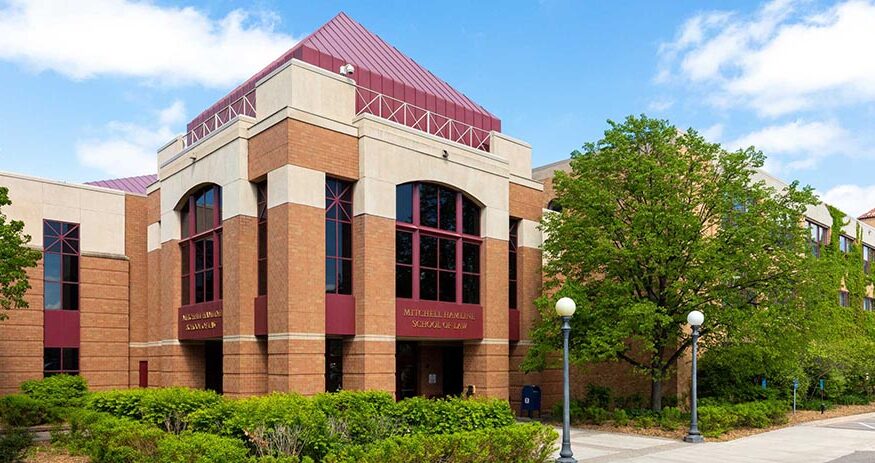
Submitted photo: Mitchell Hamline School of Law
Perspectives: Mitchell Hamline at 125 learns from past litigation
Marshall H. Tanick//December 15, 2025//


 Listen to this article
Mitchell Hamline School of Law is celebrating its 125th anniversary this year. Since its creation as the St. Paul College of Law in 1900, it has expanded substantially while educating thousands of attorneys, judges, and others in Minnesota and other states, including Warren Burger, a St. Paul native, who served as Chief Justice of the United States from 1969 to 1986.
The school changed its name to William Mitchell in 1956 after its namesake, the former legislator, 19-year state Supreme Court justice, and initial dean. In addition to its 125th anniversary, the school now known as Mitchell Hamline School of Law is completing commemoration of the 10th year of its merger with Hamline Law School, an institution that dates back to 1973. The dual commemorations drawing to a conclusion provides an opportune occasion to review 10 of its cases, nearly all victories, as the first semester of its 125th anniversary comes to a close.
Early evening
When opened in 1900, the college was an evening night school with an annual $60 tuition, making it accessible for working individuals, a posture it maintained for years. The institution these days is primarily a day school, with students paying tuitions of $27,650 annually, an increase of more than 460 times since its inception.
The school expanded its footprint with the state’s first weekend law degree program, one of only a few in the country. The most recent enlargement occurred in 2015, the year of the amalgamation with Hamline, when it pioneered a part online/part in-person J.D. degree program, known as “blended learning.”
This year, the school has put together a wide variety of commemorative events. It also welcomed 378 incoming full- and part-time attendees from 42 states, the District of Columbia, and two Canadian provinces, along with 16 Native Americans, consisting of the largest such contingent of tribal nation members at any American law school. They comprise the current enrollment this year of about 1,200 students.
They join some 700-plus law students at the University of Minnesota and another 476 at the University of St. Thomas, totaling close to 2,500 aspiring lawyers in this state.
“I went to law school. I found it interesting for the first three weeks.”
Comedian Demetri Martin (1973 – )
* * * * * * * * * *
“I believe that law schools would probably be wise … being two years instead of four years.”
Former President Barack Obama (August 23, 2013)
* * * * * * * * * *
“[A] law school belongs in the modern university no more than a school of fencing or dancing.”
Sociologist and economist Thorstein Veblen (1857 – 1929)
Student suits
Several students have cut their teeth on litigation pop by becoming litigants themselves.
Going back nearly 50 years, a couple of lawsuits were brought by students at Hamline Law School, long before it became affiliated with William Mitchell.
An important one that established standards for challenging ejections at university level was Abbario v. Hamline University School of Law, 258 N.W.2d 108 (Minn. 1977) in which an expelled student sought reinstatement after he was removed for failure to maintain a minimum grade point average during his first two years and one semester. The student claimed a number of deficiencies in how the matter was handled by the school, including inconsistent grading system and an arbitrary alteration to his grades, as well as lack of a hearing before expulsion. The Ramsey County District Court dismissed the lawsuit for failure to state a claim due to lack of “state action” by the private school.
The Supreme Court, however, treated the matter as one of “state action” based upon the allegations in the pleadings, citing some case law to that effect, even though Hamline was a private school. On the merits, the court, however, was reluctant to delve into the details of the expulsion for academic reasons, noting that a more rigorous review may be appropriate for alleged misconduct that is “not directly related to academic proficiency.”
However, the tribunal stated that the standard for reviewing a student’s expulsion is whether the ejectment resulted from “arbitrary, capricious, or bad faith actions” of the university officials. Since the issue before the court was solely on the allegations of the complaint, there was sufficient allegations pled to allow the lawsuit to proceed, although one of the claims for breach of contract due to the failure to provide tutorial seminars as represented in the school bulletin, was not actionable. The ruling, thus, allowed to proceed with his lawsuit, except for the breach-of-contract claim.
A federal court lawsuit by an expelled student from Hamline Law School for failure to make passing grades turned on reinstatement in Miller v. Hamline University School of Law, 601 F.2d 970 (8th Cir. 1979). The student was informed of his grade deficiency and impending dismissal for academic failure and allowed to present a request for readmission and given the opportunity to privately contact members of the admissions committee. These features contributed all of which contributed to a determination by U.S. District Court Judge Earl R. Larson that the student had been treated fairly and, therefore, should not be reinstated.
The 8th U.S. Circuit Court of Appeals affirmed, holding that there was sufficient grounds to expel the student, who was not denied due process, even though he was not allowed to appear before the admissions committee at a formal hearing. It relied upon a decision a year earlier by the U.S. Supreme Court in Board of Curators v. Horowitz, 435 U.S. 78 (1978) in which the court held that less stringent procedural requirements exist for dismissal based on academic matters, rather than disciplinary reasons. The court held that “a hearing is not required by the Due Process clause of the 14th Amendment,” which was fatal to Hamline student’s lawsuit.
More than a decade later, administrators at William Mitchell and Hamline, joining those at the University of Minnesota, petitioned the Supreme Court to direct the state Board of Law Examiners to delete three questions on the bar exam seeking information about mental health treatments for barred applicants in In re Petition of Frickey, 515 N.W.2d 741 (Minn. 1994).
The administrators, consisting of deans and faculty members for the three schools, asserted that the inquiry might violate the Americans With Disabilities Act and its counterpart provision under the Minnesota Human Rights Act; might unduly deter students from seeking mental health counseling; constituted an invasion of privacy; and possibly had disparate negative impact upon some women applying for bar admission.
Noting that the questions had been asked as part of the “character and fitness standards,” adopted by the court in 1988, the admissions board viewed them as necessary and reasonable to obtain the information regarding “fitness of applicants for the practice of law.” But the court ordered the questions stricken and answers disregarded that may have already been made to those questions for the pending bar examination. Although there was “doubt” about the applicability of the ADA, the prospect of having to provide mental health information in order to practice law was deleterious because it could cause many law students not to seek necessary counseling, and information relating to conduct can generally be elicited through other questions relating to past conduct to “protect the public from unfit practitioners.”
Compensation & confidentiality
A pair of cases a little over a decade ago concerned unemployment compensation and confidentiality of information from law school.
In Savard v. William Mitchell College of Law, 2013 WL 5021686 (Minn. App. Sept. 16, 2013) (nonprecedential), a part-time security officer at William Mitchell who also held a full-time job as an auditor with the Minnesota Department of Revenue sought unemployment compensation benefits after he was laid off from his Revenue Department job. An unemployment law judge (ULJ) determined that he was not entitled to obtain credits for his part-time work at William Mitchell that would elevate the amount of his unemployment benefits on grounds that wages earned with educational institutions “cannot be used as a basis for unemployment benefits during the break between school year terms” under Minn. Stat. § 268.085, subd. 7(a).
The Court of Appeals affirmed, rejecting the employee’s contention that the statute was inapplicable because he was a permanent part-time security position who “happens to work at an educational institution.” But the ULJ’s conclusion that there is “no exemption in the statute for year-round employees” negated that claim. The statute covers any exclusionary employee because there was no “reasonable assurance that the security job would be continued following summer break,” which activated the statutory bar. The ULJ’s conclusion that the clause prohibited use of his Mitchell wages to calculate unemployment benefits between “successive academic years or terms,” applied and, thus, his base period wages for determining his benefits could not include the period that he was not working during the summer.
A case of greater juridical magnitude also resulted in defeat for a student in Magee v. Trustees of the Hamline University, 747 F.3d 532 (8th Cir. 2014). The case was brought by a well-known civil rights activist and occasional political candidate who was a professor at Hamline Law School before she was terminated, which she alleged was the result of a conspiracy between the school administrators and the St. Paul police union because she had authored a newspaper article criticizing a judicial decision not to investigate allegations of racism in a trial of the murder of a St. Paul police officer.
She claimed that the termination violated her constitutional right to freedom of speech, a contention rejected by U.S. District Court Judge John Tunheim, who adopted a report and recommendation by Chief Justice Arthur Boylan, as did the 8th U.S. Circuit Court of Appeals.
The appellate court held that the reason for her termination was not to suppress her constitutional rights but because she had been charged with income tax violations, and had been convicted of four gross misdemeanor tax violations. The constitutional claim was not actionable because the university and the dean of the law school, who both combined to terminate her, were not acting under color of state law to invoke constitutional rights under the federal Civil Rights Act, 42 U.S.C. § 1983.
Furthermore, the union of police personnel’s decision to boycott the university did not sustain a constitutional claim because it did not constitute “joint activity” with the state to establish the requisite “state action,” for a constitutional claim.
Approaching appeals
As the 125th anniversary approached during this decade, a quartet of other cases concerned the combined Mitchell-Hamline.
A pair of more recent appeals involved students from outside of Minnesota seeking to sue the school in their home states.
A New Jersey resident sued after his application to attend the law school was accepted but then rescinded after the school became aware of several criminal violations and convictions that he had failed to disclose on his application. But the court there dismissed the lawsuit on grounds of lack of personal jurisdiction over the school because there was no showing of any of the claims arose out of or related to Michell Hamline’s contacts with New Jersey, which negated “specific personal jurisdiction” over the institution. Gorbaty v. Mitchell Hamline School of Law, No. 20-745 (PAM/KMN) (D.N.J. 2019).
An out-of-state law student aspirant from New Mexico sued the school in Johnson v. Mitchell Hamline School of Law, No. 1:23 cv-00224-LF (D.Minn. March 22, 2023). The bizarre compliant asserted the claimant had suffered “Torture and Murder of [her] self and family and friends with career-ruining nightmares forever,” which apparently were attributed the law school in some unspecified way. The U.S. District Court in New Mexico did not pass upon the merits of the case, but instead, transferred it to a federal court in Minnesota under the federal venue shifting statute, 28 U.S.C. § 1391(b) since there were “no allegations that any of the events or omissions” underlying the case occurred in New Mexico.
In Brown v. Mitchell Hamline Law School, Case No. 22-cv-00982 (D. Minn. Jan. 6, 2023), a student’s claim against the law school for violation of her rights under the ADA was dismissed by U.S. District Court Judge Nancy Brasel after a short-lived nine-month existence in federal court here.
Last year, the school’s students who run Equal Protection Project (EPP) filed a civil rights lawsuit with the Department of Education Department for Civil Rights against the law school in Equal Protection Project v. Mitchell Hamline School of Law, OCR No. 05-24-2493 (July 29, 20024). The claim alleged that the law school, a recipient of federal funding, maintains a “racially discriminating mentor program for aspiring lawyers” known as the MABL Law School Pathways Program, which allows only Black students to participate, which the complaint alleges discriminates against other students based on race, in violation of Title VI of the Federal Civil Rights Act of 1964. Th complaint asks for the civil rights office to investigate the matter and impose appropriate “remedial relief … for the benefit of those who have been illegally excluded” from the program due to “radically discriminatory criteria” and for injunctive relief regarding future participation in the pathways project.
The action was one of a number of similar ones filed by that organization against various institutions of higher learning concerning racially conscious programs that exclude others from participation, as a follow-up to the decision of the U.S. Supreme Court in Students for Fair Admission v. Harvard, 600 U.S. 181 (2023), which bars racially conscious or preferential admissions programs to both public and private colleges under the 14th Amendment to the U.S. Constitution for public institutions and under the Federal Civil Rights Act for private ones.
These cases reflect that Mitchell Hamline is not only an educator of the law but a participant in it.
Happy 125th Anniversary to it!
PERSPECTIVE POINTERS
Some National Law School Data
Enrollment of women: 56.25%
Enrollment of men: 42.85%
Enrollment in 2024: 138,993
Attrition rate, 1st year: 20%
Attrition rate before graduation: 38%
Average loan debt upon graduation: $30,000
Number of law students in debt at graduation: 71%
Marshall H. Tanick is an attorney with the Twin Cities law firm of Meyer, Njus, Tanick, Linder & Robbins, PA.
Related Articles
Related Content





Top News
- Judge rules DOGE’s cuts to humanities grants were unconstitutional
- Divided appellate panel revives golf ball home damage lawsuit
- Roberts laments perception of Supreme Court as ‘political actors’
- How Minnesota immigration blitz hobbled federal crime fighting
- Breaking the Ice: Wrongful death verdict ‘fulfilling on different level’
- Minnesota social media warning law faces First Amendment suit
- Wausau attorney accused of intimidating victim pleads not guilty








Expert Testimony
- Perspectives: Daily’s 125th at ‘U’ recalls varied cases
- Commentary: Will SCOTUS rule on general warrants and 4th Amendment?
- Perspectives: Law Day: Notable Supreme Court quotes
- Commentary: What can we learn from a secret act of judicial tyranny?


