


 Free Newsletter


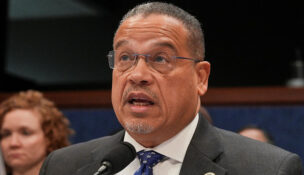
State Public Defender Bill Ward testifies in favor of House File 31, the Veterans Restorative Justice Act, during a July 30 hearing. (Image courtesy of House Public Information Services)
Vets Restorative Justice Act gets another airing
Kevin Featherly//August 7, 2020//


A House committee is mulling yet another version of a bill meant to give military veterans a second chance if they run afoul of the law.
House File 31, the Veterans Restorative Justice Act, provides a uniform framework for Minnesota courts to use when dealing with veterans who get in trouble with the law.
The program created by the bill would be available only to veterans whose crimes are rated at severity level 7 or below on the state’s criminal and drug sentencing grids. And they could only take part if their crime can be traced to a service-related disorder.
Rep. Rob Ecklund, DFL-International Falls, is the bill’s author and chair of the Veterans committee. During a July 30 information-only hearing in his committee, he said the legislation doesn’t require the presence of a veteran’s treatment court to function. It simply helps courts make treatment and services more available to ex-service members who need them.
Into the bargain, he said, it would give veterans marred by their combat experiences a chance to fully reintegrate without having a conviction on their record.
Under the program, if a military veteran is convicted of a crime but is eligible for probation, he or she can ask the court to find that service-related trauma was a factor in the offense. If the judge agrees, a guilty plea would be accepted but set aside, with no judgment entered.
Further criminal proceedings would then be deferred and the veteran would be placed on conditional probation, for a period not to exceed the offense’s maximum sentence.
Probation conditions can include completing a local, state, federal or private nonprofit residential treatment program, for a period no longer than the time the veteran would have spent in custody. Where possible, the bill requires courts and treatment program to collaborate with local county veteran’s service offices or the U.S. Department of Veterans Affairs, to maximize benefits and services for the veteran.
Supervision of the case can be assigned to a veteran’s treatment court, if one exists in that jurisdiction. But the bill does not create or fund any new veterans’ courts.
If the veteran completes the program successfully, charges would be dismissed. “It’s not a free ride,” Ecklund said.
Ben Johnson, legislative director for the Minnesota Department of Veterans Affairs, testified for the bill last week. He said its best feature is that it gives all veterans the same shot at a second chance, no matter where they live.
“It allows a vet in Roseau to be treated the same as a veteran in Roseville,” he said. “This is the best method to connect courts, veterans and existing resources to get them the help that they need to bring them all the way home.”
State Public Defender Bill Ward is another supporter. He said his resource-strapped office backs the program because it operates pre-disposition. That allows the local public defender—who probably already represents the veteran in the case—to play a meaningful role.
“I am oftentimes frustrated, because I feel that people are set up for failure,” Ward said. “This particular language talks about how we can assist people to succeed on probation. They are already in the system. They are already a part of the caseload. … This is not an onerous thing.”
The bill got some push back from Rep. Matt Grossell, R-Clearbrook, himself an Army veteran. He said he worries about its costs, particularly in rural areas that might be ill-equipped to furnish additional services to veterans.
“Everybody wants to help our veterans,” he said. “I want to make sure this is done right.”
Ward pointed to the bill’s fiscal note, saying it shows no financial impact on the courts. “This requires the guy to come back before the court again,” Ward said. “They already have the calendars in place, anyway.”
The bill likewise is expected to have a neutral fiscal impact on the state Veterans Affairs department, Johnson said. And it is likely to save the Department of Corrections money, he added, because it would likely result in fewer incarcerations.
It is not clear whether the bill’s latest iteration will makes any headway during the next special session, which is expected to get underway in mid-August.
Iterations of the well-worn legislation have passed through House Judiciary five times over its year-and-a-half history, Ecklund said, and it has spent some time on House general register waiting to be heard on the floor.
The Senate, however, has done nothing with it.
Related Content





Top News
- Former Milwaukee judge faces sentencing in ICE case
- Attorney, law firm sanctioned for AI mistakes in court filing
- 8th Circuit: Choice Hotels didn’t breach franchise pact
- Ellison shuts unit reviewing wrongful convictions, cites Trump funding cut
- Breaking the Ice: Immigration lawyer ramped up during Metro Surge
- Telemarketing fraudster loses bid to withdraw sentence
- Feds seek to intervene in Wisconsin suit challenging ICE detainers







Expert Testimony
- Perspectives: ‘Pentagon Papers’ case at 55 not far from Near
- Best at Work Insights: Workplace growth beats burnout and boreout
- Quandaries & Quagmires: Rules amended for pro bono lawyers, prosecutors
- Perspectives: NIL flaws cause concerns here after five years


