


 Free Newsletter


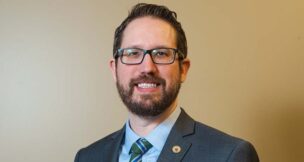
Attorney Andrew Irlbeck, left, stands with client Hamdi Osman in his St. Paul law office. Osman spent five years in federal detention on sex trafficking charges before she was acquitted. Now she is one of six plaintiffs pursuing federal civil suits against a St. Paul police officer, who they say embroiled them in a faked sex-trafficking conspiracy. (Staff photo: Kevin Featherly)
Civil rights suit against St. Paul cop survives
Kevin Featherly//June 26, 2019//


 Listen to this article
The 8th U.S. Circuit Court of Appeals has thrown out one cause of action in the case of five people who claim they were falsely implicated by a St. Paul cop in a faked sex-trafficking conspiracy.
But that doesn’t end the case against St. Paul Police Sgt. Heather Weyker, who remains on the force as an investigator in the department’s fraud and forgery unit.
The three-judge 8th U.S Circuit panel’s ruling let stand a second cause of action and remanded the cases back to Minneapolis’ U.S. District Court. Written by Court of Appeals Judge David Stras, it instructs the lower court that a potentially “fact-intensive analysis” might be needed regarding Weyker’s role in the case.
While it’s effectively a split decision, two plaintiff’s attorneys said they were happy with the results.
“Ultimately, we look at it as a win,” said Andrew Irlbeck, a St. Paul civil rights attorney whose client, Hamdi Osman, was held in federal detention for five years before prosecutors dismissed charges against her.
“We didn’t lose; we’re still in the fight, so we’re happy,” Irlbeck said.
“I would call it a stamp of approval,” said attorney Joshua Newville, who represents plaintiff Ifrah Yassin in the suit.
“We’ve maintained from the beginning that this case should go forward through discovery and we should have a trial,” he said. “Officer Weyker should be held responsible for her conduct.”
Plaintiffs accuse Weyker of faking evidence and coercing testimony in furtherance of a broad, multi-state sex-trafficking prosecution, which ultimately led to 30 people — nearly all of them Somalis — being criminally charged in Tennessee. Most of the defendants were from Minnesota.
Weyker is defended in the civil suit by attorneys from the U.S. Department of Justice in Washington, D.C. The DOJ declined to make any of them available for comment.
After former Minnesota U.S. Attorney B. Todd Jones rejected the case, Weyker convinced a federal prosecutor in Tennessee to it take on, plaintiff’s lawyers say. In 2012, nine defendants were tried in Nashville; all were either acquitted or had their jury convictions reversed.
Among those acquitted were Ahmad Abnulnasir Ahmad and Mohamed Amalle, two plaintiffs in the Minnesota federal civil case.
With the criminal case blown, charges against all other defendants, including Yasin Farah, Hamdi Osman and Bashir Mohamed, were dismissed. All three likewise are plaintiffs in the civil suit.
In a separate part of Stras’ June 12 opinion, the 8th Circuit panel fully affirmed U.S. District Court Judge Joan Ericksen’s denial of Weyker’s motion to dismiss the lawsuit of a sixth plaintiff — Yassin, who sued for false arrest.
Yassin was never accused in the sex-trafficking conspiracy, but was arrested after Weyker allegedly fed another cop false information that accused Yassin of tampering with a key witness.
The charges stemmed from a 911 call that Yassin placed to Minneapolis police reporting a brawl that Weyker’s witness was involved in, according to Newville. While the officer was enroute to the scene, Newville said, Weyker phoned him and told him he should arrest Yassin for tampering with a federal investigation.
“She flatly lied to this officer and said that there was information and documentation that my client was interfering in a federal investigation,” Newville said. “It caused her to lose her job. I mean this is a big deal for her.”
Ericksen had ruled that all six plaintiffs could proceed to trial to seek unspecified damages. Those rulings were appealed to the 8th Circuit, which consolidated the cases before hearing arguments and issuing June 12’s split decision.
Two causes of action
The plaintiffs claim that Weyker violated their Fourth Amendment rights while acting both as a federal and state law enforcement official.
Because Weyker was deputized as a U.S. marshal in the late stages of an FBI sex trafficking task force investigation, plaintiffs brought a “Bivens claim.” Based on the U.S. Supreme Court’s 1971 Bivens v Six Unknown Agents decision, the case law supplements federal statutes, which do not authorize constitutional claims against federal officers.
But because most of Weyker’s work in the case was conducted as a St. Paul police officer, plaintiffs also pleaded claims under Title 42, Section 1983 of the U.S. Code. Arising out of the Civil Rights Act of 1871, that law permits plaintiffs to sue government officials acting “under color of” state or local laws — including local cops.
Weyker moved to dismiss, saying neither theory applies.
Nothing she did in the course of her investigation was actionable under Bivens, she argued; the 8th Circuit Court of Appeals agreed.
Also, because she was acting as a deputized federal official, the Section 1983 argument fails as well, Weyker argued. On that, the 8th Circuit panel was unconvinced; it remanded those claims back to Ericksen for further proceedings.
Weyker also claims that, even if plaintiffs could legitimately sue her, she was entitled to qualified immunity because they never showed she had violated their “clearly established constitutional rights.” The Court of Appeals leaves it up to Ericksen to decide the qualified-immunity issue.
Stras’ June 12 opinion agrees with Weyker on Bivens, at least as it relates to the first five plaintiffs. Because the U.S. Supreme Court has urged caution on expanding the scope of Bivens actions, Stras wrote, the Court of Appeals felt compelled to reverse.
However, it refused to do the same on the Section 1983 claims and remanded those claims back to Ericksen’s court with instructions to determine whether those claims can survive.
‘Knew it was false’
At the time of the indictments, one Immigration and Customs Enforcement official called the Weyker bust one of the agency’s “most significant” cases in recent memory.
The defendants — described as “members or associates” of three Minnesota-based gangs — were accused of prostituting girls as young as 12 in the Twin Cities, Nashville, and Columbus, Ohio, over a 10-year period.
But the case imploded. The two star witnesses, listed as Jane Does in the criminal complaint, were labeled “unworthy of belief” in the 6th Circuit Court of Appeals opinion that affirmed the criminal trial’s outcome.
That same ruling expressed “acute concern, based on [a] painstaking review of the record, that this story of sex trafficking and prosecution may be fictitious.”
U.S. District Judge William Haynes of the Middle District of Tennessee, who presided over the criminal case, also accused Weyker of exaggerating and possibly fabricating key details of the case.
Osman, now in her late 20s, says she was a victim of Weyker’s machinations. She claims that Weyker at one point attempted to reel in one of Osman’s high school friends as a “Jane Doe” — a purported sex-trafficking victim.
At the time, her friend was living in the Twin Cities and Osman was in Tennessee.
One day about a decade ago, Osman said, she got a surprise call from that friend. The girl told Osman she was running away from home and wanted to move in with Osman. Osman said no, and immediately telephoned the girl’s parents, who came to Tennessee and took their daughter home.
Sometime later, Osman moved back to her home state of Minnesota, and was working as a translator at a Jenny-O plant in Willmar. Near the end of one shift, authorities came and informed her that she had a warrant for her arrest from Tennessee’s Middle District.
“I was just baffled,” Osman said. “I didn’t know I was being investigated. Like I’d never been questioned like everyone else has.”
According to her attorney Irlbeck, Weyker had convinced the runaway girl to say that Osman lured her to Tennessee to perform sex work for money. Because the charge was criminal conspiracy, he said, it didn’t matter that nothing of the kind actually took place. “It was false and the government knew it was false,” Irlbeck said.
Osman spent a little more than three years in custody and two on house arrest, she said. She is still trying to recover her life, she said.
“I just hope she learns a lesson, honestly,” Osman said of Weyker. “She ruined my life. Not my whole life. You know, I’m grateful that I did get justice and at least I’m not in federal prison. I wasn’t convicted for her lies on me.”
Still on the job
Immediately after the 6th Circuit Court of Appeals opinion was handed down in March 2012, Weyker was placed on administrative leave. It didn’t last long. Her public personnel profile shows that she was back on the job five days later. She was never otherwise reprimanded.
Ramsey County Attorney John Choi, through a spokesman, said after the 6th Circuit ruling that his office would look into the case to see if it warranted any action. On Tuesday, Choi’s spokesman Dennis Gerhardstein said that after reviewing the case history and an amicus brief by the Human Trafficking Institute, the office decided no further action was warranted.
However, he added, since 2016 Choi’s office has disclosed the 6th Circuit’s opinion to any defendants in cases handled by Choi’s office where Weyker is identified as a witness.
At the time of the sex-trafficking investigation, Weyker was on the police department’s vice unit. Afterward, she was for a time assigned to non-investigative duties, such as research and development and community engagement.
By October of 2017, however, Weyker was placed on the department’s Special Investigations Unit. Earlier this year, she was made part of a Special Operations Unit, which police department spokesman Mike Ernster said was created in the wake of protests in the city.
Weyker transferred to the police department’s fraud and forgery unit on June 8, records show. There, Ernster said, she works as an investigator.
Related Content






Top News
- Perspectives: Taxing issues: Court addresses property issues
- Ramsey County study examines why prosecutors reject cases
- Judge rules DOGE’s cuts to humanities grants were unconstitutional
- Divided appellate panel revives golf ball home damage lawsuit
- Roberts laments perception of Supreme Court as ‘political actors’
- How Minnesota immigration blitz hobbled federal crime fighting
- Breaking the Ice: Wrongful death verdict ‘fulfilling on different level’







Expert Testimony
- Perspectives: Taxing issues: Court addresses property issues
- Perspectives: Daily’s 125th at ‘U’ recalls varied cases
- Commentary: Will SCOTUS rule on general warrants and 4th Amendment?
- Perspectives: Law Day: Notable Supreme Court quotes


