


 Free Newsletter

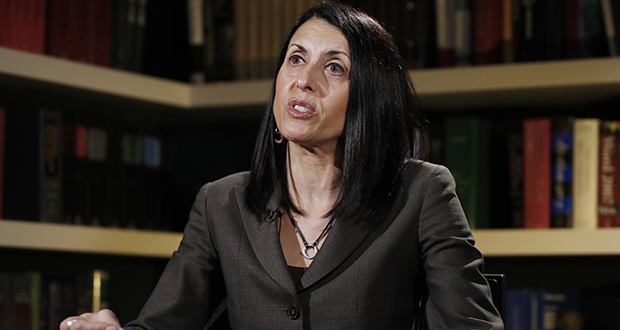
Adele Kimmel, senior attorney with the law firm Public Justice and head of its anti-bullying campaign, says any family would have to overcome a variety of obstacles in filing lawsuits under state law. (AP photo: Carolyn Kaster)
Abused students face lengthy legal fights
The Associated Press//May 25, 2017//


 Listen to this article
When children sexually assault other children at school, sometimes the only measure of justice comes through the courts.
The barriers are formidable, and can lead to long, grueling fights: Public schools in many states enjoy powerful shields, including caps on damages if they lose a lawsuit and high legal hurdles to prove misconduct. And a handful of states offer schools complete immunity from lawsuits in state court.
But the incentives for families are powerful, too: protecting their children, winning reforms and sparing others the nightmare of sexual assault.
In Miami, the mother of a second-grade boy filed suit in 2012 after she said she pleaded in vain for months for administrators to protect her son from sexual abuse by an older boy at his charter school. Eventually, the 7-year-old tried to kill himself by walking into traffic with his eyes closed, according to the family’s lawsuit. Two years later, the boy testified, he still had nightmares his tormenter would crawl in through his bedroom window and kill his mother.
His mother said she came to believe the school was more worried about its reputation than her son.
“You can’t protect the institution and forget about the students,” said the mom, whom The Associated Press is not naming to protect her son’s identity.
Ultimately, the family prevailed, but only after a legal battle that lasted more than three years.
An AP investigation has detailed how K-12 schools in the United States can fail to protect students in their care from sexual assault, sometimes minimizing or even covering up incidents.
Holding those schools accountable takes both fortitude and patience, according to lawyers who bring court cases against school systems.
Families can face judicial politics in non-jury trials and, outside the courtroom, community pressure to drop their cases. Even when schools agree to settlements, they often insist on confidentiality, which shields them from public accountability.
The fight is so tough that Nashville, Tennessee-based attorney Eddie Schmidt said he often tries to talk families out of suing.
“A lawsuit is very expensive, very uncertain and it takes a long time,” Schmidt said.
Only in rare cases do victims of student-on-student sexual assault win large verdicts. Most lawsuits never make it to trial. Many get thrown out on legal grounds, while others are settled pretrial.
Even fewer are criminally prosecuted because the burden of proof is beyond a reasonable doubt, which is difficult to meet in cases involving children, said Jeffrey Herman, the Florida lawyer who represented the Miami boy.
For many aggrieved families, the fight is particularly worth it if it prompts policy changes that can make schools safer for their children and others.
“Why do people go to court? Because no one’s helping, nothing’s moving,” said Richard Vacca, a senior fellow at Virginia’s Commonwealth Educational Policy Institute. “Court decisions have a major impact in how schools are run.”
State and federal hurdles
The Miami case resulted in one of the largest verdicts in student-on-student sexual abuse. Although it was a public charter school, Herman successfully argued that Florida’s $200,000 cap on damages in lawsuits against schools did not apply because the institution was managed by a private company.
A jury awarded the family $5.25 million in 2014. The school appealed and, in 2015, reached a confidential settlement for an undisclosed amount.
Not all states have such caps. In California, for example, there are no liability damage limits on cases brought against a public school.
But other restrictions abound, depending on the state. Virginia and Georgia give school districts absolute immunity from lawsuits in state court. In Illinois, the families of students must show there was willful and wanton misconduct, not just negligence, on the school’s part.
Adele Kimmel, a senior litigator who specializes in student abuse cases for the Washington, D.C., nonprofit Public Justice, said any family would have to overcome a variety of obstacles in filing lawsuits under state law.
“They include whether you can even sue a school district, what the liability standard is, how high a hurdle it is, whether you can sue school officials and if so, for what types of decisions,” she said.
In Tennessee, for example, someone suing a government entity such as a school has no right to a jury trial, Schmidt said. Instead, any case filed in state court would have to be heard by an elected judge, who would decide whether a fellow government employee, such as a school superintendent or principal, was negligent.
“The odds of that happening are extraordinarily slim,” Schmidt said.
So when Schmidt agreed to represent two seventh-grade boys who said they were sexually assaulted in the locker room of their rural Tennessee school after repeated harassment, he filed the lawsuit in federal court and claimed their civil rights were violated under Title IX, the federal law that prohibits sex-based discrimination in federally funded programs.
The U.S. Supreme Court ruled in 1999 that public school districts, regardless of the state, could be held liable for monetary damages under Title IX if students sexually assaulted or harassed by classmates could clear certain legal hurdles.
Victims must show that school officials with the power to act were deliberately indifferent to known sexual harassment, and also prove the harassment was “so severe, pervasive, and objectively offensive” that it effectively barred their access to an education.
While that means victims can sometimes seek justice in federal courts when a state lawsuit is not feasible, it’s not an easy road. Law professor Catherine MacKinnon, who pioneered the use of Title IX in school sexual harassment actions while at Yale University, analyzed federal courts’ treatment of the deliberate indifference doctrine over many years and found that about 6 in 10 such cases never made it past pretrial motions.
Still, Kimmel noted, “there are many students that have very good cases that can satisfy the threshold.”
Schmidt’s Title IX action in Tennessee took years to resolve, and required dozens of depositions and expert witnesses as it wound its way through district and appellate courts. Ultimately, the two families won a $200,000 verdict, upheld by an appeals panel , which turned down the school’s argument that it was not deliberately indifferent but acted reasonably when it learned of the harassment. The director of schools in the Tennessee district declined to comment on the matter or say whether any changes had been made since the 2011 verdict.
The toll of litigation
One advantage to filing in federal court is that it often removes a case from the community where victims may be under pressure to stay silent.
Attorney Terry Heiss spent more than four years representing a boy from rural Michigan who said his abuse began with name-calling and bullying in sixth grade and then escalated. In ninth grade, according to evidence introduced at trial, he was assaulted in the high-school locker room after one student blocked the door and another, a star athlete, climbed on top of him while naked and rubbed his genitals in the boy’s face.
The boy’s parents filed a complaint with police and a lawsuit in U.S. District Court for the Eastern District of Michigan. And although court records show the student eventually pleaded guilty to a misdemeanor, the community blowback was fierce.
“The community turned against the [family] for a season,” Heiss said, adding that the family received phone threats and had to temporarily relocate. “So, not only do children face harassment, the parents have a level of harassment trying to do the right thing.”
Heiss’ client pressed on, testified at trial and — even though he broke down crying on the witness stand — said he felt it was worth it in the end.
“One of the things that kept him going, he didn’t want it to happen to someone else,” Heiss said.
Jurors returned an $800,000 verdict — more than the $500,000 Heiss had requested. Both sides then reached a confidential settlement for an undisclosed sum. A judge later overturned the verdict, citing a lack of evidence that the school acted with deliberate indifference to severe, sex-based harassment, but the settlement stands.
Geography also plays a role in whether families prevail. A jury pool in a rural area may be less likely to return a big verdict than a pool in New York City, for example. In areas where there are racial biases, or biases against same-sex relationships, it can be more difficult to find a jury willing to rule against a school.
“You might find that a jury would be very sympathetic to a sexual assault where a very big boy attacks a very small girl,” Kimmel said. “But what about cases where it’s same-sex abuse, where it’s boy-on-boy?”
More than money, forcing change is often the main motivator in such cases.
Some settlement agreements can require anti-bullying training for school staff, teachers and students, in addition to money — or sometimes instead of it.
Vacca has followed such cases in his work at Virginia Commonwealth University advising Virginia schools and lawmakers about sound educational policies. He said schools need to be “proactive,” with policies and procedures that are updated, enforced and communicated to parents and the wider school community.
Schools must investigate when an assault is reported, he said, and can help avert such situations by training students on peer intervention and mediation.
“It’s an education process,” Vacca said. “We have to be very forward about it, be public about it, communicate with parents.”
The empowerment of telling
In the Florida case involving the second-grader, the mother said she hired a lawyer only after reaching an impasse with Downtown Miami Charter School.
According to the family’s lawsuit, an 11-year-old boy had forced her son to perform oral sex in the backseat of a transport van on the way home after school. The mother said she reported it to the school, which promised to monitor the older boy. Later, he cornered the second-grader twice in a school bathroom and again forced him to perform oral sex, the lawsuit said.
In his video deposition testimony played at the 2014 trial, the boy described his agony after the second bathroom attack, sure the abuse “would happen again and again.” He said the smell of a school bathroom would trigger painful memories, making him feel “shell-shocked,” a feeling he described as “very nervous, very upset, very scared.”
After his suicide attempt, the mother said, “I felt like I needed to go ahead and see what my options were, because the school was not doing enough.”
In its response to the lawsuit, the school said it took prompt, reasonable measures to prevent the boys from interacting and was not notified of any inappropriate interactions on school property. It also argued that administrators could not have foreseen what happened, and therefore the school was not liable, and cited the doctrine of sovereign immunity. During the trial, the school’s lawyer argued a lack of evidence.
The boy’s mother remembers the challenging moments, and the moments of hesitation. She had to turn over medical records and open herself and her son up to invasive questioning. But ultimately, she said, the little boy’s testimony gave him a sense of empowerment, being able to say in his own words what happened and how he felt about it.
“It seemed like he was vindicated simply by saying, ‘This happened. It hurt me. I’m still here.’”
Sex-abuse verdicts, settlements
The Associated Press reviewed verdicts and settlements across the country in lawsuits brought against schools over student-on-student sexual abuse. Here are some notable recent cases:
Honolulu, $5.75 million settlement: This settlement with the state of Hawaii over alleged abuse at the Hawaii School for the Deaf and Blind is the highest known in a student-on-student school sex abuse case, according to Public Justice, a Washington, D.C., nonprofit law firm that tracks such cases. The class-action lawsuit, settled in 2013, contended officials at the only public school in the state for deaf and blind students knew about rapes and sexual abuse among students, failed to do enough to stop them and orchestrated a cover-up. The state denied the allegations. It said when it settled that it was instituting new procedures at the school.

Miami, $5.25 million jury verdict, later settled for an undisclosed sum: The lawsuit brought against Downtown Miami Charter School alleged that an 11-year-old boy forced a 7-year-old boy to perform oral sex on him in the back seat of a transport van and that school officials failed to stop it from happening again. In testimony shown at the 2014 trial, the little boy said he was assaulted twice more in a bathroom after reporting what happened in the van. The second-grader later tried to commit suicide by walking into traffic with his eyes closed. The school said it took prompt, reasonable measures to prevent the children from interacting and argued it was not liable because it could not have foreseen what happened.
Des Plaines, Illinois, $1 million in settlements: Five former students alleged that soccer coaches at Maine West High School allowed rampant inappropriate hazing by team members. Their lawsuit said they were sexually assaulted. Two coaches were fired, and one was charged with misdemeanor hazing and battery but not convicted. While it settled with the students for $200,000 each in November 2016, the school board denied that the district had committed wrongdoing.
Hudson, Michigan, $800,000 jury verdict, later settled for an undisclosed sum: A boy said he was sexually harassed and bullied for years by multiple other students beginning in middle school. During the ninth grade at Hudson High School, according to evidence presented at trial, he was assaulted in a locker room when another student rubbed his penis and scrotum against his neck and face. A jury in 2010 awarded the boy $800,000. Both sides later reached a confidential settlement. A judge overturned the verdict, but the settlement stands.
Bainbridge Island, Washington, $300,000 judge’s verdict: A 15-year-old boy with Asperger’s syndrome was sexually assaulted and harassed dozens of times for months by upperclassmen at Bainbridge High School, according to court documents filed by the boy’s family. The abuse included the older boys doing things such as exposing and rubbing their genitals against him and trying to set his hair on fire, the documents said. It ended only after his parents obtained a restraining order and contacted police. Four boys were convicted of criminal conduct. A judge in 2013 ruled the school was negligent and awarded his family $300,000 in damages. The district issued an apology after trial and said it had changed procedures for investigating such incidents.
Huntsville, Alabama, $200,000 settlement: A federal court in Alabama blocked the case of a 14-year-old girl who said she was used as “rape bait” and assaulted in 2010 in a botched plan to catch a boy suspected of sexual misconduct. Her case did not meet the legal standards to hold the school district liable, the judge wrote, even though he said the plan, devised by a Sparkman Middle School teacher’s aide, was “foolish” and backfired “horribly.” The ruling was successfully contested, and Monroe County Schools in Huntsville ultimately settled the federal lawsuit in 2016.
Republic, Missouri, $185,000: A seventh-grader with special needs reported she was sexually assaulted multiple times by a boy at Republic Middle School, and ultimately raped, according to a federal lawsuit. School officials said she was lying, forced her to personally deliver an apology letter to the boy and expelled her for the rest of the school year, the lawsuit said. The following year, according to the lawsuit, the boy raped her again and school officials again did not believe her. Tests later confirmed the assault. The district denied wrongdoing. The lawsuit settled in 2012 for $185,000, according to The Springfield News-Leader, which sued to get the amount of the settlement.
Shoreline, Washington, $160,000 settlement: A kindergartner said she was sexually assaulted and threatened by boys on the school bus, and her mother complained that the principal at Briarcrest Elementary did not do enough to address it, according to court documents filed in relation to a 2012 settlement with the school district. The principal later expelled the girl, allegedly for inappropriate behavior. The district had argued that its investigation found the girl was not sexually assaulted while in its care. The agreement states that some of the settlement money was to be used for counseling and for tutoring, so the girl could catch up after missing much of her first-grade year.
Wisconsin Rapids, Wisconsin, $100,000 settlement: A ninth-grader who was deaf and legally blind joined Lincoln High School’s highly successful state champion wrestling team, where elite members of the team subjected him to sexual and verbal abuse, according to a lawsuit filed by his family. When the boy and his mother complained, little was done to stop it, the suit said. At one point, he said he crawled into his locker to get away from a tormenter. The district denied the allegations and argued school officials acted in good faith. Its insurer settled in 2014, something the superintendent said was “in the best interests of all parties.”
San Diego, $105,000 settlement: A kindergartner alleged that a classmate at Green Elementary school performed oral sex on him in a school bathroom and demanded that he reciprocate. A year later, a first-grader at the same school alleged she was attacked in a bathroom stall by three female students who took turns fondling her. The first incident prompted an investigation by the U.S. Department of Education’s Office for Civil Rights and, as a result, the district agreed to create guidelines for elementary school principals on how to handle students’ sexual harassment and assault complaints. A lawsuit over the first incident was settled in 2015 for $105,000. A settlement agreement in the second case is pending.
Related Content






Top News
- Supreme Court limits gun ban for marijuana users
- Court of Appeals reinstates malpractice suit in child’s death
- Breaking the Ice: Children’s advocate adds immigration pro bono work
- 8th Circuit revives ADA vaccine accommodation lawsuit
- Judge denies Dugan’s bid to overturn jury verdict in ICE case
- Massachusetts judge’s gift to crime victim sparks request for new trial
- Accused planners of Wisconsin fake elector scheme plead not guilty








Expert Testimony
- Legally Speaking: What spring can teach us about active listening
- Perspectives: Key figure’s recent death recalls Watergate here
- Perspectives: Two new cases here recall Miranda at 60
- Perspectives: Election litigation starting early in Minnesota


