


 Free Newsletter


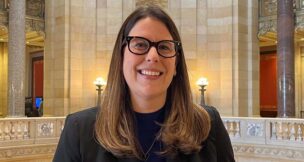
Ellen Jaquette, reference librarian at the Minnesota Historical Society, frequently helps lawyer research bills’ legislative intent. Ancient committee books, like those shown here, are a primary tool. (Staff photo: Kevin Featherly)
Legislative intent remains go-to research resource
Kevin Featherly//April 19, 2017//


 Listen to this article
For decades, courts have insisted that legislative intent barely matters. But that has never stopped lawyers from scouring the historical record to tease out what legislators really meant when they passed a bill.
Ellen Jaquette, reference librarian at the Minnesota Historical Society, sees it playing out all the time.
“For whatever reason, there can be ambiguities or vagueness in some statutory language,” she said. “That is often when attorneys or other researchers will come and try to research legislative intent.”
Jaquette frequently guides attorneys on step-by-step journeys through the sometimes frustratingly scant legislative historical record, particularly on legislation passed before 1991. That is the earliest year for which committee meeting audio records — the juiciest historical resource for legislative intent — remain available.
“Before 1991, people said, ‘Why would we need those tapes after 40 years? We’ll just destroy them,’” Jaquette said.
Pauline Afuso, Washington County’s law librarian, went directly to the audiotapes when trying to determine the purpose of a bill that she fears might impact her library and others across the state.
Her issue is over Senate File 1113 and its identical companion, House File 1390. The bill passed the Senate on March 20 by a unanimous 64-0 vote. It received its second reading on the House floor March 23.
The legislation says that if a law library has reserves big enough to sustain operations for five years, it can transfer half of that money, up to $200,000, to county government. The cash then can be used in “constructing a new building to house the law library and courts,” the bill says.
Those last two words — “and courts” — were a flashing red warning sign for Afuso. “Why is that in there?” she said. “Why would we want to spend money to go and build a court?” She went to legislative committee-meeting audio tapes to find out if that is what the law intended. She thinks she found it in March 2 testimony from the House bill’s author, Rep. Nick Zerwas, R-Elk River.
Zerwas told House Government Operations and Elections Policy Committee members that his was “a local bill having only to do with Sherburne County.” The county, he explained, is remodeling and expanding its government operations center and the bill would allow the library to dedicate funds toward that project.
But its impact could span far beyond Sherburne County, Afuso insists. Whether intended or not, she thinks it might allow any county to divert money raised to support law libraries toward court-related capital projects, she said. That is not what the money is for, she said.
“Why not just say that a law library can donate money if it wants to and then leave it up to the discretion of the board of trustees?” she said. “Why is it saying all these weird things?”
Plain language
Were the bill to pass and then face a court challenge based on legislative intent, it is an open question whether a judge would lend the case a sympathetic ear.
A “plain meaning rule” has been in effect since 1917, based on Caminetti v. U.S. “It is elementary that the meaning of the statute must, in the first instance, be sought in the language in which the act is framed,” the U.S. Supreme Court ruled. If that much is clear, Justice William R. Day wrote for the majority, “the sole function of the courts is to enforce it according to its terms.”
The late Justice Antonin Scalia was a vehement defender of that principle, said Peter Knapp, long-time court-watcher and professor at the Mitchell Hamline School of Law. “Scalia said that you don’t need to look at anything other than the language of the law, unless there is a problem,” Knapp said. “The language of the law is the best indication we have of what the Legislature meant.”
Lawmakers sometimes demonstrate keen awareness of that idea. During a March 29 reinsurance bill conference committee, for instance, Sen. Tony Lourey, DFL-Kerrick, offered a motion to replace one of its section titles. It originally read: “Intent of the Legislature.”
“‘Intent of the legislature’ is a term of art,” Lourey said. “We should encompass what the intent of the legislature is within our language, not as a title.” He succeeded in getting the wording changed.
“I think Senator Lourey was exactly right,” Knapp agrees. “I think he made an accurate prediction of what courts are likely to do.”
Brian Rice, an attorney and longtime Capitol lobbyist, said Lourey’s motion squared with legislators’ predominant view that intent should never be overtly defined in legislation. In part, Rice said, they are following principles codified in Minnesota’s statutory “canons of construction.”
“Basically, that says that you take words at their face value and you don’t read beyond them,” Rice said. “It really does kind of set out that this is how the courts and legislators will look at laws.”
Step by step
Of course, courts do brisk and continual business interpreting statutes. And if the volume of time Jaquette spends helping attorneys do research is any indicator — as it likely is — lawyers are far from abandoning legislative intent as a lever for influencing the judiciary.
“What lawyers are often doing is saying, ‘We think that there is a problem here, we think that there are two competing and reasonable reads of this statute,’” Knapp said. If ambiguity is present in the statutory language, the lawyers’ interpretation just might prevail.
So if you happen to be an attorney researching a statute’s legislative intent, Jaquette offers a few tips:
- Know what you really want. Often researchers have located a bill number and think they are ready to roll, Jaquette said. They often don’t count on one statute being the product of four, five or more bills rolled together. Once you know what you are looking for, she said, it’s time to move onto the next step.
- House and Senate journals. These publications contain key information, including bill file numbers and the committees to which they were referred. With that in hand, you can move to your next stop.
- Committee books. These thin bound tomes may be your best resource for pre-1991 bills legislation, Jaquette said. They record the bills heard in specific committees and sometimes reprint reports presented to members, along with voting records, lists of testifiers, amendments and the like. Be forewarned that you likely will encounter frustrating vagaries like this one from a 1930s-era Municipal Affairs Committee book. “[Rep. W. Kenneth] Nissen of the committee read and explained the report.” What exactly was did he explain? History stands mute.
- Read the news. Old newspapers can help, particularly if you know where and when bills were heard. The Historical Society has digitized records of metropolitan newspapers dating to the 1920s. Many others are available on microfilm.
- Listen in. Most researchers want to jump right to the audiotapes, Jaquette said, and for those willing to undertake the slog of listening, they are a rich resource. But she recommends against looking there first. Particularly if you don’t know what you’re looking for (see step one), you’ll never find the right tape.
- Ask for help. Many attorneys approach Jaquette sheepishly if at all, assuming their law school training will guide them toward the right resources. Jaquette encourages them to seek assistance.
“This is something I do every day,” she said. “It’s not something that attorneys have to do every day.”
Related Content






Top News
- Perspectives: Taxing issues: Court addresses property issues
- Ramsey County study examines why prosecutors reject cases
- Judge rules DOGE’s cuts to humanities grants were unconstitutional
- Divided appellate panel revives golf ball home damage lawsuit
- Roberts laments perception of Supreme Court as ‘political actors’
- How Minnesota immigration blitz hobbled federal crime fighting
- Breaking the Ice: Wrongful death verdict ‘fulfilling on different level’






Expert Testimony
- Perspectives: Taxing issues: Court addresses property issues
- Perspectives: Daily’s 125th at ‘U’ recalls varied cases
- Commentary: Will SCOTUS rule on general warrants and 4th Amendment?
- Perspectives: Law Day: Notable Supreme Court quotes


