


 Free Newsletter

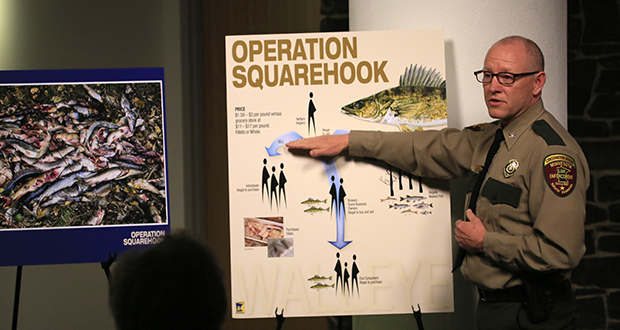
Jim Konrad, the Department of Natural Resources's chief enforcement officer, talks about Operation Squarehook on April 15, 2013, in Minneapolis. (AP file photo: Star Tribune)
Fish Fight
Mike Mosedale//February 26, 2015//


In 1837, the Indian chief from Leech Lake known as Flat Mouth traveled to Fort Snelling, where he and a cohort of fellow Ojibwe met with the territorial governor to negotiate the terms under which they would cede millions of acres of prime timber land to the U.S. government.
Flat Mouth and his fellow Indians got the worst of the White Pine Treaty — about $24,000 in goods and services in exchange for a vast swath of present day Minnesota and Wisconsin.
But Flat Mouth was prescient in one demand. He said his people wanted the right to “get their living from the Lakes and Rivers” because “we cannot live, deprived of our Lakes and Rivers.”
Almost two centuries later, the effects of those words are still reverberating in the federal courts.
On Feb. 10, a three-member panel of the 8th Circuit U.S. Court of Appeals cited Flat Mouth’s plea in ruling that the federal government can’t prosecute four Ojibwe men for netting walleye on Leech Lake Reservation and then selling the fillets in defiance of tribal law.
The decision — which affirmed a similarly reasoned 2013 ruling from U.S. District Court Judge John Tunheim — is probably final nail in the coffin for Operation Squarehook, the much-ballyhooed multi-year state and federal investigation into black market walleye.
Or perhaps it’s just the penultimate nail in the coffin for the sting, which was trumpeted as the largest fishing poaching case in the state since the early 1990s.
Of the 10 defendants originally arrested on federal Lacey Act charges — an anti-wildlife trafficking measures — eight have seen their charges dropped or dismissed.
The two remaining federal defendants — both non-Indians from the Bemidji area — still face aiding and abetting charges. It remains unclear whether the government will pursue those cases or, for that matter, whether it will appeal the 8th Circuit ruling.
Most see it as a long shot, though no definitive decision has been revealed.
“We’re still reviewing the court’s decision,” said Ben Petok, a spokesman for the U.S. Attorney of Minnesota Andy Luger.
Attorney Paul Engh, who argued the defense case before the 8th Circuit, said he suspects no appeal will be forthcoming.
“I think if they wanted to continue this they would have already moved for an en banc hearing, which would stop the time clock,” he observed. The ruling could make it harder to garner Lacey Act convictions against the two remaining federal defendants, Engh said.
“They’re accused of aiding and abetting a crime that did not occur. If the person who fishes didn’t commit a crime, you can’t aid and abet,” Engh said. “I think it’s a pretty skinny case at this point.”
According to Frank Bibeau, an Indian attorney and treaty rights activist who consulted with Engh in preparing the defense strategy, Squarehook is among the most significant treaty rights victories since the Supreme Court’s landmark 1999 decision in Minnesota v. Mille Lacs Band of Chippewa Indians.
“This really strengthens the Mille Lacs decision,” said Bibeau. “I think the 8th Circuit is telling us, ‘Go out and use your rights. Your rights are exclusive and separate from everyone else’s.’”
In its ruling, the 8th Circuit repeatedly referenced the Mille Lacs case decision, including in the deliberation over one critical issue: How did the Indian signatories to the treaties understand the terms?
That is significant because the Leech Lake Reservation — the epicenter of the Squarehook investigation — was not established until 1855, when Flat Mouth and a delegation of Ojibwe leaders travelled to Washington, D.C., and negotiated another treaty.
The Treaty of 1855 — a worse deal than its predecessor — was larded with details, including a careful geographic description of the 10 million acres of northern Minnesota lake country the Objibwe were to cede, a paternalistic requirement from the government that the Ojibwe “settle down in the peaceful pursuits of life,” and precise quotas of assorted goods and services the government promised to deliver on a regular basis. (Among the latter: $100 worth of “gilling twine,” which was used to make nets).
But unlike the 1837 treaty, the Treaty of 1855 made no explicit reference to fishing, hunting or other usufructuary rights.
“As the Supreme Court noted in Minnesota v. Mille Lacs Band, the silence regarding usufructuary rights in the 1855 treaty and the negotiations leading up to it suggest that the Chippewa Indians did not believe they were relinquishing such rights,” Judge Diana Murphy wrote in the 8th Circuit decision. “Even if the 1837 treaty does not apply, the rights it protects are relevant because in this particular case the Chippewa would have understood similar broad rights to apply on the Leech Lake Reservation.”
In a reply brief from Department of Justice attorney Allen Brabender, the government conceded that Leech Lakers retain the right to fish on reservation lakes free from the usual state regulation. But, he argued, tribal members do not have “the right to transport and sell contraband fish taken in violation of tribal law on the black market” — which, he said, was the basis for the Lacey Act charges.
Under the Leech Lake Conservation Code, band members are prohibited from using gill nets to harvest fish except for personal use.
Brabender argued that because the defendants violated tribal law, the Lacey Act charges did not constitute an abrogation of treaty rights. He further contended that tribal fishing rights are held collectively, not individually.
That claim did not win over the judges on the 8th Circuit, which noted in its decision that it is a “well-settled” principle that individual Indians may assert their usufructuary rights in defense against criminal charges.
Retired law professor Peter Erlinder — who collaborated with Bibeau in helping to construct the theoretical foundation for the Squarehook defense — said the 8th Circuit’s ruling hews closely to the reasoning in Mille Lacs, as well as a similar Ojibwe treaty case out of Wisconsin.
“It recognizes that usufructuary rights are property rights. When we think about in terms of property — instead of in terms of treaty rights, which are much more ephemeral — the issues becomes clearer,” Erlinder said. “And those property rights are protected by the Constitution, just like other types of property rights, like minerals or utility easements.”
Erlinder, who recently authored a law journal article examining the history and legal status of Ojibwe usufructuary rights, said the ramifications from the Squarehook ruling may extend beyond the matters of regulating the commercial sale of fish fillets in northern Minnesota.
For instance, the tribes could use their usufructuary rights as the basis of a legal challenge in certain environmental disputes. Two controversial projects still in the planning stage for northern Minnesota —the Sandpiper pipeline and the Polymet copper-nickel mine — could be vulnerable to Ojibwe challenges if the tribe’s attorneys can demonstrate that the projects jeopardize resources.
“These people have a right to a modest living from the land. Anything that interferes with that right has to be accommodated, somehow,” Erlinder said.
‘The feds signed off on it’
Engh, who argued the on behalf of the four Squarehook defendants before the 8th Circuit, said he was “thrilled by the outcome and happy for my Leech Lake friends.”
Engh said that pleasure was muted some because his client — Mark Lyons of Bena — died before the 8th Circuit ruling came down.
“The crux of the decision is that Indians in their own territory have a right to hunt and fish protected by the 1837,” he said. “But what the case was really about is the government’s lack of institutional memory.”
In 1971, Engh noted, the federal government sided with Leech Lake band in a treaty rights fight with the state of Minnesota. Under that the settlement, the state acknowledged the band’s fishing rights and the band agreed to adopt a conservation code prohibiting commercial netting in exchange for $2.5 million in annual payments
“The feds signed off on it. The big triumph came when another lawyer and I were looking at all the documents in these old files filled with dust,” Engh says. “The U.S.’s position then was exactly the same as the Indians’ position, and the exact opposite of the U.S. position today. That really hurt their case.”
While the federal prosecution in the Squarehook case appears on the brink of collapse, eight Ojibwe defendants who are charged with Squarehook-related offenses in Leech Lake Tribal Court have yet to resolve their cases.
Bibeau, who represents three of those defendants, said prosecutors are dragging their feet because a successful defense could threaten the band’s 1971 fishing rights settlement with the state of Minnesota.
While Leech Lake receives $2.5 million annually as part of that agreement, he said, members of other Ojibwe bands — including White Earth, the state’s most populous — are covered under the same treaties but don’t reap any benefits from the deal.
“You don’t need to be enrolled at Leech Lake to get a cut of the pie but those rights have been intercepted,” Bibeau said. “I think the tribal government is afraid of the next step. If they can’t prosecute [the accused netters under tribe’s conservation code], what does that mean for the cash flow from the settlement.”
Related Content






Legal Tech
- How ransomware tactics against law firms are changing
- How large language models are leveling the personal injury playing field
- Attorney Share, Lawmatics integrate to automate law firm referrals
Top News
- Court-appointed U.S. attorney for Seattle sues over firing by Trump
- Senate Democrats demand investigation into ouster of IRS lawyer
- White House lawyer confirmed to judgeship after bashing senators
- Administration pauses $1B in Medicaid payments to Minnesota, California
- HHS sued over attempts to restrict child care funding








Expert Testimony
- Legally Speaking: How communication failures turn disputes into lawsuits
- Perspectives: Umpire’s death recalls case law in Minnesota
- Perspectives: It’s not ‘football’ here, but soccer cases abound
- AI prompts used by experts may be discoverable


